Croatia Travel Guide 2026: Cities, Tips & Top Things to Do
Croatia uses the Euro (EUR) since January 2023, making budgeting easier — a mid-range traveller spends €60–120 per day, covering accommodation, meals, and entry fees like the Dubrovnik City Walls at €35.
The best time to visit Croatia is May–June or September–October: sea temperatures are warm (22–25°C), crowds are lighter than July–August, and ferry connections from Split to Hvar and other islands run full schedules.
Croatia's Adriatic coastline stretches for nearly 1,800 km, studded with over a thousand islands, medieval walled cities, and clear turquoise water. Dubrovnik — the 'Pearl of the Adriatic' — wows with its perfectly preserved limestone city walls. Split blends ancient Roman heritage (Diocletian's Palace is a living city within a city) with a buzzing waterfront scene. Further north, Istria's hilltop villages and the charming port of Rovinj offer a quieter, more authentic Croatian experience. Zadar rounds out the coast with its famous Sea Organ and some of Croatia's most accessible beaches.
This guide covers the best of Croatia — including Dubrovnik, Split, Hvar, Rovinj, Zadar — with expert tips on old towns, beaches, day trips, safety, and travel planning for 2026.
Dubrovnik: The Pearl of the Adriatic
Walk the 2 km circuit of Dubrovnik's medieval city walls for sweeping views over terracotta rooftops and the shimmering Adriatic. The Dubrovnik City Walls are the single most visited attraction in Croatia — tickets cost €35 per adult in 2026 (€15 for children 7–18, free under 7). The walk takes 60–90 minutes at a leisurely pace and rewards visitors with dramatic vistas from every angle of the fortification.
The old town's marble-paved Stradun, fortress towers, baroque churches, and the Rector's Palace are part of a UNESCO World Heritage Site. Inside the walls, expect to pay €15–20 for a sit-down meal, €5–8 for a coffee, and €80–200 per night for a private room in summer. The Dubrovnik City Pass (€35–55 depending on duration) bundles walls access, cable car, museum entry, and bus travel — excellent value if you plan to tick multiple attractions in a single day.
Day trips are a natural extension of any Dubrovnik stay. The nearby best day trips from Dubrovnik include Kotor (Montenegro, €35–50 by group tour), the Elafiti Islands by boat (€25–45), and Mostar in Bosnia (€30–40 group tour). Arrive at the city walls before 8 AM or after 5:30 PM to avoid the thickest tour-group traffic. Safety is not a concern — Dubrovnik is one of Europe's safest cities, with very low petty crime — see our full Dubrovnik safety guide for specifics. Nightlife centres on the bars and clubs inside the old town walls and in the Lapad neighbourhood — our Dubrovnik nightlife guide covers the best venues by vibe and budget.
Getting around inside Dubrovnik is best on foot — the old town is compact and pedestrianised. From the cruise port or Pile Gate, everything is walkable. Parking near Dubrovnik old town is limited and expensive (€5–8/hour), so use the Park & Ride from Dubrovnik Airport or Ilijina Glavica if driving. Full details in our Dubrovnik parking guide.
Split & Diocletian's Palace
Split is Croatia's second-largest city and the gateway to the Dalmatian islands. At its heart sits Diocletian's Palace — built by the Roman Emperor around AD 300 as a retirement complex — which today houses a living neighbourhood of restaurants, bars, apartments, and galleries inside 1,700-year-old walls. Entry to the Diocletian's Palace complex is free; individual attractions inside (the Cathedral of Saint Domnius, the cellars, the Vestibule) charge small fees of €4–8 each.
The Split Old Town sprawls beyond the palace walls into the medieval Varoš neighbourhood, the bustling Pazar market, and the Riva waterfront promenade — the ideal spot for an evening stroll and a €3–5 coffee while watching ferries depart for the islands. A sit-down lunch in Split costs €10–18; dinner at a mid-range konoba (tavern) is €20–35 with wine. Accommodation in Split runs €50–120/night for hotels and €40–90 for apartments — significantly cheaper than Dubrovnik, making Split an excellent base for island-hopping.
The Split 3-day itinerary dedicates one day to the palace and beaches, one to a ferry trip to Hvar, and one to a day trip further afield. Popular day trips from Split include Krka National Park (€30–40 including entry, €20–30 by bus), Hvar Town (ferry €10–15 each way), Trogir (bus €3 each way), and Brač island (ferry €5 each way). Split's nightlife is centred on the old town bars and the clubs along the Bačvice beach strip — the Split nightlife guide maps the best options from sunset cocktails to late-night venues. Parking in Split can be challenging in summer; see our dedicated Split parking guide for the best garages and zones.
For a half-day orientation, the free Split walking tour covers all the palace highlights in 90 minutes. The Split beach guide covers options from the city beaches (Bačvice, Žnjan) to quieter coves reachable by water taxi — essential reading for summer visitors.
Hvar Island: Beaches, Lavender & Island Life
Hvar is Croatia's sunniest island — recording over 2,700 hours of sunshine per year — and one of the most fashionable destinations on the Adriatic. Hvar Town, centred on the main square (Pjaca) and the 16th-century loggia, offers a relaxed daytime atmosphere and a glamorous evening scene. The Spanish Fortress (€2) above Hvar Town delivers panoramic views across the harbour and the Pakleni Islands offshore. The Hvar Old Town is best explored on foot — the main attractions (the Cathedral of St Stephen, the Benedictine Convent, the Arsenal) are all within a 10-minute walk of the ferry pier.
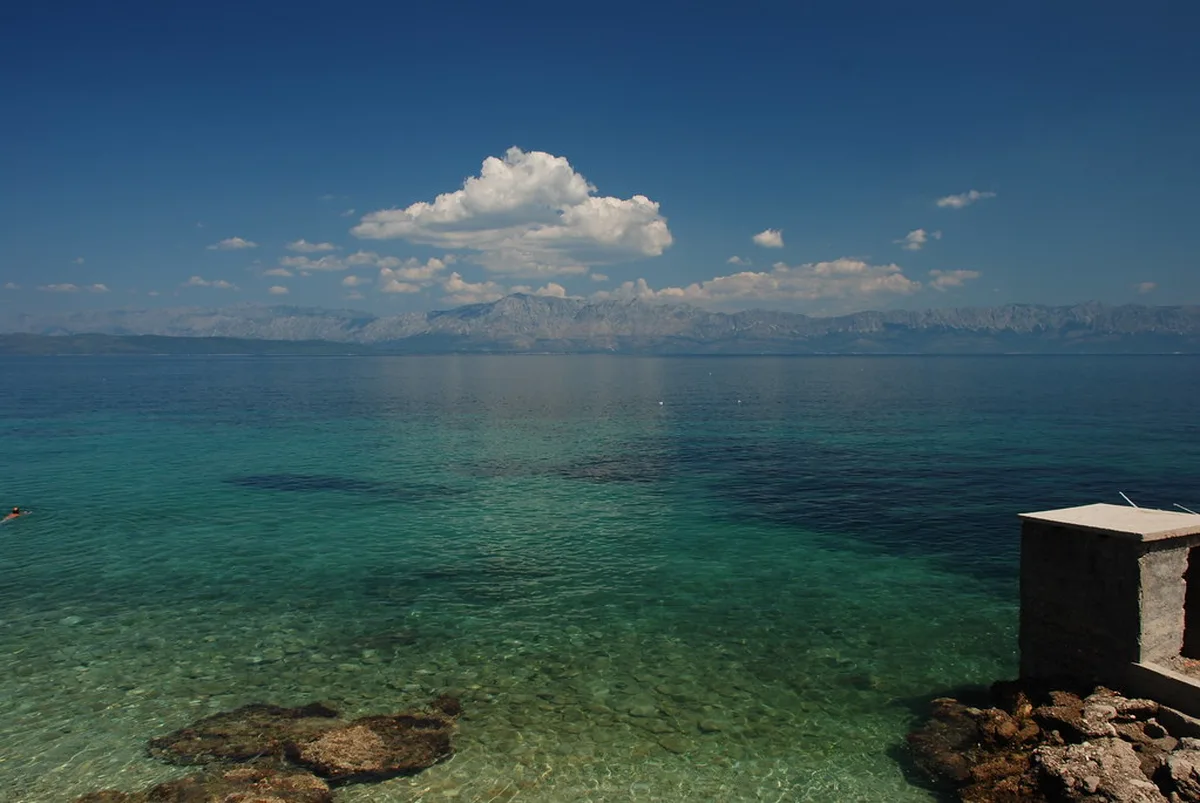
Beaches are Hvar's biggest draw. The Hvar beach guide covers the best spots: Dubovica (pebbly cove, 5 km east of Hvar Town by taxi or boat), Mekičevica (naturist, 4 km from town), and the Pakleni Islands — accessible by water taxi (€5–7 each way) from Hvar Town harbour. The Pakleni chain includes Jerolim (naturist), Stipanska, and Palmižana, all with crystal-clear water ideal for snorkelling. Budget for water taxis: a full Pakleni day can cost €15–25 per person including lunch at a beach restaurant.
Ferry connections from Split: the fast catamaran reaches Hvar Town in 55–70 minutes (€15–18); the car ferry goes to Stari Grad (2.5 hours, €10–13 foot passenger). Day trips to Hvar from Split (day trips from Hvar in reverse) also connect to Vis Island (€25–30 organised tour) and Korčula. Restaurants in Hvar Town range from budget pizza (€10–14) to upscale seafood (€50–80 per head). Nightlife is famously vibrant — rooftop bars, yacht parties, and clubs keep the main square lively until 2–3 AM in July and August.
Hvar is more expensive than Split or Zadar: expect to add 20–30% to accommodation and dining costs in peak season. A budget traveller sharing a hostel dorm (€25–35) and eating at konobas can manage on €70–90/day; a mid-range couple will spend €200–280/day all-in.
Rovinj & Istria: Venetian Charm on Croatia's Northern Coast
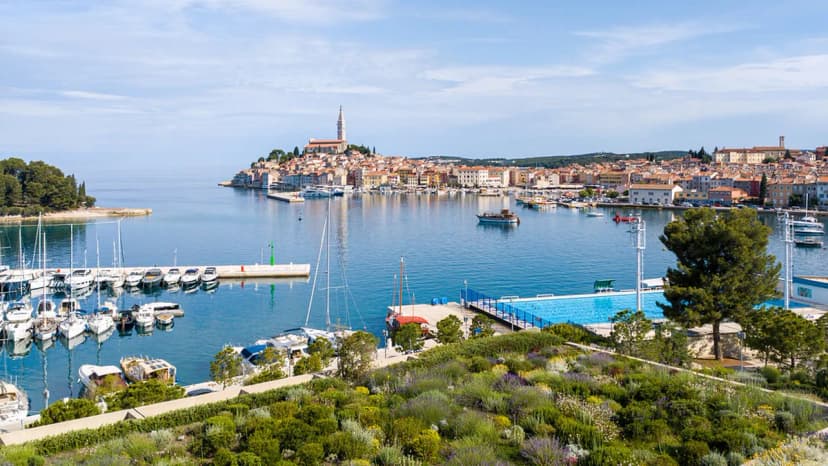
Istria is Croatia's northernmost peninsula, bordering Slovenia, and feels distinctly different from Dalmatia — Venetian architecture, Italian as a co-official language, and a landscape of vineyards, truffle forests, and hilltop medieval towns. The port of Rovinj is Istria's star attraction: a rainbow of painted houses climbing a peninsula crowned by the Baroque Church of Saint Euphemia (free entry, tower €4). The Rovinj Old Town is one of the most photogenic places in Croatia — narrow cobbled lanes, fishing boats in the harbour, and small galleries and wine bars filling former fishermen's houses.
Beaches near Rovinj are primarily rocky and clear-watered. The Rovinj beach guide highlights Monsena (rocky, naturist section, 2 km north), Mulini Beach (closest to old town, pebbly, very popular), and the Golden Cape Forest Park (Zlatni Rt) where pine-shaded paths lead to a series of quiet coves. Entry to Golden Cape is free; sun lounger hire runs €10–15/day. Water sports, kayak rental, and snorkelling trips are available from the harbour (€20–40 depending on activity).
Day trips from Rovinj (day trips from Rovinj) extend into Istria's interior: Pula's Roman amphitheatre (€12 entry, 45 min by bus), Poreč's UNESCO Euphrasian Basilica (free, 35 min north), and the hilltop town of Motovun (truffle capital, 1 hour inland). The Istrian wine and truffle scene is worth a half-day: local restaurants charge €20–40 for a truffle pasta and a glass of Malvazija white wine. Rovinj is less crowded than Dubrovnik or Hvar but still busy in July–August; May, June, and September offer the best balance of pleasant weather and manageable visitor numbers.
Accommodation in Rovinj ranges from €70–150/night for a hotel room in or near the old town. Camping options in the Monsena and Veštar bays cost €20–35/night per pitch, making Istria one of the most affordable camping destinations on the Adriatic. Getting to Rovinj: bus from Zagreb (4 hours, €20–30), from Pula (45 min, €5), or by car on the Istrian Y highway.
Zadar: Sea Organ, Roman Forum & Dalmatia's Hidden Gem
Zadar is one of Croatia's most underrated cities — a working port with a peninsula old town packed with Roman ruins, medieval churches, and two of Croatia's most unusual modern attractions: the Sea Organ (a musical instrument built into the seafront steps, free) and the Sun Salutation (a solar-powered light installation on the same promenade, free). The Zadar Old Town sits on a compact peninsula connected to the mainland by land gate, and is entirely walkable. Key sights include the 9th-century Church of St Donatus (entry €5), the Roman Forum (free to walk through), and the Cathedral of St Anastasia (€3).
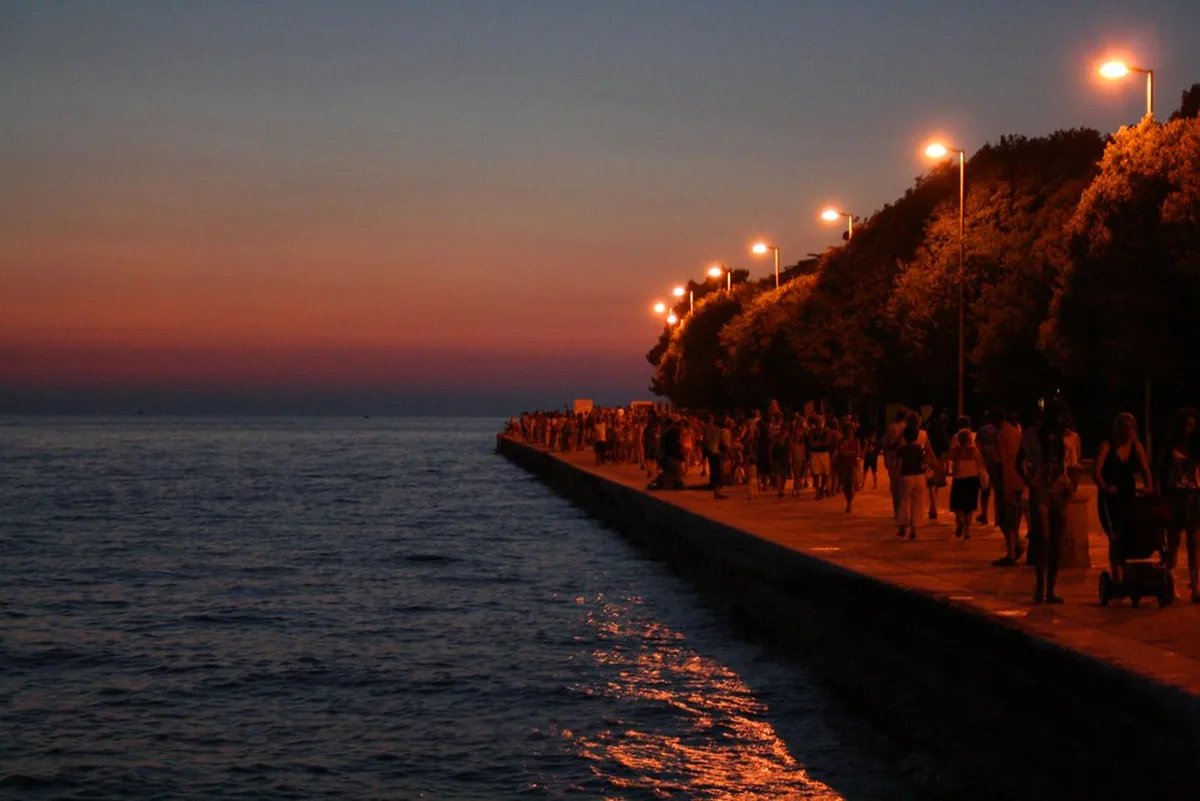
Zadar's beaches are some of the easiest to access along the Dalmatian coast. The Zadar beach guide covers Kolovare (10 min walk from old town, sandy and pebbly mix), Borik (4 km north, family-friendly resort beach), and the Zadar archipelago islands reachable by short ferry rides (Ugljan: 20 min, €3.50; Pašman: 35 min, €4.50). Beaches on these islands are quieter and often backed by pine forest. Day trips from Zadar (day trips from Zadar) include Plitvice Lakes National Park (2 hours by bus, €30–40 including entry), the Kornati Islands archipelago (boat trip €60–90 all-day tour), and the National Park Krka (1.5 hours, €35–45 with entry).
Zadar is notably cheaper than Dubrovnik and Hvar: a mid-range dinner costs €15–25, a hotel room €50–100/night, and a coffee €2–3. For budget travellers and those seeking a less commercialised Dalmatian city, Zadar is an excellent base. Direct ferry connections link Zadar to Ancona in Italy (9 hours overnight, Jadrolinija), making it a natural gateway for travellers arriving from Italy.
Croatia Travel Budget 2026: Costs for Islands vs Coast
Croatia adopted the Euro in January 2023, removing the need to exchange into Kuna. Prices have risen slightly since the switch, but Croatia remains more affordable than Western Mediterranean destinations. Here is what to expect in 2026 by destination type:
Dubrovnik (most expensive): Budget travellers (hostel dorm, self-catering, minimal entry fees) need €80–100/day. Mid-range (private room, restaurant meals, City Walls + one tour) averages €130–180/day per person. Families and couples sharing double rooms can split costs: a comfortable mid-range stay runs €200–280/day for two.
Split (mid-range city base): Budget: €60–75/day. Mid-range: €90–130/day. Split is the most cost-effective major city on the Dalmatian coast — accommodation averages 30–40% cheaper than Dubrovnik, and meals are similarly lower. An excellent base for island-day trips without paying island accommodation prices.
Hvar (island premium): Hvar Town is the priciest island destination — budget travellers need €80–100/day (hostel + simple meals). Mid-range: €120–180/day. The Pakleni Islands day trips, water taxis, and beach bars add up quickly. Staying in Jelsa or Stari Grad (quieter Hvar villages) cuts accommodation costs by 30–50%.
Rovinj & Istria (excellent value): Mid-range budget: €80–120/day. Istria's camping scene is Croatia's best — many sites along the coast charge €20–35/pitch/night with direct beach access. Restaurant prices are 10–20% lower than Dalmatia on average, and wine is notably cheaper (a bottle of Malvazija: €8–14 in a restaurant).
Zadar (cheapest Dalmatian city): Budget: €50–70/day. Mid-range: €80–110/day. Zadar is the most affordable entry point to Dalmatia, with good transport connections to national parks and islands at reasonable prices.
Island ferries and transport costs: Jadrolinija (state ferry) operates most routes: Split–Hvar €10–15, Split–Brač €5–8, Zadar–Ugljan €3.50, Split–Vis €15–20. Fast catamarans (Krilo, TP Line) are 2–3x the ferry price but save 60–90 minutes each way. Inter-city buses (Flixbus, Arriva) connect Zagreb, Split, Zadar, and Dubrovnik; the Split–Dubrovnik express takes 4.5 hours (€12–20). Renting a car is the best option for exploring Istria (€30–55/day including insurance) but impractical on the islands where ferries are the only option.
Key entry fees at a glance (2026): Dubrovnik City Walls €35 | Dubrovnik Cable Car €20 return | Diocletian's Palace Cellars €8 | Hvar Spanish Fortress €2 | Plitvice Lakes €20–35 (season-dependent) | Krka National Park €15–30 (season-dependent) | Kornati boat trip €60–90. Book City Walls tickets online in advance in July–August to avoid sellouts.
Getting Around Croatia: Ferries, Buses and Split Transfers
Croatia's geography — a long, thin coastline with hundreds of islands — means transport is a mix of coastal roads, buses, and ferries. Understanding the network is essential for a smooth trip, especially if you plan to combine mainland cities with island stops.
Ferries and catamarans: Jadrolinija operates the main car-ferry and passenger-ferry network. The company runs year-round routes from Split to Hvar (Stari Grad, 2 hours; or Hvar Town by catamaran, 55–70 min), Split to Brač (50 min), Split to Vis (2.5 hours), and Zadar to the Zadar archipelago. In summer, private operators Krilo and TP Line add fast catamaran routes (Split–Hvar Town 1 hour, Split–Korčula, Dubrovnik–Hvar). Book ferries online via Jadrolinija.hr for peak-season travel — car spaces sell out weeks in advance in July and August. Foot passengers rarely need to book ahead except on the fastest Krilo catamarans.
Coastal buses: Flixbus, Arriva, and local operators run frequent services along the A1 motorway (Zagreb–Split: 5 hours, €14–25) and the coastal D8 (Split–Dubrovnik: 4.5 hours, €12–20, with a short Bosnia-Herzegovina border crossing through Neum). Buses connect Split–Zadar (2.5 hours, €8–14), Zadar–Rijeka (3.5 hours, €12–18), and Rijeka–Rovinj (2.5 hours, €8–12). Book online via Flixbus, GetByBus, or Voznired.hr.
Flights: Croatia has airports in Dubrovnik, Split, Zadar, Pula (Istria), Rijeka, and Zagreb. Ryanair, easyJet, and Wizz Air serve most from major European hubs. Flying into Dubrovnik and out of Split (or vice versa) is an excellent one-way trip strategy — Dubrovnik–Split by bus (4.5 hours) makes a scenic final leg before flying home from Split airport.
Driving: Renting a car is ideal for Istria (Rovinj, Pula, hilltop villages) and for reaching Plitvice Lakes and other national parks from Zagreb. The Istrian Y motorway (Istra Expressway) is fast and tolled (€4–8 depending on distance). On the Dalmatian coast, the D8 coastal road is scenic but slow (heavy traffic in summer). Parking in cities: see our guides for Dubrovnik and Split. On islands, cars are expensive to ferry across and largely unnecessary — leave the car on the mainland.
Transfers and taxis: Dubrovnik Airport (22 km from old town) is served by Atlas shuttle bus (€10 one way) and taxis (€30–40). Split Airport (24 km from city) has Pleso bus shuttle (€8 one way) and taxis (€25–35). Uber operates in Zagreb and Split. On islands, golf buggies and scooters (€35–60/day) are popular alternatives to taxis.
Frequently Asked Questions about Travelling to Croatia
When is the best time to visit Croatia?
May–June and September–October are the ideal months: sea temperatures reach 22–25°C, crowds are lighter than July–August, and prices for accommodation drop 20–40% compared to peak season. July and August are the busiest and hottest months — Dubrovnik and Hvar become very crowded and hotels book out weeks in advance. Spring and autumn offer the best combination of good weather, manageable visitor numbers, and lower costs.
What currency does Croatia use?
Croatia adopted the Euro (EUR) on 1 January 2023, replacing the Kuna (HRK). All prices are now in Euros across shops, restaurants, hotels, and transport. ATMs and card payments are widely accepted, including contactless. There is no need to exchange currency if you are arriving from another Eurozone country.
How much does it cost to visit Croatia in 2026?
A mid-range budget for Croatia is €60–120 per person per day, covering a private room, restaurant meals, and entry fees. Dubrovnik is the most expensive city (€100–180/day mid-range); Zadar is the cheapest (€50–80/day). Key entry fees: Dubrovnik City Walls €35, Diocletian's Palace Cellars €8, Plitvice Lakes €20–35. Island-hopping adds ferry costs of €5–20 per leg. Shoulder season (May, September) reduces accommodation costs by 25–40%.
How do I travel between Croatian cities and islands?
Coastal buses connect Dubrovnik, Split, Zadar, and Rijeka (book via Flixbus or GetByBus). Ferries and catamarans link Split to Hvar (55 min catamaran, €15), Brač (50 min, €8), and Vis (2.5 hours, €15). Jadrolinija operates the main network; private operators Krilo and TP Line run faster summer catamarans. Renting a car is best for Istria and national parks but impractical on islands.
Is Dubrovnik worth visiting despite the crowds?
Yes — Dubrovnik's old town and city walls are genuinely extraordinary and worth the effort. Visit in May, June, or September to avoid the peak crush. Arrive at the city walls before 8 AM or after 5:30 PM to beat tour groups. Book City Walls tickets (€35) online in advance in summer — they sell out. Stay overnight rather than day-tripping to experience the city in the evening when cruise passengers leave and the old town quiets considerably.
Which Croatian city should I visit first: Dubrovnik or Split?
Split makes a better first base if you plan to island-hop or cover multiple cities — it is more affordable, centrally located on the Dalmatian coast, and has excellent ferry connections to Hvar, Brač, and Vis. Dubrovnik is the more iconic destination but more expensive and geographically isolated. A classic one-way route: fly into Dubrovnik, travel by bus or ferry up the coast (Hvar → Split → Zadar), and fly home from Split or Zadar. See our full comparison: Dubrovnik vs Split.
Do I need a visa to visit Croatia?
Croatia is a member of the European Union and the Schengen Area (joined Schengen January 2023). EU/EEA citizens need only a national ID card. Most non-EU visitors — including UK, US, Canadian, Australian, and New Zealand citizens — can enter visa-free for up to 90 days in any 180-day period. Check current requirements with your national government if you hold a passport from outside the standard visa-waiver list.
Croatia offers an extraordinary breadth of experiences — from medieval old towns and ancient ruins to dramatic coastlines and vibrant food scenes. Whether you're planning your first visit or returning to explore deeper, our city-by-city guides below give you everything you need to plan a confident, rewarding trip in 2026. Start with the Dubrovnik Old Town guide or the Split Old Town guide to build your itinerary, then explore the islands and regions that match your pace and budget.