Exploring Catania on Foot: A Complete 2026 Walking Tour Guide
A Catania walking tour follows a 3 km loop from Piazza del Duomo through La Pescheria, Via Crociferi, and Via Etnea — free entry at most stops, Roman Theatre €6, Benedictine Monastery cloister €5, total walking time 2.5–3 hours.
In 2026 free tip-based tours depart Piazza del Duomo daily at 10:00 AM and 3:00 PM (tip €10–15); private guided tours cost €15–25 per person for a 2–3 hour circuit of Old Town Baroque highlights.
Catania sits at the base of Mount Etna and offers a stunning mix of volcanic stone and Baroque style. Exploring this Sicilian city on foot allows you to feel its raw energy and ancient history directly. A well-planned Catania walking tour reveals hidden courtyards, vibrant markets, and impressive Roman ruins all within a compact historic center you can cover in a single morning.
Starting Your Catania Walking Tour at Piazza del Duomo
Every great walk in this city begins at the iconic Piazza del Duomo, the heart of the historic center and the natural meeting point for both free and guided tours. The square is large enough to be impressive yet compact enough to take in from a single vantage point, making orientation straightforward even on your first visit to Sicily.
The Fountain of the Elephant stands in the middle of the square and serves as the official symbol of the city, carved from black Etna basalt and topped with an Egyptian obelisk. The elephant itself dates to ancient Roman times, while the obelisk was added in 1736 by architect Giovanni Battista Vaccarini. The fountain sits at the crossing of the two main Baroque axes of the city and is the most photographed monument in Catania. Entry to the square is free at all hours.
Admire the Cathedral of Saint Agatha directly behind the fountain — its Sicilian Baroque facade was completed in 1711 and entry is free for visitors, though modest attire is required. Inside, the composer Vincenzo Bellini is buried in a tomb to the left of the main altar, making this a point of pilgrimage for opera lovers visiting in 2026. The cathedral's sacristy holds a treasury of gold reliquaries associated with Saint Agatha, open Tuesday through Saturday for a small fee of €3.
On the western side of the square, the Municipio (Town Hall) and the Porta Uzeda arch frame a photo-perfect view. Porta Uzeda is a 17th-century city gate built in volcanic basalt that once marked the edge of the walled city; today it leads directly down to La Pescheria market below. Walk through it and descend the broad staircase to reach the market level — the contrast between the formal Baroque square above and the raw market energy below is immediate and dramatic.
On the eastern side of the square stands the Palazzo degli Elefanti, home to the city's municipal offices and one of the finest Baroque civic buildings in Sicily. Its ornate balconies and wrought-iron railings are worth examining closely before you move on. Most visitors spend 30–45 minutes in and around Piazza del Duomo before moving northeast toward La Pescheria, which is just 80 metres away down Via Garibaldi.
- The Elephant Fountain (u Liotru)
- Material: Black Etna basalt, Egyptian obelisk
- Significance: City symbol since 1736
- Location: Center of Piazza del Duomo
- Cost: Free access
- Cathedral of Saint Agatha
- Style: Sicilian Baroque (facade 1711)
- Entry: Free for visitors; treasury €3
- Dress: Modest attire required
- Highlight: Bellini's tomb inside
- Porta Uzeda
- Type: 17th-century city gate
- Location: South edge of the square
- Cost: Free to walk through
The Sensory Rush of La Pescheria Fish Market
Just 80 metres northeast of Piazza del Duomo, down the steps behind Porta Uzeda, you will encounter the loud and colorful fish market known as La Pescheria. This is one of the most atmospheric food markets in all of southern Italy, and it belongs on any serious walking itinerary through Catania's old town.
Local vendors shout their daily prices while displaying fresh swordfish, sea urchins, and prawns caught from the nearby Ionian Sea — a tradition that has continued on this site since the Arab period of Catania's history, roughly between the 9th and 11th centuries AD. The calls are theatrical and competitive, and the displays of whole fish laid out on beds of crushed ice form an extraordinary visual spectacle. Arrive between 7:30 AM and 9:00 AM for peak atmosphere and the widest selection of the morning catch.
The market operates Monday through Saturday, from approximately 7:00 AM until 1:00 PM. Stalls begin to thin out after 11:30 AM, so arriving early gives you the most atmospheric experience. The wet lava-stone floors can be slippery, so watch your step carefully as you navigate the narrow stalls. Budget around 20 minutes to walk the full market; longer if you want to photograph the displays or pick up snacks to fuel the rest of your walk.
Adjacent to the fish stalls on Piazza Pardo you will also find a general produce market selling Sicilian citrus, olives, and street food including arancine (fried rice balls) for around €2 each in 2026. The stigghiola (grilled lamb intestines skewered on rosemary) is a Catanian street food you will either love or politely decline; the smell alone is unforgettable either way. A freshly squeezed blood orange juice from one of the stalls typically costs €1.50 and is the ideal market refreshment before continuing the route.
The covered area beneath the market on Via Garibaldi extends into a small alley that leads to Piazza Alonzo di Benedetto, a quieter square that locals use as a shortcut and that most tourists miss entirely. If you have time, duck through to see the authentic neighbourhood life away from the main tourist circuit before looping back to the market to continue north toward Via Crociferi.
Walking the Baroque Splendor of Via Crociferi
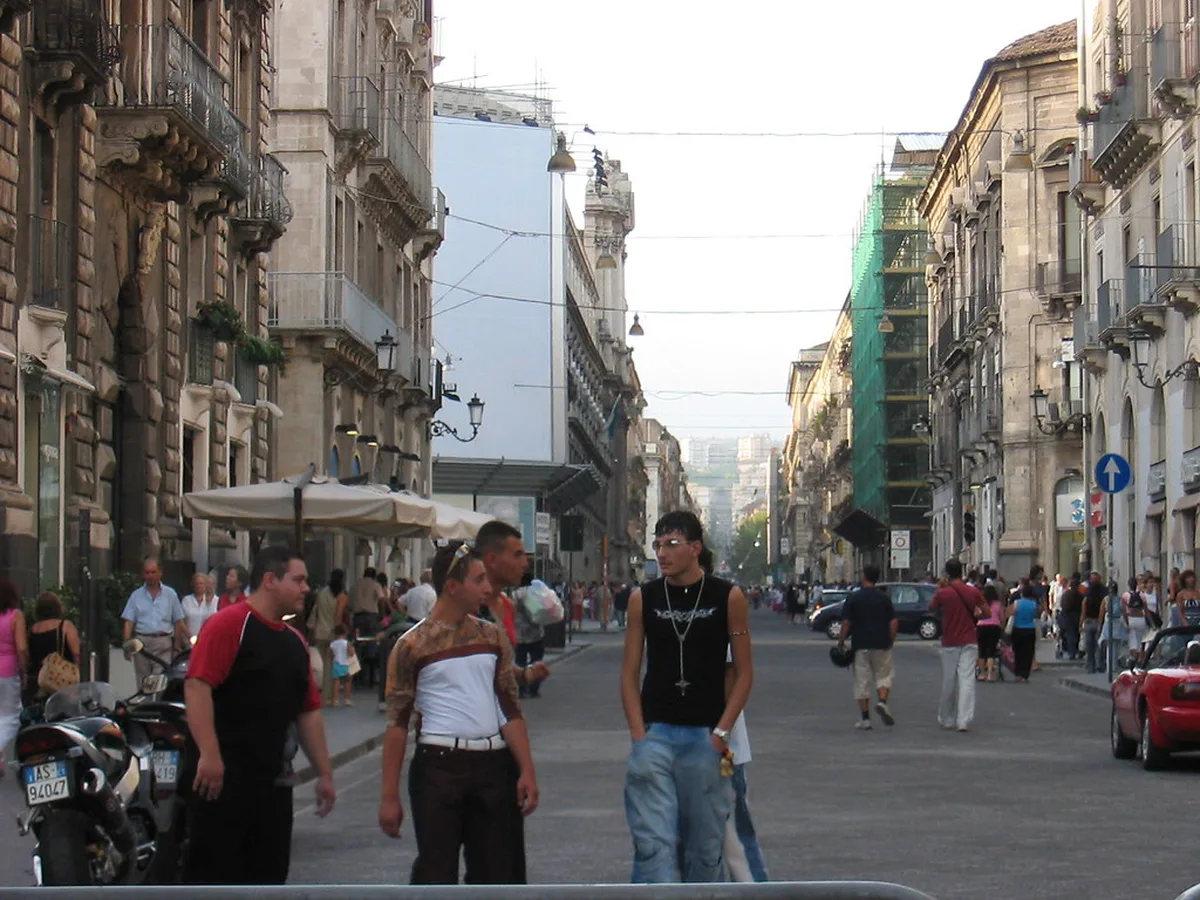
Via Crociferi is widely considered one of the most beautiful Baroque streets in all of Italy, running about 300 metres between Via Vittorio Emanuele II and Via dei Crociferi. The street was laid out following the devastating earthquake of 1693 that destroyed most of eastern Sicily, and it was rebuilt as a deliberate statement of Baroque ambition and civic pride. Walking it today, you feel that original intention clearly.
You will find four stunning churches and a historic monastery packed into this single quiet stretch — the Church of San Benedetto, the Church of San Francesco Borgia, the Church of the Collegiata, and the Arco di San Benedetto spanning the road overhead. The Arco di San Benedetto (Benedictine Arch) is the gateway to the street and the most photographed element: a bridge connecting two wings of the Benedictine Monastery of San Nicolò l'Arena, built after 1693 to illustrate how Catania rose from the rubble with greater grandeur than before.
The Church of San Francesco Borgia, directly beyond the arch on the left side, has a richly decorated interior with gilded stucco and an 18th-century organ still used for concerts today. Entry is free; however, the sacristy is accessible only during morning hours (9:00 AM–12:00 PM) when a volunteer attendant is present. A small donation of €1–2 is customary inside churches along the route.
The Benedictine Monastery of San Nicolò l'Arena, accessed from Piazza Dante just off the top of Via Crociferi, charges a cloister entry fee of around €5 in 2026. The cloister is one of the largest in Europe and is decorated with lava-stone columns, ornate terracotta details, and a double loggia that frames the open sky in a remarkably photogenic way. The monastery now houses the Faculty of Arts of the University of Catania, so expect a mix of students and tourists during the day. Allow 30–40 minutes if you pay for the cloister tour.
From Via Crociferi, head north along Via Teatro Greco to reach the Roman Theatre — a 2,000-seat ancient amphitheatre still partly embedded in the surrounding residential buildings. The theatre dates to the 2nd century AD and was built over an earlier Greek theatre from the 5th century BC. Entry costs €6 in 2026 and includes the small adjacent Odeon theatre next door, a more intimate 1,500-seat venue used for musical performances. Allow 25 minutes for both sites before continuing north to Via Etnea.
The street feels like a movie set and typically has fewer crowds than Via Etnea. Visit between 9:00 and 11:00 AM for the best light on the golden stone facades. Photography tip: stand at the arco looking south toward the Cathedral campanile for a layered shot that captures three centuries of Baroque architecture in a single frame.
Ursino Castle and the Medieval Layer of Catania
A short detour of around 600 metres southwest of Piazza del Duomo brings you to Castello Ursino, the 13th-century fortress built by Holy Roman Emperor Frederick II between 1239 and 1250. The castle represents a completely different historical layer from the Baroque streets that define most of the walking tour, and it rewards visitors who take the extra time to include it in their itinerary.
The castle was originally built on a promontory overlooking the sea, but the catastrophic 1669 eruption of Mount Etna extended the coastline outward by several kilometres, leaving the fortress stranded inland surrounded by the lava flow that hardened into the basalt plain you walk across today. This geological story is visible in the black rock immediately around the castle's base, making it one of the most striking examples of how Etna has physically reshaped the city over centuries.
Entry to the castle costs €6 in 2026 and includes access to the Museo Civico housed inside. The museum collection holds Greek and Roman artifacts excavated from Catania, medieval ceramics, and a significant collection of Baroque paintings — all housed within the castle's original vaulted chambers. The circular towers at each corner of the square plan can be climbed for views over the surrounding basalt plain toward the city center. Allow 45–60 minutes for a proper visit, or 20 minutes if you limit yourself to the courtyard and exterior.
The square in front of the castle, Piazza Federico di Svevia, is relatively quiet compared to the tourist corridors of the old town, and it is a good place to sit and eat your market snacks before completing the remainder of the route. A small bar on the north side of the square sells espresso, granita, and light lunches at local prices (espresso €1.20, granita €2.50), unlike the tourist-priced cafes closer to Piazza del Duomo.
From Ursino Castle, the most direct route back to the main walking circuit is north along Via Castello Ursino, which brings you back to Via Etnea in approximately 10 minutes on foot. Alternatively, walking northeast from the castle along Via Auteri brings you to the southern end of La Pescheria market, which is useful if you arrive after the market has closed and want to see the empty square where it operates.
For visitors who want to understand the full historical arc of Catania's old town — from its Greek and Roman origins through the Norman medieval period and the Baroque reconstruction — adding Ursino Castle to the walking route provides the missing medieval chapter that Via Crociferi and Via Etnea alone cannot tell.
Self-Guided vs Guided Tour Options in Catania
One of the most common questions visitors ask is whether to explore Catania independently or book a guided experience. Both approaches work well — the right choice depends on your budget, pace, and appetite for historical context. Having clear expectations about what each option offers helps you decide before you arrive.
Self-guided walking tour (free): The compact old town is easy to navigate on foot without a guide. Download an offline map via Google Maps or Maps.me before you arrive. The route in this article takes you through all major highlights in roughly 2.5–3 hours at a relaxed pace. There are no tickets required for most outdoor sites. The Roman Theatre (€6) and Benedictine Monastery cloister (€5) are optional paid additions if your budget allows.
Free walking tours (tip-based, 2026): Operators such as Free Tour Catania and GuruWalk Catania run English-language tours departing from Piazza del Duomo at 10:00 AM and 3:00 PM daily. Tours last approximately 2 hours and 20 minutes and cover all major Baroque highlights including the Cathedral, La Pescheria, Via Crociferi, and the Roman Theatre exterior. The guides work for tips — the customary amount is €10–15 per person for a quality tour. No booking fee is charged, but reservations via the operators' websites are recommended in high season (June–September) when groups fill quickly.
Private and small-group guided tours (€15–25 per person): Several local agencies offer private guided tours lasting 2–3 hours. These include access to sites that are harder to interpret alone, such as the Roman Theatre interior and the Ursino Castle museum. In 2026, group tours start at around €15 per person for groups of eight or more; private tours for two people typically cost €40–60 total. Some operators include Ursino Castle entry and the Benedictine Monastery cloister in the tour price — confirm when booking.
Audio guide apps: If you want context without booking a tour, apps such as Rick Steves Audio Europe and GPsmycity offer Catania city walks for under €5. These are useful for independent travelers who prefer to set their own pace without committing to a group schedule. The GPsmycity Catania route is updated for 2026 and covers 14 stops across the old town.
If you are extending your time in Sicily beyond the city itself, see our guide to day trips from Catania for Etna crater hikes, Taormina visits, and coastal excursions, all of which pair naturally with a morning walking tour of the city center.
Practical Logistics for Your Catania Stroll
Navigating the city on foot is generally easy, but staying aware of your surroundings and preparing properly will make the experience much more comfortable, especially during the hotter months between June and September when temperatures regularly exceed 33°C in the midday hours.
Keep your belongings secure in crowded areas like La Pescheria or busy bus stops near Piazza della Repubblica, where pickpockets can operate in high season. A crossbody bag with a zipper is the most practical option. Avoid keeping your phone visible in your back pocket near the market stalls. Many visitors wonder is Catania safe for tourists during their first visit to Sicily — the short answer is yes, with standard urban precautions. The old town is well-lit and busy throughout the day, and incidents are rare compared to larger Italian cities.
The lava-stone basole pavements that cover the historic centre are beautiful but uneven. Sturdy closed-toe shoes with a grip sole are essential — avoid sandals with thin soles or heels. Many of the side streets off Via Crociferi involve short but steep inclines. If you are visiting with children or with limited mobility, the main route along Via Etnea is largely flat and manageable.
Public drinking water is available from the fountain in Piazza del Duomo at no cost; refill a bottle there before heading toward Via Crociferi. Most churches along the route are free to enter but request modest dress (covered shoulders and knees). Carry a lightweight scarf or sarong for this purpose, as it doubles as sun protection on exposed squares like Piazza Pardo near the market.
Getting to the start of the walk is straightforward: from Catania Centrale station it is a 15-minute walk south along Via Vittorio Emanuele II to reach Piazza del Duomo. Buses 1, 2, and 4 stop at Piazza del Duomo. For parking options if you are arriving by car, see our dedicated guide to parking in Catania, which covers the nearest garages to the old town and their 2026 daily rates.
- Essential Walking Gear
- Shoes: Sturdy grip-sole sneakers or walking shoes
- Water: Refillable bottle (public fountains at Piazza del Duomo, free)
- Sun: Hat and SPF 30+ (essential May–September)
- Map: Offline digital version via Maps.me or Google Maps
- Cash: €20–30 for market snacks, tips, museum entries, and espresso stops
Roman Ruins and Modern Life on Via Etnea
Via Etnea serves as the main artery of the city and stretches about 3 km directly north toward the looming silhouette of Mount Etna, offering one of the most dramatic urban vistas in all of Sicily. It is the ideal final leg of your walking tour, blending archaeological remains, elegant shopping, and public green space in a single straight corridor.
The street is lined with elegant shops, historic palaces, and three major public squares — Piazza del Duomo at the south end, Piazza Stesicoro roughly in the middle, and Villa Bellini park toward the northern end. High-end Sicilian brands and artisan ceramics shops cluster in the first 500 metres north of the Duomo, while international chain stores dominate the stretch closer to Piazza Stesicoro.
At Piazza Stesicoro, roughly 1 km north of Piazza del Duomo, pause to look down into the excavated Roman Amphitheatre, partially visible below street level at the center of the square. This is one of the largest Roman amphitheatres ever built in Sicily, with an estimated original capacity of around 15,000 spectators. The visible remains are only a fragment of the full structure, most of which remains buried beneath the surrounding urban fabric. Viewing from street level is free; a perimeter fence protects the excavated sections but the scale is clearly visible without paying an entry fee.
On clear days, Mount Etna creates a dramatic snow-capped backdrop at the end of the street — the best photography angle is from the steps of the Cathedral looking north up Via Etnea in the early morning before the haze builds up. The alignment of the street with the volcano's summit was intentional, designed as part of the post-earthquake urban plan of 1693 to give the city a dramatic visual axis. This view is one of the most iconic in all of Sicily and should not be missed on your walk.
Villa Bellini, the elegant public garden at the northern end of Via Etnea approximately 2 km from Piazza del Duomo, is the ideal place to rest your feet before turning back or continuing to other neighborhoods. Entry is free; the garden opens at 7:00 AM daily and closes at sunset. The garden features busts of Catania's most celebrated citizens including the composer Vincenzo Bellini (born in Catania in 1801) and offers shaded benches, ornamental fountains, and a small café near the main entrance. A coffee here costs around €1.50 at the bar. The garden also connects to Piazza Roma, from which you can pick up return buses to Catania Centrale station if you do not want to walk back.
For more context on how Via Etnea connects to the broader Catania nightlife scene that begins after 9:00 PM along this same street and in the parallel lanes to the east, see our dedicated nightlife guide which covers which bars and piazzas come alive in the evening hours.
Frequently Asked Questions
How long does a Catania walking tour take?
A standard self-guided walk covering Piazza del Duomo, La Pescheria, Via Crociferi, and Via Etnea takes 2.5 to 3 hours at a relaxed pace. Guided group tours (free tip-based or paid) typically run 2 hours 20 minutes. Add an extra 45–60 minutes if you plan to visit the Roman Theatre (€6 entry) or the Benedictine Monastery cloister (€5). Including Ursino Castle (€6 entry, 600 metres southwest of Piazza del Duomo) adds another 45–60 minutes. A full half-day of 4–5 hours is comfortable for first-time visitors who want to cover all stops with time for coffee and photography.
Are there free walking tours in Catania?
Yes. In 2026, Free Tour Catania and GuruWalk both operate tip-based English-language walking tours departing from Piazza del Duomo at 10:00 AM and 3:00 PM daily. There is no upfront booking fee — tours are free to join and guides work for tips. Tours last approximately 2 hours and 20 minutes and cover the Elephant Fountain, Cathedral of Saint Agatha, La Pescheria fish market, Via Crociferi, and the Roman Theatre exterior. The customary tip is €10–15 per person for a quality experience. It is worth booking a spot in advance via each operator's website during summer (June–September), as groups can fill quickly at peak times.
What is the best time of day for a Catania walking tour?
Early morning between 9:00 and 11:00 AM is the best time to start your walk. La Pescheria fish market is at its liveliest before 11:30 AM, and the Baroque facades on Via Crociferi are beautifully lit in morning sunlight. Starting early also helps you avoid the intense Sicilian midday heat from June through September, when temperatures regularly reach 33–38°C. Late afternoon from 5:00 PM onward is also pleasant as the city cools and locals begin the traditional evening passeggiata along Via Etnea. Avoid midday starts in summer — the open squares around Piazza del Duomo and Piazza Stesicoro offer almost no shade.
How much does a Catania walking tour cost in 2026?
The self-guided route described in this article is free for most stops. Paid attractions along the route include the Roman Theatre and adjacent Odeon (€6 combined entry), the Benedictine Monastery of San Nicolò l'Arena cloister (€5), and Ursino Castle with the Museo Civico (€6). The Cathedral of Saint Agatha is free to enter; its treasury costs €3. Free tip-based guided tours are available (tip €10–15 per person). Private guided tours cost €15–25 per person for a group of eight or more, or €40–60 total for a private tour for two. Budget €15–30 total per person for a comfortable half-day with museum entries, a market snack, and a coffee stop.
Is Catania a walkable city for most tourists?
Yes, the historic center of Catania is compact and pedestrian-friendly. Most major attractions are within a 15-minute walk of each other, and the main route from Piazza del Duomo to Villa Bellini along Via Etnea is largely flat and shaded in parts. However, the black lava-stone basole pavements are uneven in many places, so comfortable grip-sole shoes are essential. Visitors with limited mobility should note that some side streets off Via Crociferi have short steep inclines, and the steps down to La Pescheria from Porta Uzeda have no ramp alternative. The main Via Etnea corridor is accessible and smooth for the full 2 km stretch from the Duomo to Villa Bellini.
What should I wear and bring on a Catania walking tour?
Wear sturdy closed-toe shoes with grip soles — the lava-stone streets are beautiful but uneven throughout the old town. From May to September, bring a sun hat, sunscreen (SPF 30+), and a refillable water bottle; public fountains at Piazza del Duomo provide free drinking water. Carry €20–30 in cash for market snacks, museum entry fees (Roman Theatre €6, Benedictine Monastery cloister €5, Ursino Castle €6), and tips on free tours. If you plan to enter the Cathedral of Saint Agatha or any church along Via Crociferi, shoulders and knees must be covered — a lightweight scarf or sarong works well and doubles as sun protection in exposed squares.
What is the best beach to visit after the Catania walking tour?
The closest beaches to Catania's old town are at La Playa, approximately 3 km south of Piazza del Duomo, reachable by bus 4 in around 15 minutes. For cleaner water and more organised facilities, the beaches at Lido di Playa and the Ognina district (2 km north) are popular day options. For a wider guide to options across the region, including free public beaches and paid lido sections with sun loungers (typically €10–15 per pair of sunbeds), see our full Catania beach guide, which covers all main stretches by distance from the city center and public transport access.
A Catania walking tour in 2026 offers the best way to experience the authentic soul of Sicily without spending a fortune. From the bustling La Pescheria fish market to the quiet Baroque churches of Via Crociferi, every corner of this compact old town tells a unique story shaped by earthquakes, Arab traders, and Baroque architects.
Whether you join one of the free tip-based tours departing from Piazza del Duomo or follow this self-guided route at your own pace, plan at least a half-day to do the city justice. The medieval detour to Ursino Castle adds a compelling pre-Baroque layer that puts the city's architectural transformation in vivid perspective.
Enjoy the local flavors — an arancina at the market (€2), an espresso on Via Etnea (€1.50) — and the warm volcanic energy of this remarkable Sicilian city. For more ideas on how to spend time here, see our guide on staying safe in Catania and the broader Sicily travel guide for planning your wider island itinerary.