North Macedonia Travel Guide 2026: Cities, Tips & Top Things to Do
North Macedonia is the Balkans' most affordable and overlooked destination — currency is the Macedonian denar (MKD; €1 = 61.5 MKD), the capital is Skopje, and UNESCO-listed Lake Ohrid is the unmissable highlight. Best visited May–September, a typical backpacker spends 1,500–2,500 MKD (€25–€40) per day.
Skopje is walkable and compact: the Ottoman Old Bazaar, Alexander the Great statue, and Stone Bridge are all within 20 minutes on foot. Budget 2–3 days for Skopje plus a day trip to Lake Ohrid (2 hours by bus, 350 MKD / €6 each way). English is widely spoken by younger residents, and the country is safe for solo and family travellers alike.
North Macedonia is the Balkans' most overlooked destination — a landlocked country with a complex and fascinating history, a capital city that rewrote its own skyline with ancient-style monuments, and an authentically affordable travel experience that feels completely off the tourist trail. Skopje's chaotic mix of Ottoman old bazaar, Neo-Classical statues, and Byzantine churches is unlike any other European capital. The country also claims some of the Balkans' most beautiful lakes, including UNESCO-listed Lake Ohrid, sometimes called the 'Jerusalem of the Balkans'.
This guide covers the best of North Macedonia — including Skopje — with expert tips on old towns, day trips, safety, and travel planning for 2026.
Skopje Old Bazaar (Čaršija)
The Ottoman old bazaar is the largest in the Balkans after Istanbul's Grand Bazaar. Hundreds of traders sell copper work, leather goods, spices, and traditional textiles in a maze of hans (caravanserais) that dates from the 15th century. Walking through Čaršija feels like stepping into a different era entirely — the narrow cobblestone lanes, the smell of grilled meat from street vendors, and the minarets rising above terracotta rooftops make it one of the most atmospheric urban spaces in all of Europe.
Entry to the bazaar itself is free, and you can spend hours simply wandering without spending a single denar. That said, the food here is unmissable. A burek pastry from a bakery in the bazaar costs around 60–80 MKD (€1–€1.30); a sit-down shopska salad at one of the traditional kafanas costs 150–200 MKD (€2.50–€3.25); and a full tavče gravče (baked bean stew, North Macedonia's national dish) with bread runs 250–350 MKD (€4–€5.70). Coffee — thick, Turkish-style — is 50–80 MKD (€0.80–€1.30) and comes with a glass of water as standard.
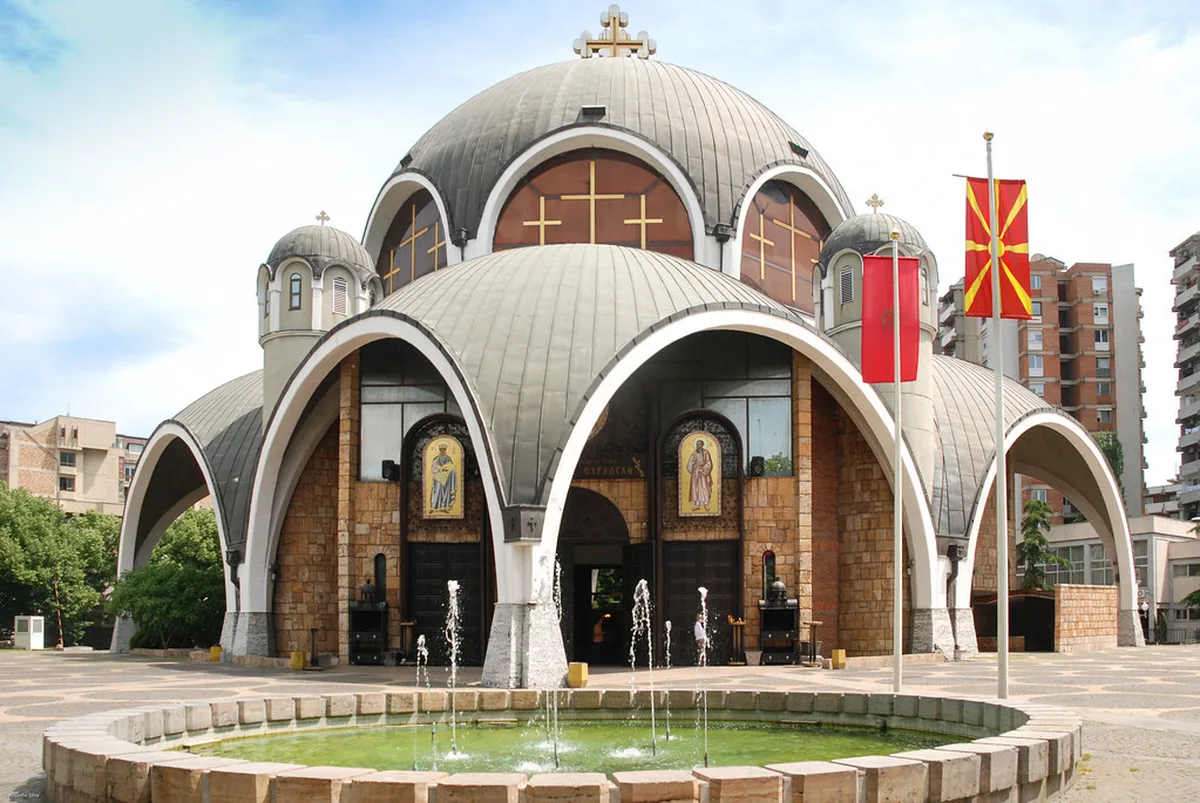
The bazaar is also home to several important historical structures. The Daut Pasha Hammam is a 15th-century Ottoman bath complex that now serves as an art gallery — entry is 100 MKD (€1.60). The Chifte Amam (Double Bath) nearby dates from the same era. The Sveti Spas Church, partially underground to comply with Ottoman-era height restrictions, contains an ornate carved iconostasis that took master craftsmen decades to complete — admission is 100 MKD (€1.60). The Painted Mosque (Šarena Džamija) in neighbouring Tetovo, reachable by bus for around 200 MKD (€3.25), features extraordinary interior floral frescoes.
For a deeper dive into the bazaar's history and architecture, our Skopje Old Town guide covers every landmark with opening hours, prices, and walking routes. The bazaar is open daily from early morning until around 8 PM in summer, with some stalls operating later on weekends. Fridays see the most activity, particularly around midday prayer time. Pickpocketing is rare but possible in the busiest sections — standard urban vigilance applies.
Skopje's Controversial Skyline
The government's 'Skopje 2014' project erected dozens of Neoclassical statues, fountains, and monuments across the city centre — creating a surreal urban landscape that divides opinion but is undeniably photogenic. At the heart of it all stands the enormous "Warrior on a Horse" statue (understood by many as Alexander the Great) rising 22 metres from the Macedonia Square fountain. The statue itself cost an estimated 9.5 million euros and is surrounded by bronze lions, interactive fountains, and a cascade of steps descending to the Vardar River. At night, the entire complex is illuminated in dramatic colours that attract crowds of locals and visitors alike.
The Skopje 2014 project was deeply controversial. Critics — including many Macedonian architects and urbanists — argued it distorted history, wasted public funds, and created a kitsch Disneyland aesthetic incompatible with the city's genuine Ottoman and Byzantine heritage. Supporters contended it gave Skopje an iconic identity and boosted tourism revenues. Whatever your view, it is impossible to ignore. Macedonia Square and the surrounding pedestrian boulevard are where Skopje's social life happens — especially in spring and summer evenings when families and young people fill every bench and café terrace.
From the square, the Stone Bridge — dating from the 15th century — crosses the Vardar River directly into the Old Bazaar district. The bridge is free to walk and offers excellent photo angles of both the modern monuments and the minarets beyond. The Archaeological Museum of Macedonia, housed in a grand Neoclassical building beside the bridge, charges 120 MKD (€1.95) for entry and holds significant artefacts from the ancient Macedonian civilisations. The Memorial House of Mother Teresa — she was born in Skopje in 1910 — is nearby and free to enter.
Café culture around Macedonia Square is affordable by any European standard. An espresso costs 60–90 MKD (€1–€1.50); a glass of local Tikveš wine is 150–200 MKD (€2.50–€3.25); and a craft beer from the growing Macedonian brewery scene runs 150–220 MKD (€2.50–€3.60). For details on where to drink and socialise after dark, see our Skopje nightlife guide.
Lake Ohrid: UNESCO Gem
Lake Ohrid is one of Europe's oldest and deepest lakes — a UNESCO World Heritage site with medieval monasteries perched above the water, a charming old town, and crystal-clear swimming. The two-hour drive from Skopje is worth every minute. The lake is around 30 kilometres long and 15 kilometres wide, sitting at 693 metres above sea level on the border with Albania. Its water is so clear that visibility extends to 22 metres in places — exceptional for a lake of this age and ecological complexity. Scientists believe the lake is over 3 million years old and home to endemic species found nowhere else on Earth.
Getting to Ohrid is straightforward. Direct buses depart from Skopje's central bus station roughly every two hours throughout the day; the journey takes 2 to 2.5 hours and costs 350–400 MKD (€5.70–€6.50) one way. A taxi or private transfer costs 3,000–4,500 MKD (€49–€73) each way but is worth it if you have a group. The town of Ohrid itself is small enough to explore on foot — accommodation ranges from guesthouses at 1,500–2,500 MKD (€25–€40) per night to hotel rooms at 3,000–5,000 MKD (€49–€81) per night in peak summer (July–August).
The highlights include the Church of St. John at Kaneo, perched dramatically on a cliff above the lake (entry free; photography from the viewpoint is the real draw), and the ancient theatre of Ohrid — a Hellenistic amphitheatre used for summer concerts and still remarkably intact. Entry to the Old Town fortress of Tsar Samuel is 60 MKD (€1). The National Museum charges 100 MKD (€1.60). Swimming is free from the public beaches; a sun-lounger and umbrella rental on organised lido beaches costs 200–300 MKD (€3.25–€4.90).
The lake is also famous for Ohrid trout (Salmo letnica) — an endemic species now legally protected and no longer served in restaurants. Instead, order the freshwater eel or carp; a grilled fish main course at a lakefront restaurant runs 500–800 MKD (€8–€13), which is exceptional value for the setting. The best time to visit is May to mid-June (before peak crowds) or September (warm water, empty beaches, harvest-season food). July and August are busy with domestic Albanian and Macedonian tourists, and prices rise by 20–30%.
Authentic Balkan Hospitality and Food
North Macedonia is one of Europe's most genuine destinations — low prices, minimal tourist infrastructure, and extraordinary food. The shopska salad (tomato, cucumber, onion, roasted peppers, and grated white cheese) is served at almost every meal and costs 150–200 MKD (€2.50–€3.25). Tavče gravče — a slow-cooked bean stew baked in a clay pot — is the unofficial national dish and costs 250–350 MKD (€4–€5.70) in a local restaurant. Grilled meats (kebapčinja, ćevapi, pljeskavica) are ubiquitous and cheap: a portion with bread and salad costs 300–450 MKD (€4.90–€7.30).
Rakija (fruit brandy) is the national spirit and social lubricant. A home-made rakija served in a kafana (traditional tavern) costs 80–150 MKD (€1.30–€2.50) per small glass. Macedonian wine — particularly from the Tikveš wine region in the south — is excellent and criminally underrated by the rest of the world. A bottle of decent Tikveš Vranec red costs 500–700 MKD (€8–€11) in a shop; the same wine might cost 900–1,200 MKD (€14.60–€19.50) in a restaurant.
Macedonian hospitality is warm and genuine. Locals in villages and small towns will frequently offer tea, coffee, or food to visitors — refusing once is acceptable, but refusing repeatedly is considered impolite. English is widely spoken among people under 40 in cities, less so in rural areas. Greek, Serbian, and Bulgarian are also useful since they're closely related to Macedonian.
For visitors concerned about personal safety, North Macedonia is among the safer Balkan countries. For a full safety breakdown of Skopje including specific neighbourhoods to be aware of, see our guide on whether Skopje is safe for tourists. Petty theft is rare, the political situation is stable following NATO accession in 2020, and healthcare in Skopje is adequate for standard emergencies. Travel insurance is always recommended.
North Macedonia Travel Budget 2026
North Macedonia is one of the most affordable countries in Europe, making it a dream destination for budget travellers and an extraordinary-value proposition for anyone used to Western European prices. Whether you're on a backpacker shoestring or a mid-range comfort budget, here is what you can realistically expect to spend per day in 2026.
Backpacker budget: 1,500–2,500 MKD (€25–€40) per day. This covers a dorm bed in a Skopje hostel (700–1,000 MKD / €11–€16 per night), breakfast from a bakery (80–120 MKD / €1.30–€2), a sit-down lunch at a kafana (250–400 MKD / €4–€6.50), street food or a cheap dinner (200–350 MKD / €3.25–€5.70), and one or two attraction entries. Local buses cost 35 MKD (€0.57) per trip in Skopje — affordable for unlimited city exploration.
Mid-range budget: 3,000–5,000 MKD (€49–€81) per day. This covers a private room in a guesthouse or three-star hotel (1,500–2,500 MKD / €25–€40 per night), sit-down meals at good restaurants (three meals for 700–1,200 MKD / €11–€19.50), entrance fees, and one day trip (e.g., to Ohrid for 700–900 MKD / €11–€14.60 return). Taxis within Skopje city centre cost 150–250 MKD (€2.50–€4) for most short trips.
Comfort budget: 6,000–10,000 MKD (€97–€163) per day. Four-star hotels in Skopje charge 3,000–6,000 MKD (€49–€97) per night. Dinner at one of Skopje's better restaurants (e.g., Kaj Serdarot or Restaurant Kapan An in the Old Bazaar) costs 800–1,500 MKD (€13–€24) per person including wine. Private car transfers to Ohrid cost 3,000–4,000 MKD (€49–€65) each way.
ATMs are widely available in Skopje and Ohrid. Most withdraw MKD; euro withdrawal is possible at some machines near the airport but at poor rates. Always pay in MKD — merchants who accept euros typically use an unfavourable exchange rate of €1 = 58–60 MKD instead of the official 61.5. Dynamic Currency Conversion at ATMs should be declined. Visa and Mastercard are accepted at hotels, larger restaurants, and supermarkets; smaller kafanas and market traders are cash-only.
Tipping is not obligatory but is appreciated. Rounding up to the nearest 50 or 100 MKD is standard in restaurants. Taxi drivers do not expect tips. Tour guides appreciate 200–400 MKD (€3.25–€6.50) at the end of a half-day tour. Note that North Macedonia is not in the EU and is not part of the Schengen Area, which means border crossings from Greece, Bulgaria, Kosovo, Albania, or Serbia involve passport checks — allow extra time at land borders during summer peak months.
Frequently Asked Questions about Travelling to North Macedonia
Is Skopje worth visiting?
Yes — Skopje is one of the most unusual and affordable European capitals. The Old Bazaar, the cultural blend of Ottoman and Neoclassical architecture, and excellent day trips to Ohrid make it well worthwhile. Budget 2–3 days in Skopje. Entry to most attractions costs 60–120 MKD (€1–€2), and a full sit-down meal with drinks runs 400–700 MKD (€6.50–€11). See our Skopje Old Town guide for a detailed itinerary.
Is North Macedonia safe for tourists?
North Macedonia is safe for tourists in 2026. Skopje has a low crime rate by European standards, political stability has improved significantly since NATO accession in 2020, and violent crime against tourists is exceptionally rare. Petty theft in crowded bazaar areas is the most common risk. For a full neighbourhood-by-neighbourhood safety breakdown, read our guide on is Skopje safe for tourists.
What currency does North Macedonia use?
North Macedonia uses the Macedonian denar (MKD). The exchange rate in 2026 is approximately €1 = 61.5 MKD. Euros are not officially accepted but some tourist businesses near Ohrid lake and in Skopje's hotel district will take them at an unfavourable rate. Always pay in MKD for the best value. ATMs in Skopje and Ohrid are reliable and dispense MKD directly.
How do I get to North Macedonia?
Skopje International Airport (SKP) connects to European hubs via Wizz Air, Turkish Airlines, and regional carriers. Overland buses connect from Sofia (3–4 hours, ~500 MKD / €8), Pristina (2 hours, ~400 MKD / €6.50), Thessaloniki (3 hours, ~600 MKD / €9.75), and Belgrade (5–6 hours, ~900 MKD / €14.60). North Macedonia is not in the Schengen Area; passport checks apply at all land borders.
What is the best time to visit North Macedonia?
The best time to visit North Macedonia is May to September. May and June offer mild temperatures (18–25°C), wildflowers, and thin crowds. July and August are peak beach season at Lake Ohrid but crowded and slightly pricier. September is arguably the finest month — warm lake water, harvest-season food, and far fewer tourists. Skopje can be visited year-round; winters are cold (often below 0°C) but the Old Bazaar remains lively and hotels offer lower rates of 800–1,200 MKD (€13–€19.50) for budget rooms.
Do I need a visa for North Macedonia?
Most EU citizens, UK passport holders, and US/Canadian/Australian citizens do not need a visa for North Macedonia and can stay up to 90 days. North Macedonia is not in the EU or Schengen Area, so this 90-day period is counted separately from Schengen allowances — useful for long-stay travellers combining the Balkans with EU countries. Always check the current entry requirements for your specific nationality before travel, as rules can change.
Where is the best nightlife in Skopje?
Skopje has a surprisingly vibrant nightlife scene centred on the Debar Maalo neighbourhood (local bars and craft beer) and the riverside area near Macedonia Square (clubs and cocktail bars). A local beer at a bar costs 120–180 MKD (€2–€3); cocktails run 300–450 MKD (€4.90–€7.30). Entry to clubs is typically free before midnight and 200–400 MKD (€3.25–€6.50) after. See our Skopje nightlife guide for the top venues in 2026.
North Macedonia offers an extraordinary breadth of experiences for 2026 — from the Ottoman splendour of Skopje's Old Bazaar and the surreal Neoclassical monuments of Macedonia Square to the UNESCO-listed serenity of Lake Ohrid. It remains one of Europe's genuinely undiscovered destinations, where a daily budget of 1,500–2,500 MKD (€25–€40) goes far, hospitality is authentic, and the food is excellent. Whether you're planning your first visit or returning to explore deeper, our city-by-city guides below give you everything you need to plan a confident, rewarding trip.