Discover the Magic of Skopje Old Town: A Complete 2026 Guide
Skopje Old Bazaar (Stara Čaršija) is free to enter — no ticket, no gate. The bazaar covers 40+ hectares with 800+ shops, two hammam galleries (120–150 MKD / €2.00–€2.50), free mosques, and a free fortress. Best visited 9AM–6PM; most atmospheric on weekday mornings when local traders outnumber tourists.
Entry to the Old Bazaar costs nothing. Mustafa Pasha Mosque is free (open 9AM–sunset). Çifte Hamam art gallery charges 120 MKD (€2.00), Daut Pasha Hammam gallery charges 150 MKD (€2.50), and Kuršumli An caravanserai costs 100 MKD (€1.60). Budget 370 MKD (€6) to see all paid sites in the bazaar district.
Walking through the Skopje Old Town feels like stepping back into the Ottoman era. The Old Bazaar — Stara Čaršija — remains one of the largest and oldest marketplaces in the Balkans, stretching across more than 40 hectares and sheltering over 800 shops. Visitors find a vibrant mix of historic mosques, traditional caravanserais, and bustling artisan workshops. This guide helps you navigate the winding cobblestone streets of this cultural treasure, plan your time wisely, and avoid the common tourist pitfalls. For a full picture of safety in the city before you arrive, read our dedicated guide on whether Skopje is safe for tourists.
Must-See Landmarks in the Skopje Old Bazaar
Start your journey at the Mustafa Pasha Mosque, which overlooks the bazaar from a hill on the northwestern edge. Built in 1492 on the orders of Grand Vizier Mustafa Pasha, it is one of the finest examples of classical Ottoman architecture in the Western Balkans. The interior features intricate marble work, a carved wooden ceiling, and a tranquil garden with an ornate 16th-century sarcophagus. Entry is free for visitors, but dress modestly — covered shoulders and removed shoes are required. The mosque opens daily at 9:00 AM and closes at sunset, with brief closures of 15–20 minutes during the five daily prayers. The garden alone is worth a pause, offering a shaded bench with panoramic views over the red-roofed bazaar towards the Vardar River. For architectural and historical background, the Wikipedia entry on Mustafa Pasha Mosque provides detailed context.
The Çifte Hamam (Double Bath Gallery) is one of the most architecturally distinctive buildings in the entire bazaar district. Built in the 15th century under Sultan Murat II, the hammam once served men and women in separate sections simultaneously — hence the "double" name. Since its restoration it has functioned as a gallery exhibiting contemporary Macedonian and regional art. Entry costs 120 MKD (€2.00) in 2026, and the gallery is open Tuesday through Sunday, 9:00 AM to 6:00 PM. The domed interior, with its original star-shaped skylights casting light across the whitewashed stone vaults, provides a striking backdrop for temporary exhibitions. Allow 30–45 minutes here.
The Daut Pasha Hammam is the largest historic bathhouse in the Balkans that remains structurally intact. Commissioned in the late 15th century by Grand Vizier Daut Pasha, it features 13 domes of varying sizes arranged in a distinctive asymmetric plan. Today it houses the National Gallery of Macedonia's collection of fine arts. Entry costs 150 MKD (€2.50) and it is open Tuesday through Sunday, 9:00 AM to 8:00 PM. The sheer volume of the interior — the main dome rises nearly 15 metres — and the quality of the art collection make this one of the most rewarding paid sites in Skopje.
Kuršumli An (the Lead Inn) stands as the most impressive surviving caravanserai in North Macedonia. Built in the mid-16th century, its distinctive lead-domed roof and double-storey arched courtyard once housed traveling merchants, their pack animals, and their goods on separate floors. Entry costs 100 MKD (€1.60). The courtyard frequently hosts contemporary art installations and cultural events. The Bezisten covered market, dating from the early 16th century and substantially rebuilt in the 19th, provides one of the most atmospheric shopping environments in the Balkans. Its barrel-vaulted central hall and side corridors are lined with textile merchants, tailors, and sellers of traditional Macedonian fabrics. It is open Monday through Saturday, 9:00 AM to 8:00 PM, and free to enter.
Bit Pazaar open-air market on the northern edge of the bazaar operates Monday through Saturday, 8:00 AM to 5:00 PM, and is free to browse. This is where Skopje residents — not tourists — shop for seasonal fruit and vegetables, dried herbs, live poultry, and household goods. The contrast with the tourist-oriented southern section of the bazaar is immediate: prices are lower, the pace is faster, and the atmosphere is entirely authentic. A good orientation point throughout the bazaar is the Old Bazaar Clock Tower, visible above the rooftops and a useful landmark when reorienting yourself in the winding alleys. Allow at least two to three hours to explore these landmarks properly; the bazaar's street layout has changed little since the 17th century, so getting pleasantly lost is part of the experience.
Authentic Dining and Coffee Culture
Food lovers should head straight to Destan Restaurant near the heart of the bazaar for a plate of traditional Macedonian kebapi. These small, dense grilled meat sausages — made from a blend of beef and lamb — are served with fresh somun flatbread, raw onions, and a side of ajvar (roasted pepper spread). A full meal here typically costs between 400 and 600 MKD (€6–€10) per person in 2026. Destan opens at 11:00 AM and closes at 11:00 PM daily. Portions are generous and the wood-fired grill sends aromas into the street well before you arrive.
Sip a glass of strong çaj (black tea) at one of the many outdoor tea houses tucked into the bazaar's side alleys. Local men often gather here from mid-morning onwards to play backgammon, and visitors are warmly welcomed to sit alongside them. A small glass typically costs 50–80 MKD (under €1.50), making it one of the most affordable cultural experiences in the city. The tea houses around the Mustafa Pasha Mosque garden are particularly atmospheric, with views of the minaret framed by old plane trees.
Sweet shops throughout the bazaar offer rich Ottoman-influenced desserts: baklava layered with walnuts and pistachios, trilece (a three-milk sponge cake that is intensely popular locally), and kadaif soaked in sugar syrup. These treats reflect the deep culinary legacy of five centuries of Ottoman governance. A generous serving of baklava costs around 80–120 MKD (€1.30–€2.00). Pair your dessert with a thick, cardamom-scented Turkish coffee — ordered as tursko kafe — for a truly local experience. Most sweet shops open by 8:00 AM and stay open until 10:00 PM, catering to the after-dinner dessert crowd as well as morning regulars.
Restaurants near the Stone Bridge (Kameni Most) offer modern Macedonian cuisine with river views. Pelister Restaurant and several newer venues along the north bank of the Vardar provide outdoor terraces where you can watch the evening foot traffic crossing between the old and new city. Expect to pay 700–1,200 MKD (€11–€20) for a two-course meal with a local Tikveš wine. Prices are somewhat higher here than in the deeper alleys of the bazaar, but the ambience justifies the premium for a slower evening meal. Stone Bridge is free to cross and open 24 hours.
For budget travellers, the Bit Pazar area on the northern edge of the bazaar has cheap sandwich stalls and fresh-pressed juice bars where a full breakfast costs under 200 MKD (€3.25). This neighbourhood serves locals more than tourists, so prices reflect it. Look for the stalls selling burek — flaky pastry filled with minced meat or cheese — at around 60–100 MKD (€1.00–€1.60) per portion, which is the unofficial morning meal of Skopje. Juice bars pressing local fruit typically charge 80–120 MKD (€1.30–€2.00) for a large glass.
Shopping for Traditional Crafts and Souvenirs
The bazaar is internationally recognised for its intricate silver filigree jewelry, a craft with roots stretching back at least 400 years in Skopje. Master artisans still work in tiny open-front workshops, drawing thin silver wires through progressively finer dies and soldering them into geometric or floral patterns without solder flowing onto the visible surface. Watching the process is free and fascinating. Small filigree earrings start around 800–1,200 MKD (€13–€20); brooches and pendants range from 2,000–5,000 MKD (€32–€80) depending on complexity and silver weight. The highest concentration of filigree workshops sits in the alley running northeast from the Bezisten towards the Kuršumli An.
Leather goods and handmade shoes are a second staple of the bazaar's traditional trades. Several cobblers still produce opinci, the traditional leather sandals with curled-up toes, alongside modern shoes and bespoke belts. Prices for a quality leather belt start around 700 MKD (€11). Bargaining is acceptable in some family-run shops, though many vendors now use fixed pricing on displayed items — asking politely is fine. Custom shoes take 2–3 days to make and cost between 2,500 and 4,500 MKD (€40–€73), making them an exceptional value keepsake.
Look for hand-painted ceramics from the Ohrid region — distinctive for their blue-and-white patterns — as well as locally produced honey from Macedonian mountain apiaries and jars of homemade ajvar and pindjur (roasted pepper and eggplant spreads). These make far more authentic alternatives to mass-produced souvenirs. A 500 g jar of mountain honey costs around 400–600 MKD (€6.50–€10). A 720 ml jar of traditionally-made ajvar from a family producer typically costs 250–400 MKD (€4–€6.50). Supporting these local producers directly also helps sustain the centuries-old trade culture of the bazaar.
Several streets in the bazaar are lined with gold jewellery shops catering primarily to local families shopping for wedding and engagement gifts. The craftsmanship is exceptional and designs follow traditional Macedonian and Albanian patterns. Even if you are not buying, the window displays of stacked gold necklaces and elaborate earring sets are worth a pause. Prices follow international gold market rates and are generally competitive with Western European cities.
Opening hours across bazaar shops are broadly 9:00 AM to 7:00 PM Monday through Saturday. Many shops close on Sunday, and the bazaar becomes noticeably quieter. Friday afternoons see a brief lull as Muslim vendors attend Jumu'ah prayers at the Mustafa Pasha and Sultan Murat mosques. The Bezisten covered market itself stays open until 8:00 PM on weekdays, making it one of the latest-closing venues in the district for last-minute souvenir purchases before an evening dinner.
Navigating the Skopje Old Town Safely
Wear comfortable, flat-soled walking shoes because the cobblestone streets can be uneven and become slippery after rain. The majority of the bazaar is a pedestrian zone, making it easy to wander without traffic worry. Be alert for occasional delivery scooters and small carts in the narrower service alleys, particularly in the early morning hours before 10:00 AM when vendors are restocking.
The Old Bazaar is generally very safe, and violent crime is extremely rare. Standard anti-pickpocket precautions apply in the busiest sections — particularly the main entrance from the Stone Bridge (Kameni Most) and the Bezisten — so keep bags zipped and phones in front pockets. The bazaar has a visible police presence, especially on weekends and during the summer tourist season. Read our full Skopje safety guide for a detailed breakdown by neighbourhood and time of day.
Most shops and mosques open around 9:00 AM and the bazaar winds down by sunset; restaurants stay open until 10:00 PM or later. After dark the narrow alleys become quiet rather than threatening, but the atmosphere is much less vibrant than during daylight hours. If you want lively evening entertainment, cross the Stone Bridge to the modern city centre. Check the Skopje nightlife guide for bar and live-music options across the river.
Public restrooms are available near the Mustafa Pasha Mosque and the Kuršumli An — both require a small coin fee of around 20–30 MKD (under €0.50). Carry small Macedonian Denar notes for these minor expenses, as cards are never accepted for toilets. Alternatively, most cafes and restaurants in the bazaar will allow customers to use their facilities. The Daut Pasha Hammam gallery also has clean modern restrooms available to visitors paying the 150 MKD (€2.50) gallery entry.
The bazaar is fully walkable from the main Macedonia Square in about eight minutes on foot, crossing the Stone Bridge (Kameni Most). There is no entrance fee, no turnstile, and no formal opening or closing gate — it is a living commercial district, not a museum. However, note that the interior mosque spaces do observe prayer-time closures (roughly 15–20 minutes, five times daily), so plan your visit to the Mustafa Pasha Mosque around the prayer schedule if possible. The mosque opens at 9:00 AM and closes at sunset.
The Contrast of Ottoman and Byzantine History
While the Ottoman influence is dominant in the bazaar, the Byzantine roots of the area remain visible and compelling. The Church of the Holy Savior (Sveti Spas), tucked behind an unassuming low wall just a short walk from the bazaar's northern edge, houses a magnificent 19th-century wood-carved iconostasis created by master craftsmen Makarije Frčkovski and brothers Marko and Petar Filipovski. The iconostasis stretches 10 metres wide and took five years to complete. Entry costs 100 MKD (€1.60) and the church is open Tuesday through Sunday, 9:00 AM to 4:00 PM.
The Skopje Fortress (Kale) sits directly above the bazaar and is free to enter. Its stone curtain walls date from the 6th century under the Byzantine emperor Justinian I, built on even older Paeonian and Roman foundations. Walking along the ramparts provides a panoramic view stretching from the domes of the Mustafa Pasha Mosque to the Skopje 2014 neoclassical facades across the river, making the architectural contrast between centuries viscerally clear. The fortress is open daily during daylight hours, year-round, at no charge. It takes approximately 10 minutes on foot from the Mustafa Pasha Mosque entrance to the main fortress gate.
Understanding this layering of cultures is essential for appreciating the true character of Skopje. The bazaar serves as a living bridge between the ancient Hellenic and Roman past, the medieval Byzantine period, five centuries of Ottoman governance, and the modern post-Yugoslav capital. Spend time at the Kale ramparts to observe how each era has left its physical imprint on the valley below. The view is best in the late afternoon when the light falls across the red rooftops from the west.
Ongoing archaeological excavations near the fortress continue to reveal new details about the city's Roman-era predecessor, Scupi. Visitors can often observe active dig sites during summer months between June and September. These discoveries periodically add newly recovered artefacts to the National Museum of North Macedonia, located at the foot of the Stone Bridge — entry costs 100 MKD (€1.60), open Tuesday through Sunday, 9:00 AM to 5:00 PM.
The bazaar itself has survived major catastrophes that erased much of the surrounding city, including the devastating 1963 earthquake that killed over 1,000 people and destroyed approximately 80% of Skopje's buildings. The Old Bazaar's stone construction meant it survived largely intact, which partly explains why it remains the most authentic historic streetscape in the Macedonian capital today. An information panel near the Bezisten chronicles the earthquake and subsequent reconstruction — worth five minutes of reading for historical context before exploring further.
Skopje 2014: The Controversial Statues and Neoclassical Facades
No visit to Skopje is complete without grappling with the Skopje 2014 urban renewal project — one of the most audacious, expensive, and contested city-branding exercises in modern European history. Launched in 2010 by the then-ruling VMRO-DPMNE party and substantially completed by 2014, the project spent an estimated €500–€680 million (figures disputed; official audits were never released) transforming the city centre across the Vardar River from the Old Bazaar.
The centrepiece is the colossal equestrian statue officially titled "Warrior on a Horse" — standing 22 metres tall including its fountain pedestal — but universally understood locally and internationally to depict Alexander the Great. The choice was deeply political: naming it officially would have provoked Greece, which at the time objected to North Macedonia's use of the name "Macedonia" as implying territorial claims. The statue anchors Macedonia Square (Ploštad Makedonija) and is surrounded by four lion fountains. It is illuminated nightly and best photographed from the Stone Bridge level looking south, approximately 200 metres from the Old Bazaar entrance.
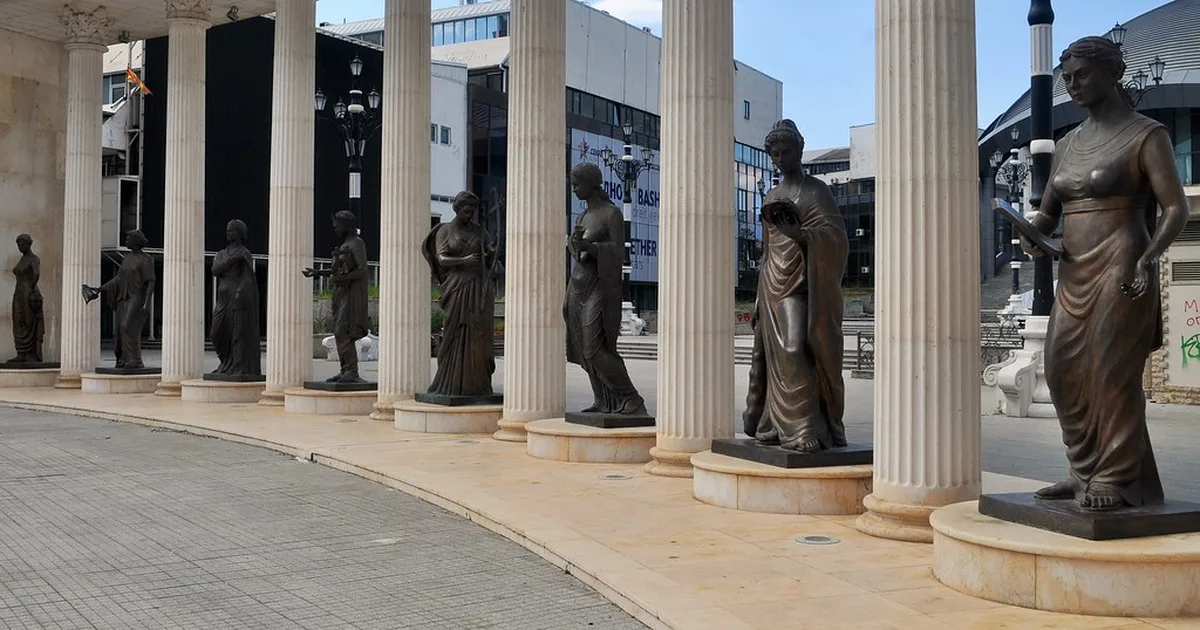
The broader Skopje 2014 project added more than 20 additional large statues across the city centre, representing figures ranging from Philip II of Macedon (father of Alexander) to Mother Teresa — who was born in Skopje in 1910 — to medieval Macedonian tsars and early 20th-century national figures. A 12-metre-tall statue of Philip II stands on the south side of the Stone Bridge. More than a dozen Baroque-style triumphal arches, fountains, and memorial columns line the riverside promenade called the Macedonian Riviera.
The most visually striking element of Skopje 2014 is the application of neoclassical and Baroque facades to existing Yugoslav-era concrete government buildings. The Ministry of Finance, government headquarters, courts, and other official structures had ornate stone facades bolted onto their exteriors, complete with columns, pediments, and bas-relief friezes. The visual effect is startling — from certain angles the buildings genuinely resemble 19th-century Austro-Hungarian architecture; from others the seams between old concrete and new stone are visible.
The controversy is threefold. Critics argue the project constituted historical revisionism — manufacturing an ancient Hellenic identity for a Slavic nation whose historical connection to Alexander the Great is contested by historians. Second, the cost drew intense criticism given North Macedonia's status as the poorest country in Europe by GDP per capita at the time. Third, local architects and urban planners objected that the pastiche neoclassical aesthetic was entirely disconnected from the country's genuine Ottoman and Yugoslav architectural heritage, most visibly preserved in the Old Bazaar directly across the river.
The Stone Bridge (Kameni Most) — a genuine 15th-century Ottoman structure of real historical significance, with 13 stone arches spanning 214 metres — serves as the literal and symbolic centrepiece connecting the two halves of the city. Standing on the bridge at sunset in 2026 offers the defining Skopje photograph: the Ottoman clock tower and Mustafa Pasha Mosque behind you, the 22-metre equestrian warrior directly ahead, with the Kale fortress watching from above. The fountain light show runs nightly from 9:00 PM to midnight, free of charge. Plan at least 90 minutes to walk the south riverbank promenade from the Stone Bridge to the Archaeological Museum and back.
Getting from Skopje Old Town to the City Centre
The Old Bazaar and the modern city centre are separated by the Vardar River, but the distance is short and entirely walkable. The primary crossing point is the Stone Bridge (Kameni Most), a 15th-century Ottoman bridge of 13 stone arches that spans approximately 214 metres. Walking from the heart of the bazaar — say, from the Mustafa Pasha Mosque or the Bezisten covered market — to Macedonia Square (Ploštad Makedonija) on the south bank takes roughly 8–12 minutes on foot at a relaxed pace. There is no charge to cross, and the bridge is open 24 hours.
From Macedonia Square, the main pedestrian boulevard Makedonija Street runs south, lined with cafes, shops, and the neoclassical facades of the Skopje 2014 project. The Archaeological Museum of North Macedonia is on the south bank immediately after crossing the bridge, on the left; entry costs 200 MKD (€3.25) and it is open Tuesday through Sunday, 9:00 AM to 5:00 PM. The Mother Teresa Memorial House — built on the site of the church where she was baptised in 1910 — is a 5-minute walk further south along the boulevard. Entry is free.
City buses connect the Old Bazaar area to more distant neighbourhoods. The main bus stop serving the bazaar is on Bitpazarska Street, near the Bit Pazar market entrance. A single bus ride within Skopje costs 35 MKD (€0.57). Bus routes 4, 5, and 15 connect the bazaar area to the bus and train stations roughly 2 km southwest. Taxis from the bazaar to the train or bus station should cost no more than 150–250 MKD (€2.50–€4.00) using a metered cab; always confirm the meter is running before departing.
Rideshare apps including inDrive and local taxi aggregators operate in Skopje and can be cheaper than street-hailed taxis for longer journeys. From the Old Bazaar to Skopje International Airport (Alexander the Great Airport) the journey takes approximately 20–25 minutes by road and a taxi costs roughly 700–1,000 MKD (€11–€16) depending on traffic and the specific taxi firm. Airport transfer companies advertise fixed rates online; booking in advance through a hotel concierge saves negotiation time. Car rental is available at the airport; driving within the bazaar itself is not recommended as most lanes are pedestrianised or extremely narrow.
For visitors staying in accommodation near Macedonia Square or the Čair municipality, the entire bazaar area is walkable without any transit. The Kale Fortress above the bazaar requires a short but steep uphill walk of approximately 10 minutes from the bazaar floor; wear shoes with good grip, particularly after rain. The fortress is free and provides the best elevated orientation point before descending into the bazaar streets for the first time. For a broader look at the country beyond Skopje, the North Macedonia travel guide covers day trips to Ohrid, Matka Canyon, and other regional highlights accessible by bus or organised tour from the capital.
Essential Stops for First-Time Visitors
Visiting the Old Bazaar requires a few hours to truly appreciate the atmosphere. Prioritize these specific locations if you have limited time during your city trip. Each spot offers a different perspective on the cultural evolution of the Macedonian capital and can be reached entirely on foot from the Stone Bridge (Kameni Most).
Make sure to cross the Stone Bridge to experience the contrast between the Ottoman bazaar behind you and the neoclassical spectacle ahead. The bridge itself dates to the 15th century under Sultan Murat II and was restored most recently in 2015. It provides some of the best unobstructed views of the Kale fortress and the Vardar riverbanks. Walking across at sunset — with the equestrian warrior lit in gold and the bazaar minarets catching the last light behind — offers the defining photo opportunity of any Skopje visit. For the best bar and restaurant options after your bazaar exploration, the Skopje nightlife guide covers the south-bank venues in detail.
- Bit Pazar Market
- Type: Local food market
- Best for: Authentic local shopping, fresh produce
- Where: North bazaar, 8-min walk from Stone Bridge
- Hours: Mon–Sat 8:00 AM–5:00 PM
- Cost: Free to enter; produce very cheap
- Stone Bridge / Kameni Most
- Type: 15th-century Ottoman bridge
- Best for: City views, photography, orientation
- Where: River Vardar, base of Macedonia Square
- Hours: Open 24 hours
- Cost: Free access
- Çifte Hamam (Double Bath Gallery)
- Type: 15th-century hammam, now art gallery
- Best for: Contemporary local art exhibitions
- Where: Central bazaar, 3 min from Bezisten
- Hours: Tue–Sun 9:00 AM–6:00 PM
- Cost: 120 MKD (€2.00)
- Daut Pasha Hammam (National Gallery)
- Type: 15th-century hammam, now National Gallery
- Best for: Fine art and Ottoman interior architecture
- Where: Near Stone Bridge, south of bazaar
- Hours: Tue–Sun 9:00 AM–8:00 PM
- Cost: 150 MKD (€2.50)
- Kale Fortress
- Type: 6th-century Byzantine–Ottoman fortress
- Best for: Panoramic city views, history
- Where: Hill above north bazaar
- Hours: Daily, daylight hours
- Cost: Free
- Alexander the Great Fountain (Skopje 2014)
- Type: Modern monumental fountain
- Best for: Spectacle, photography, light show
- Where: Macedonia Square, south of Stone Bridge
- Hours: Light show nightly 9:00 PM–midnight
- Cost: Free
Frequently Asked Questions
What is the best time to visit the Skopje Old Bazaar?
The best time to visit is during the morning when the market is most active and the light is best for photography. Spring (April–May) and autumn (September–October) offer pleasant temperatures of 15–22°C for walking the cobblestone streets. Summer visits are rewarding but hot — plan bazaar exploration for before noon and return in the early evening. Most shops open by 9:00 AM and close around 7:00 PM. Winter visits are quieter but atmospheric, with fewer crowds and lower hotel prices in Skopje.
Is the Skopje Old Town expensive for tourists?
The Old Town is very affordable compared to other European capitals. A traditional meal of kebapi with bread costs 400–600 MKD (€6–€10). A glass of Turkish tea costs under 80 MKD (€1.30). Most historic sites are free or charge 100–150 MKD (€1.60–€2.50). Çifte Hamam gallery costs 120 MKD (€2.00) and Daut Pasha Hammam costs 150 MKD (€2.50). You can comfortably explore the entire district, eat two meals, and visit three paid sites for under €25 per person in 2026.
Do people speak English in the Old Bazaar?
Many younger shopkeepers and restaurant staff speak good English, particularly in the southern bazaar sections closest to the Stone Bridge. Older vendors may speak Macedonian, Albanian, or Turkish as their primary languages, but are typically patient and helpful with non-speakers. Using simple gestures and a few basic Macedonian phrases — fala (thank you), kolku čini (how much) — is appreciated. Restaurant menus are widely available in English throughout the bazaar.
Is it safe to walk in the Old Town at night?
The Old Bazaar area is generally safe at night, though it becomes significantly quieter after shops close at sunset. Stick to the main lit thoroughfares around the Mustafa Pasha Mosque and the Stone Bridge approach if you are walking back to accommodation. Violent crime targeting tourists is extremely rare. The modern nightlife district across the Stone Bridge — bars, clubs, and late restaurants along the Macedonian Riviera — is lively and well-populated until late. Always stay aware of your surroundings in any unfamiliar city.
What is Skopje 2014?
Skopje 2014 was a large-scale urban renewal project launched in 2010 by North Macedonia's government, costing an estimated €500–€680 million. It added over 20 large statues — including the 22-metre-tall equestrian "Warrior on a Horse" widely understood to represent Alexander the Great — alongside neoclassical and Baroque facades bolted onto existing government buildings and a series of triumphal arches and fountains along the Vardar riverbank. The project is highly controversial: critics cite its cost, its historical revisionism, and its architectural disconnect from the genuine Ottoman heritage preserved in the Old Bazaar directly across the river. The fountain light show runs nightly from 9:00 PM to midnight at no charge and is one of the most-photographed sights in the Western Balkans.
Is Skopje Old Town free to explore?
Yes, the Old Bazaar (Stara Čaršija) is entirely free to enter and wander. There are no gates, admission booths, or compulsory guided tours. Individual attractions within or adjacent to the bazaar charge modest fees: Kuršumli An caravanserai (100 MKD / €1.60), Çifte Hamam gallery (120 MKD / €2.00), Daut Pasha Hammam gallery (150 MKD / €2.50), Church of the Holy Savior (100 MKD / €1.60), and the National Museum of North Macedonia at the Stone Bridge (100 MKD / €1.60). The Mustafa Pasha Mosque, Kale Fortress, Stone Bridge (Kameni Most), and the bazaar streets themselves are all free. Budget around 370–570 MKD (€6–€9) total if you intend to visit all the paid sites.
How far is the Old Bazaar from Skopje city centre?
The Old Bazaar is separated from the modern city centre by the Vardar River, but the distance is minimal. Crossing the Stone Bridge (Kameni Most) on foot takes about 3 minutes, and the full walk from the Mustafa Pasha Mosque or the Bezisten market to Macedonia Square takes 8–12 minutes. There is no bus or taxi needed — the crossing is free and the bridge is open 24 hours. Taxis from the bazaar to Skopje bus and train station cost 150–250 MKD (€2.50–€4.00) by metered cab.
The Skopje Old Town remains the beating heart of the city's cultural and historic identity. Exploring the bazaar offers a unique chance to experience the intersection of Ottoman, Byzantine, and modern Macedonian civilisations in a single afternoon's walk. Pair it with a stroll across the Stone Bridge to the Skopje 2014 spectacle on the south bank, and you will leave with a thorough and nuanced understanding of a city that defies easy categorisation. Plan your 2026 visit to include both the famous landmarks and the quieter hidden alleys — the best of Skopje reveals itself slowly, to those who take their time. For a deeper dive into everything the country has to offer beyond the capital, the North Macedonia travel guide is the place to start.