Ultimate Split Old Town Guide: Explore Croatia's Living History
Split Old Town and Diocletian's Palace are free to enter at all hours in 2026; paid highlights include the Cathedral of Saint Domnius bell tower (€5), Palace Cellars (€10), and Meštrović Gallery (€10), totalling under €30 for a full day of discovery.
The Riva promenade and all four ancient city gates are free to walk at any time; arrive before 9 AM to experience the Peristyle and Vestibule without cruise-ship crowds, and hear klapa singers perform in the open-air Vestibule at no cost throughout the day.
Split Old Town feels like a massive open-air museum where ancient history breathes in every corner. Walking through these streets reveals Roman ruins standing right next to lively modern cafes and shops. This unique blend makes the city center a top destination for travelers visiting the Adriatic coast. Exploring the narrow limestone alleys uncovers complex layers of history spanning well over 1,700 years, from the Roman Emperor Diocletian's grand palace to medieval merchant guilds and modern Croatian daily life.
Exploring the Heart of Diocletian's Palace
The palace remains the crown jewel of the city and forms the core of the historic center. Roman Emperor Diocletian built this massive retirement home around the turn of the fourth century, and it is considered one of the best-preserved Roman structures anywhere in the world. Visitors can enter the palace grounds for free since it serves as a functional part of the city — over 3,000 people actually live and work inside the ancient walls today. Booking a professional Split walking tour helps you understand the complex architecture and hidden symbols carved into the limestone.
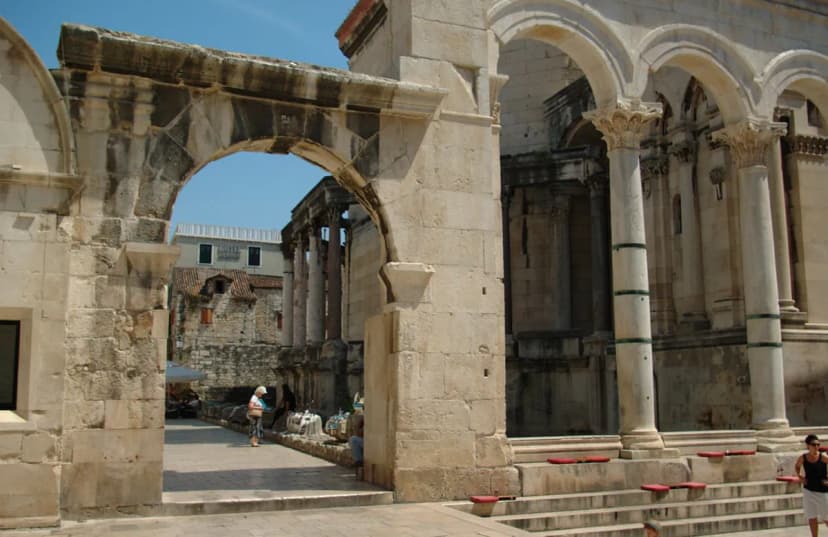
The Peristyle serves as the central ceremonial court and is the most famous spot in the Old Town. Ancient granite columns and sphinxes brought all the way from Egypt decorate this impressive square. The sphinxes are among the oldest objects in Croatia, dating back to the reign of Pharaoh Thutmose III around 1450 BC. Travelers often sit on the worn stone steps to enjoy live music during warm summer evenings. Professional actors dressed as Roman soldiers perform daily reenactments during the peak tourism season from June through August. In July, the Peristyle transforms into an open-air opera stage for the Split Summer Festival — tickets range from €15 to €60 and sell out weeks in advance.
Climbing the bell tower of the Cathedral of Saint Domnius offers the best panoramic views of the city. Tickets for the climb cost €5 in 2026 and can be bought at the Cathedral entrance on the Peristyle. The staircase is quite narrow and steep with irregular stone steps, so visitors should wear rubber-soled shoes. Reaching the top rewards you with a stunning view over the terracotta rooftops, the Riva waterfront, and the islands of Brač and Šolta shimmering in the Adriatic on a clear day. The Cathedral itself charges a separate €8 entry fee and is one of the oldest Catholic cathedrals in the world — it was originally built as Diocletian's mausoleum.
Below the palace floor lie the massive Substructures (Podrumi), which once supported the imperial living quarters above. Fans of Game of Thrones will recognize these dark stone halls, which were used as filming locations for the slave city of Meereen across multiple seasons. Modern vendors now sell local crafts, lavender products, and souvenirs in the central hall of the cellars. Entry to the cellars costs €10 in 2026. Guided tours of the restricted areas, available for €15 to €20 per person, provide a deeper look into Roman engineering, drainage systems, and the original spatial logic of the imperial palace complex. Allow at least 45 minutes to explore thoroughly.
The Temple of Jupiter, tucked into a narrow alley just steps from the Peristyle, is one of the best-preserved Roman temples in existence. It was later converted into a baptistery, and the original coffered ceiling is remarkably intact. Entry is included in the Cathedral combo ticket. Directly outside the temple entrance sits a headless Roman sphinx on a pedestal — one of the three sphinxes that originally flanked Diocletian's mausoleum procession route.
The Peristyle and Vestibule: Two Free Highlights You Cannot Miss
The Peristyle is the beating heart of Diocletian's Palace and arguably the finest outdoor Roman space in Croatia. Unlike many ancient sites that sit behind ticket barriers, the Peristyle is completely free and fully integrated into the living city — locals cross it on their way to work, children play on the steps, and cafe owners set up chairs among the ancient columns each morning. The square is framed by a prostyle portico on the south side, six Corinthian columns, and the entrance arch to the Vestibule. It measures roughly 35 by 13 meters and was used for imperial ceremonies when Diocletian resided here in retirement from 305 AD.
Arrive at the Peristyle by 8 AM to have it largely to yourself for photography. By 10 AM in peak summer, cruise-ship groups begin flooding through in guided formations. The steps facing the Cathedral are the best informal vantage point. During the Split Summer Festival (July to August), evening opera and classical music performances take place here — the acoustics created by the surrounding stone walls are extraordinary. Festival tickets are separate and must be booked through the Split Summer Festival website.
A few steps north of the Peristyle, through a narrow passage, lies the Vestibule — the circular antechamber that once served as the formal entrance to Diocletian's private apartments. Entry is free. The domed roof is open to the sky, creating a dramatic circular oculus that floods the interior with natural light. The real magic happens when traditional klapa singers perform here. Klapa is a UNESCO-recognized form of Dalmatian a cappella harmony singing, and the circular stone walls amplify the voices into something genuinely extraordinary. Performances happen informally throughout the day, particularly at midday and early evening. While watching is free, buying a CD (around €10-15) directly supports the local musicians who keep this tradition alive.
The Vestibule's acoustic chamber is also used by choirs for rehearsals and small concert events during the summer. If you hear singing as you approach, take the side alley and find a spot inside before the small space fills up. The contrast between the ancient dome above, the rectangle of blue sky at the top, and the rich harmonics of the klapa singers makes this one of the most affecting free experiences in all of Dalmatia.
Split's Vestibule and Underground Halls: Diocletian's Palace Highlights
The Vestibule and the Underground Halls (Substructures) of Diocletian's Palace are the two most architecturally distinctive spaces in Split Old Town — and together they reveal the full engineering ambition of one of Rome's last great emperors. Both are accessible from the Peristyle within a two-minute walk, making them natural companions on any self-guided circuit of the palace interior.
The Vestibule was the formal threshold between the public ceremonial world of the Peristyle and the emperor's private apartments. Its circular plan, roughly 10 meters in diameter, is capped by a corbelled stone dome with a central oculus open to the sky. In antiquity, this dome was richly decorated with marble revetment and mosaic — traces of the fixing holes for the cladding remain visible on the inner walls. When afternoon light pours through the oculus and strikes the curved stone walls, the space glows with a warm amber that photographs beautifully. Entry is free; the Vestibule is open 24 hours as part of the living city.
The Underground Halls, known locally as Podrumi (cellars), form a mirror image of the imperial apartments above. Because the palace was built on a sloping site near the shoreline, Diocletian's engineers created a massive subterranean platform of vaulted chambers to raise and level the imperial floor. These spaces were not used as living quarters — they were structural. After Diocletian's death, the cellars became the city's rubbish tip for centuries, which paradoxically preserved their form perfectly beneath layers of debris. When they were excavated in the 20th century, the plan of the lost imperial apartments above could be reconstructed almost entirely from the vaulted rooms below. Entry costs €10 in 2026; opening hours run roughly 9 AM to 9 PM in summer, shorter in winter.
The main cellar hall, running east-west beneath the palace, is the primary public space and now hosts a permanent craft and souvenir market. A series of smaller side chambers branch off on both flanks. The western wing, accessible on specialist guided tours (€15-20), reveals original Roman drainage channels and cisterns that managed groundwater beneath the imperial platform. Game of Thrones fans will recognize the vaulted brick passageways from the Meereen slave-pit filming scenes used across seasons five and six. Guided tours depart from the main cellar entrance, typically at 10 AM, 12 PM, and 3 PM in peak season; confirm times at the ticket desk near the Bronze Gate. Allow at least one hour to do both sections justice and to photograph the long barrel-vaulted corridors without crowds, which thin out after 4 PM.
A combined visit to the Vestibule (free) and the Underground Halls (€10) represents one of the highest-value pairings in all of Split Old Town — two spaces that bracket the lived experience of the emperor, one opening his private world to the sky, the other anchoring his palace to the bedrock of Dalmatia.
Navigating the Four Ancient City Gates
The Golden Gate (Zlatna Vrata) stands as the most ornate entrance and was originally used only by the Emperor for processional arrivals from the imperial road to Salona, the Roman capital of Dalmatia. The gate's niches, which once held statues of Diocletian and his co-emperors, are now empty but still convey the monumental scale of the original design. Just outside this gate, you will find the towering statue of Gregory of Nin (Grgur Ninski) by sculptor Ivan Meštrović, installed in 1929. At nearly nine meters tall, it is one of the most dramatic public sculptures in Croatia. Rubbing the statue's giant bronze left toe, worn bright by millions of hands, is a local tradition said to bring good luck for travellers. This area often hosts local artists, musicians, and street performers who work the crowds of passing tourists during summer mornings and evenings. A pleasant garden square sits just beyond the gate, offering a moment of calm before re-entering the palace maze.
The Silver Gate (Srebrna Vrata) on the eastern side leads directly to the vibrant open-air Green Market (Pazar). Locals gather here every morning from around 7 AM to buy fresh produce, honey, dried figs, lavender sachets, and traditional olive oil from nearby Brač island. Walking through this gate connects the quiet palace interior with the vibrant sensory energy of the market — the smell of ripe stone fruits in summer, the calls of vendors, and the sounds of Dalmatian dialect all hit at once. Prices at the Pazar are significantly lower than in the boutique shops found deeper in the palace. A bag of fresh tomatoes costs around €1.50, and a jar of local honey runs €5 to €8. The adjacent Ribarnica (fish market) operates from early morning until stocks run out, typically by 10 AM. Fresh bream, sea bass, squid, and octopus are displayed on ice slabs — a working fish market that has operated on this site for centuries.
The Iron Gate (Željezna Vrata) on the western side features a beautiful medieval clock tower built by the city's commune in the 14th century. This entrance leads into Narodni Trg (People's Square) and showcases a layered mix of Roman substructure, medieval arch, and later Venetian ornament. Look up at the unique 24-hour clock face — a rare survivor from the medieval period when Split used the Italian hora italica system to count hours from sunset. Small cafes tucked into the archways of the gate offer shaded spots for a quick espresso (around €1.50) on warm afternoons. The clock is one of the most photographed details in Split by visitors who take the time to look up.
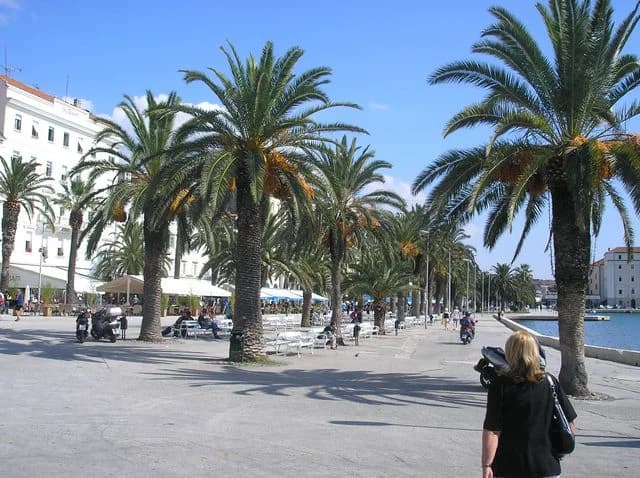
The Bronze Gate (Brončana Vrata) on the southern wall provides a direct passage between the palace cellars and the Riva promenade along the sea. It was originally designed as a sea gate — ships could unload supplies directly into the palace storage chambers that sit beneath the imperial apartments. Today, the gate serves as the main entry point for visitors arriving from the ferry and catamaran terminal, and it is often the busiest of the four gates during summer mornings. Step through and you immediately transition from the stone warren of the palace interior to the wide, palm-lined sweep of the Riva — one of the most beautiful waterfronts in the Adriatic. The contrast is dramatic and makes for an excellent photo from either direction.
The Best Squares for Local Culture
Narodni Trg (People's Square), also known locally as Pjaca, has been the center of political and social life in Split since the medieval commune period. Elegant Gothic buildings, including the old Town Hall with its distinctive triple-arched loggia, frame this beautiful white limestone square. The Town Hall building, dating to the 15th century, now houses a small ethnographic collection. Many locals meet here for their morning coffee ritual — espresso costs €1.50 to €2 at the cafes tucked into the arcade. The square stays lively late into the night, with several popular bars setting up outdoor tables and the gentle hum of conversation filling the space between the historic facades. On summer evenings, informal musicians sometimes play in the square corners. No tickets or entry fees apply — Narodni Trg is a functioning public space that happens to be one of the most beautiful in Dalmatia.
Voćni Trg (Fruit Square) earned its name from the vibrant morning markets that were held there for generations. A large octagonal Venetian tower, built in the 15th century, dominates the northwestern corner and serves as a reminder of the city's centuries under Venetian rule. You can find a statue of Marko Marulić, considered the father of Croatian literature and author of the 1501 epic poem Judita — one of the first major literary works written in the Croatian language. The surrounding shops offer high-end fashion boutiques and unique jewelry from local Croatian designers, making Fruit Square a good reference point for quality souvenir shopping at the upscale end of the market.
Prokurative (Republic Square) is the grand neoclassical public square just west of the Old Town, built in the 19th century by Austrian architects who drew clear inspiration from Piazza San Marco in Venice. Three sides are enclosed by tall neo-Renaissance colonnaded buildings that create an almost theatrical sense of enclosure; the fourth side opens out toward the harbor and the Adriatic Sea, providing a natural visual draw toward the water. Sitting at one of the upscale cafe terraces here — espresso around €2.50, a glass of local wine from €5 — provides a grand, unhurried atmosphere for an afternoon drink. Prokurative is also Split's main outdoor event venue: it hosts the Split Open-Air Cinema in summer (July to August), with evening screenings shown against the backdrop of the lit colonnade (tickets €5-8). The square also hosts concerts, folklore performances, and the Split International Festival of New Theatre (FINK), usually held in September. Evening is the best time to visit, when the facades are warmly lit and the square fills with a mix of locals and visitors.
Marmont Street (Marmontova ulica), the elegant pedestrian boulevard named after Napoleon's marshal Auguste de Marmont who governed Dalmatia in the early 19th century, runs along the western edge of the Old Town. It is lined with the densest concentration of cafes and gelato shops in Split, and in the late afternoon it fills with the Dalmatian tradition of the korzo — a slow, sociable evening promenade. Locals dress up and walk the street to meet friends, making it an excellent place to observe everyday Split life. Gelato costs around €2 per scoop; a long coffee at one of the pavement cafes averages €2 to €3. The street connects Prokurative to the market area and is one of the most pleasant fifteen-minute walks in the city.
Split's Markets and Local Food Scene
The best place to eat like a local in Split is not inside the palace walls but in the streets and markets just beyond them. The Ribarnica fish market on the eastern side of the Old Town (adjacent to the Silver Gate) opens daily from around 6 AM and sells out of the freshest catch — usually sea bass, bream, mackerel, and octopus — by 10 AM. A whole sea bass for two people costs around €10 to €14 depending on size and season. Vendors will typically gut and clean your purchase if you ask. The Pazar (open-air fruit and vegetable market) next to the Ribarnica is the cheapest place to buy fresh produce: a kilo of local tomatoes costs around €1.50, a bunch of herbs €0.50, and a bottle of olive oil from Brač €8 to €12. Both markets operate seven days a week but are busiest and freshest Monday through Saturday mornings.
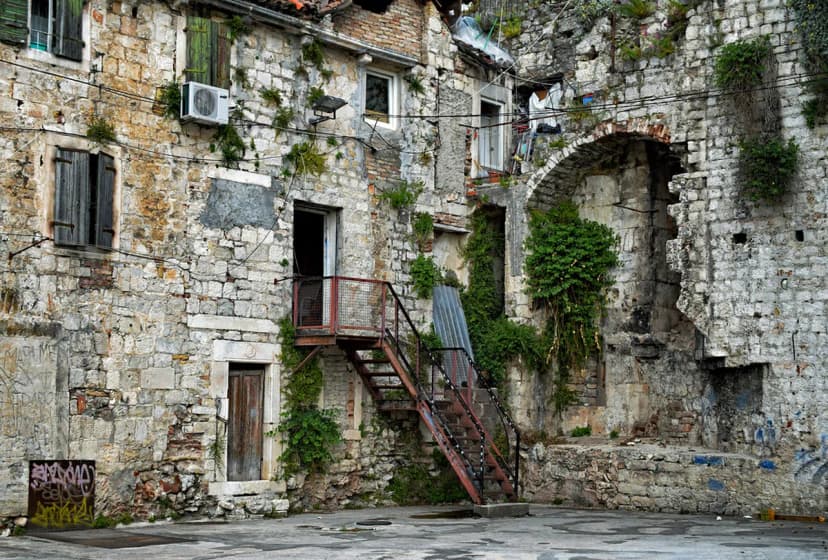
The Varoš district, the traditional fishermen's neighbourhood immediately west and south of the palace walls, is where locals go for a cheap, honest lunch. Varoš is built on a hillside of narrow stone lanes climbing up from the Riva, and its konobas (traditional taverns) have been serving Dalmatian food for generations. Look for places with handwritten menus in Croatian and no tourist-facing laminated signs — these are the real ones. A two-course lunch with house wine costs €12 to €18 per person. The neighbourhood is also quieter and less polished than the palace interior, with laundry strung between windows and cats sleeping in doorways, giving it an authentic residential character that contrasts sharply with the tourist-heavy palace core.
For the traditional Dalmatian slow-roasted dish called peka — meat (lamb, veal, or octopus) and vegetables cooked under a bell-shaped iron lid buried in embers — you typically need to pre-order at least 24 hours in advance. Konobas in the Varoš area and on the outskirts of the Old Town offer peka from around €20 to €30 per person, usually for a minimum of two people. Ask your accommodation to help you make a reservation, as most konobas offering peka do not have an English-language online booking system. The result — deeply caramelised, fall-apart meat with roasted seasonal vegetables — is worth the planning effort and is one of the defining food experiences in Dalmatia.
The Archaeological Museum, located about a 15-minute walk north of the Old Town in a neoclassical building on Zrinsko-Frankopanska Street, is often overlooked by visitors focused on the palace. Entry costs €8 in 2026. The collection covers 2,500 years of Dalmatian history from prehistoric through Roman and early medieval periods and contains the largest numismatic (coin) collection in Croatia. For visitors with a deeper interest in the Roman context of Diocletian's Palace, a visit here provides excellent background before or after exploring the palace itself.
The Meštrović Gallery, housed in a purpose-built seaside villa the sculptor Ivan Meštrović designed as his own home and studio in the 1930s, sits about 3 km west of the Old Town in the Meje district. Entry costs €10 in 2026. Take Bus 12 from the Riva (€2, around 10 minutes) or walk along the waterfront promenade in about 35 minutes. The gallery holds the largest single collection of Meštrović's work anywhere in the world — over 190 sculptures in wood, marble, and bronze — displayed across the villa's light-filled halls and terraced garden. Even visitors with no prior knowledge of Meštrović typically emerge genuinely moved by the scale and emotional intensity of the works. The garden sculptures, which include a remarkable series of crucifixion figures, are particularly powerful in late afternoon light.
Practical Tips for Your Old Town Visit
Wear sturdy walking shoes with rubber or non-slip soles because the polished limestone streets become dangerously slippery when wet. Centuries of foot traffic have smoothed the stones to an almost mirror-like surface, particularly in the high-traffic lanes around the Peristyle and near the four gates. Arriving before 8:30 AM allows you to photograph the major landmarks without heavy cruise-ship crowds — two to four ships dock at Split regularly in peak summer, disgorging several thousand visitors by mid-morning. Morning light also provides the best photographic conditions, with warm golden tones hitting the pale stone facades from the east.
Croatia joined the Eurozone on 1 January 2023, so the currency is now the euro (EUR). All prices throughout Split are quoted and paid in euros. ATMs are widely available in the Old Town — look for Erste, Raiffeisen, and Hrvatska Poštanska Banka machines, which typically offer competitive rates without hidden surcharges. Avoid currency exchange kiosks on the Riva, which commonly charge 5-7% above the interbank rate. Credit and debit cards are accepted almost universally in restaurants, larger shops, and the main museum ticket desks. Smaller market stalls and some traditional konobas still prefer or require cash.
Most key sites have the following 2026 entry fees: Cathedral of Saint Domnius interior €8, Cathedral Bell Tower €5, Palace Cellars (Substructures) €10, Archaeological Museum €8, Meštrović Gallery €10. A combined ticket for the Cathedral complex (Cathedral + Bell Tower + Temple of Jupiter + Treasury) is available for €20 and represents solid value if you plan to visit all components. The palace grounds, Peristyle, Vestibule, Golden Gate area, Riva, and all four city gates are free to access at any hour.
If you are driving, finding parking in Split near the center is often difficult and expensive during summer. The Old Town is a fully pedestrianized zone where private vehicles are not permitted. Public parking garages, including the Sukoišan garage north of the Golden Gate (around €2-3 per hour), are located a short walk from the main palace entrances. Using public transport, a taxi from the ferry terminal (€6-10 flat rate), or walking from your accommodation is typically the most stress-free option. If arriving by ferry from the islands, walk straight off the boat and through the Bronze Gate — you are inside the Old Town in under five minutes.
Most travelers find that two full days provides adequate time to cover the main historic highlights without feeling rushed. On the first day, focus on the palace interior: Peristyle, Vestibule, Cathedral complex, and Cellars. On the second day, explore the four gates, markets, Varoš neighbourhood, and Prokurative. Check the official opening hours for the palace cellars and Cathedral, which vary by season and are shorter in winter. The peak summer season runs June through August; shoulder season (April-May and September-October) offers a significantly more comfortable experience with shorter queues and lower accommodation prices. Booking museum tickets online is possible for the Meštrović Gallery but less critical for the smaller palace sites, where queues rarely exceed 10-15 minutes outside of July-August peak.
Hidden Gems and Secret Historic Alleys
Look for Ulica između polača — the so-called "Let Me Pass" street, which is one of the narrowest alleys in the world. It is so thin that two adults cannot walk past each other without turning sideways. This quirky passage is located just east of the Temple of Jupiter in the palace interior, and it is easy to miss unless you know to look for a gap barely wider than a person's shoulders. Finding these small details makes your Split Old Town experience feel genuinely exploratory rather than a tick-box tour.
The Jewish Ghetto area, located in the northwestern corner of the palace, offers quiet residential corners and unique artisan shops well away from the main tourist flow. One of the oldest surviving synagogues in Europe — the Split Synagogue, established in the 16th century — is tucked into the upper floor of a building on Žudejska Street. The architecture here feels more intimate and more worn than the grand squares: laundry hangs between windows, potted geraniums crowd windowsills, and elderly residents sit in doorways as they have done for generations. Exploring this neighbourhood provides a glimpse into the diverse and layered history of the local community, where Jewish, Venetian, Ottoman, and Croatian influences overlap.
The Vestibule, described in detail in the Peristyle and Vestibule section above, is worth a second mention here as a hidden gem in its own right. Many visitors walk past the narrow entrance arch without stopping. The circular domed chamber with its open oculus and extraordinary acoustics is one of the most atmospheric spaces in the entire Old Town. When klapa singers are not performing, the space is blissfully quiet — a rare thing in summer Split. Stepping inside for five minutes of stillness is one of the best free experiences in the city.
The Diocletian's Palace cellars contain a less-visited western wing beyond the main souvenir market hall. This section, sometimes accessible on specialist guided tours, reveals the original drainage channels and cisterns built by Roman engineers to manage the imperial complex. The engineering ingenuity — creating a stable raised platform above the sloping shoreline terrain — is as impressive as the decorative elements above ground. Ask specifically about access to the western cellars when booking guided tours at the main entrance.
The rooftop terrace of several restaurants and bars inside the palace walls offers views directly down into the Peristyle and across the roofline to the sea. These terraces are not always signposted — look for narrow staircases leading upward from ground-floor cafes. Arriving at sunset produces views of the warm limestone catching the last light of the day, with the Cathedral dome and bell tower silhouetted against the darkening Adriatic sky.
Dining and Evening Life in the Center
Traditional Dalmatian konobas serve local specialties like black risotto (crni rižot, made with cuttlefish ink) and fresh grilled fish. These small taverns use recipes passed down through families for generations and source their seafood daily from the Ribarnica fish market at the Silver Gate. Pair your meal with a glass of local wine: Pošip and Grk whites from the island of Korčula, or Plavac Mali red from Hvar or Pelješac, are the regional benchmarks. A typical konoba dinner for two with wine costs €40 to €70. Reservations are strongly recommended from June through August — call ahead or ask your accommodation to book, as many of the best konobas in Varoš do not take online reservations.
For the peka experience — the slow-cooked Dalmatian clay-pot dish of lamb or veal with vegetables — plan at least 24 hours in advance and expect to pay €20 to €30 per person (minimum two people). The dish takes three to four hours to cook properly and is not a menu-order item; it must be requested and prepared specially. Konobas in the Varoš district and the streets south of the Iron Gate are the most reliable places to find authentic peka in Split Old Town.
The Riva promenade is the perfect stage for the evening ritual known locally as the đir (pronounced "djeer") — the slow, sociable evening promenade along the waterfront. Locals and tourists alike walk the full length of the palm-lined waterfront to see and be seen as the sun sets behind the hills across the harbour. Grab a seat at a cafe and enjoy the spectacle with a cold Karlovačko beer (€3-4) or a glass of white wine (€4-6). This area transitions naturally into the evening as the Split nightlife guide unfolds — bars inside the palace walls stay open until 1 AM or later, and the Bačvice area a short walk south runs later still.
Marmont Street (Marmontova) is the hub of the café culture scene and the korzo tradition. In the late afternoon and early evening, locals fill the pavement tables for long, unhurried coffees. This is distinctly not a tourist-pace experience — Croatians take their coffee seriously and will sit for an hour over a single espresso. Joining this ritual, rather than rushing through the Old Town on a schedule, is one of the best ways to feel the city's actual rhythm. Gelato shops on and around Marmontova charge €2 per scoop for high-quality Italian-style ice cream.
Combine your historical walks with a visit to the nearby Split beaches for afternoon relaxation. Bačvice, the sandy cove a 10-minute walk southeast of the Bronze Gate, is famous for picigin — a traditional Dalmatian water sport involving keeping a small ball airborne through spectacular diving and kicking moves in shallow water. It is a distinctly local spectacle and free to watch. Following a structured Split 3-day itinerary ensures you balance history with modern leisure effectively. Evening hours bring a special magic to the Old Town as the ancient stone walls glow under warm amber streetlights and the Riva fills with the sound of conversation and clinking glasses.
- Traditional Konoba Dining
- Type: Local tavern
- Best for: Seafood, peka, black risotto
- Where: Varoš neighbourhood
- Cost: €40-70 for two with wine
- Riva Waterfront Cafes
- Type: Coffee, beer, wine
- Best for: People watching, đir ritual
- Where: Main promenade
- Cost: €3-6 per drink
- Old Town Wine Bars
- Type: Tasting rooms
- Best for: Local Plavac Mali and Pošip wines
- Where: Palace alleys
- Cost: €5-12 per glass
- Peka Slow-Roast Dinner
- Type: Pre-order only, 24h notice
- Best for: Traditional Dalmatian experience
- Where: Varoš konobas
- Cost: €20-30 per person
Day Trips from Split Old Town
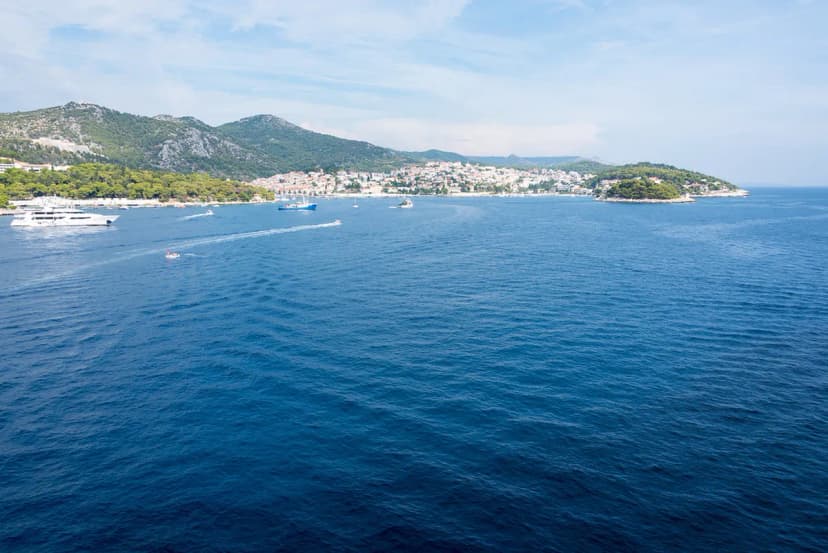
Split's position on the central Dalmatian coast makes it one of the best bases in Croatia for island day trips, and the ferry and catamaran terminal sits right next to the Bronze Gate — you can be on a boat within a five-minute walk from the Peristyle. The most popular day trip from Split is to Hvar Town, reached by catamaran in about 55 minutes (€10 one way in 2026). Hvar's Old Town centres on one of the most beautiful Venetian piazzas in the Adriatic, with the St. Stephen's Cathedral and the 16th-century Arsenal theatre framing a vast stone square that slopes down to the harbour. For a full breakdown of beaches, hikes, and logistics, see the day trips from Split guide.
The island of Brač is the closest island to Split, reachable by car ferry in 50 minutes (€5 passenger, €35 car in peak season). The main draw is Zlatni Rat (Golden Horn) near the town of Bol — an iconic white pebble spit that changes shape with wind and current and is consistently rated among the most beautiful beaches in Europe. Brač also produces some of the finest olive oil in Dalmatia, available directly from estate farms around the village of Škrip.
For visitors with a strong interest in Roman history, the ruined city of Salona (Solin) sits just 5 km north of Split and can be reached by local bus (Line 37 from the city bus station, €1.50, 20 minutes). Salona was the Roman capital of Dalmatia and the birthplace of Emperor Diocletian himself — an irony given that he chose to retire to a coastal palace rather than return to his hometown. The ruins include an amphitheatre, early Christian basilicas, and extensive city walls spread across a large open archaeological park. Entry costs €5 in 2026. Combine Salona with a visit to the Klis Fortress (€7 entry), the dramatic medieval castle perched on a ridge above Split that was another key Game of Thrones filming location. Buses run from Split bus station to Klis village regularly.
The walled city of Trogir, a UNESCO World Heritage Site, is 30 km west of Split and reachable by local bus (Line 37 from the city bus station, €3, about 45 minutes) or by tourist ferry from the Riva (seasonal, around €15 return). Trogir's medieval cathedral, narrow lanes, and intact city walls are a complement rather than a rival to Split — the two sites feel entirely different in scale and character. A half-day in Trogir pairs well with a morning in Split Old Town on the same day.
Frequently Asked Questions
Is Split Old Town free to visit?
Yes, entering Split Old Town and Diocletian's Palace is free — the area is a living part of the city with over 3,000 residents. Specific paid attractions in 2026: Cathedral of Saint Domnius interior €8, Cathedral Bell Tower €5, Palace Cellars (Substructures) €10, Archaeological Museum €8, Meštrović Gallery €10. A Cathedral complex combo ticket covering the Cathedral, Bell Tower, Temple of Jupiter, and Treasury costs €20. Budget around €25-30 if you plan to visit all key paid sites in a single day.
How long should I spend in Split Old Town?
Plan for a minimum of one full day to cover the main landmarks: Peristyle, Vestibule, Cathedral complex, Cellars, and the four city gates. Two days is more comfortable and allows time for the markets, Varoš neighbourhood, and Prokurative. Three days gives you space to also visit the Meštrović Gallery and plan day trips from Split to nearby islands like Hvar or Brač.
Is the Old Town accessible for people with mobility issues?
Split Old Town is mostly flat within the palace interior, but the limestone floors are uneven and many passages have small steps or raised thresholds. The Cathedral Bell Tower and palace cellars' deeper sections are not wheelchair accessible due to steep, narrow staircases. The Riva promenade is fully accessible and the main squares — Peristyle, Narodni Trg, and Prokurative — are all level and manageable. Contact the specific attraction in advance for current accessibility details.
What currency is used in Split? Do I need cash?
Croatia joined the Eurozone on 1 January 2023, so the currency is the euro (EUR). Credit and debit cards are accepted at most restaurants, museums, and larger shops. However, the Pazar market, Ribarnica fish market, and some traditional konobas and market stalls require cash. Carry €20-30 in cash for market shopping and small cafes. ATMs from major banks (Erste, Raiffeisen) are the best option — avoid currency exchange kiosks on the Riva.
When is the best time to visit Split Old Town to avoid crowds?
Arrive before 8:30 AM or visit after 6 PM in July and August to avoid peak cruise-ship crowds. The shoulder months of May, early June, and September offer dramatically lower visitor numbers, comfortable temperatures (20-25°C), and lower accommodation prices. April and October are quieter still but some seasonal restaurants close and ferry schedules are reduced. Midday in July and August is the worst time — the Peristyle and main gates become extremely congested between 10 AM and 4 PM.
What is the best free thing to do in Split Old Town?
The single best free experience in Split Old Town is standing in the Vestibule when klapa singers are performing. The circular domed chamber with its open sky oculus amplifies the traditional Dalmatian a cappella harmonies into something genuinely extraordinary — a UNESCO-recognised art form performed in a 1,700-year-old Roman space, completely free to experience. The Peristyle, all four city gates, Gregory of Nin statue, Narodni Trg, Prokurative, and the Pazar market are also all free.
How much does it cost to climb the Cathedral of Saint Domnius bell tower?
Climbing the Cathedral of Saint Domnius bell tower costs €5 in 2026. Tickets are purchased at the Cathedral entrance on the Peristyle. The staircase is narrow and steep, so wear non-slip shoes. At the top you get panoramic views over Split's rooftops, the Riva waterfront, and the islands of Brač and Šolta on a clear day. A combined Cathedral complex ticket (Cathedral + Bell Tower + Temple of Jupiter + Treasury) costs €20 and offers better value if you plan to see all four components.
Is the Riva promenade worth visiting in Split Old Town?
Yes — the Riva promenade is one of the finest free attractions in Split and is completely free to walk at any hour. The palm-lined waterfront stretches along the southern edge of Diocletian's Palace and is the social heart of the city, especially in the evening when locals gather for the đir promenade tradition. Cafes, bars, and gelato shops line the Riva. The Bronze Gate connects the Riva directly to the palace interior, making it the most dramatic entry point for visitors arriving by ferry from the islands.
Split Old Town offers a rare opportunity to walk through a living piece of Roman history where daily life and ancient stone exist in genuine, unscripted coexistence.
From the grand Peristyle echoing with klapa harmonies to the narrow "Let Me Pass" alley and the fresh catch of the morning fish market, every corner rewards unhurried attention.
Use this guide to plan your 2026 visit and you will leave Split with far more than photographs — you will leave with the kind of layered, sensory understanding of a place that only comes from taking the time to look beyond the obvious.