Ultimate Split Diocletian Palace Complete Visitor Guide 2026
Diocletian's Palace entry is free year-round, open 24 hours through all four gates. Inside, the Underground Halls (Podrumi) cost €10, the Cathedral bell tower costs €5, and the combined cathedral-and-tower ticket is €7; paid attractions are open 8 AM–8 PM April through October.
The best time to visit is 7–9 AM before cruise ships dock: the Peristyle glows in golden morning light, the ancient columns are empty, and you can explore the narrow Roman lanes with barely another person in sight.
Walking into the heart of Split feels like stepping through a portal into the ancient Roman Empire. This massive complex remains one of the most imposing and well-preserved Roman ruins in the entire world. Unlike many static museums, this historic site functions as a vibrant part of the modern city today. Locals still live and work within these ancient stone walls, creating a unique atmosphere for every visitor.
This Split Diocletian Palace complete visitor guide helps you navigate the labyrinth of marble streets and hidden courtyards. You will discover the best times to visit the monuments and how to avoid the largest crowds. Many travelers find that understanding the history of the Split old town enhances their experience significantly. Planning ahead ensures you see every major landmark without missing the subtle details of Roman engineering.
The palace serves as the foundation for the city's identity and its most famous cultural attraction. Every corner reveals layers of history ranging from Roman columns to medieval houses and Renaissance palaces. Prepare for a journey that combines architectural grandeur with the daily rhythms of Croatian coastal life. Exploring this UNESCO World Heritage site requires a mix of curiosity and practical preparation for the best results.
History of the Roman Emperor's Retirement Home
Emperor Diocletian ordered the construction of this fortress-like palace at the turn of the fourth century. Born in 245 AD in the nearby town of Salona, Diocletian rose from humble origins to become one of Rome's most powerful rulers. He assumed the throne in 284 AD and reigned for over two decades before making the remarkable decision to voluntarily abdicate — one of the very few Roman emperors to do so peacefully. He intended the palace to serve as his luxurious retirement residence, and he died here in 311 AD after spending his final years tending his famous cabbage garden — a detail he famously referenced when urged to return to power.
Construction began around 295 AD using high-quality white limestone quarried from the nearby island of Brač, the same material used centuries later for the White House in Washington. The massive project employed thousands of workers and took nearly ten years to complete before the Emperor finally moved into his quarters in 305 AD. The complex covered roughly 30,000 square metres — comparable in footprint to a small town — and enclosed an imperial court of around 9,000 people including soldiers, servants, and members of the imperial household.
The palace layout reflects a traditional Roman military camp design known as a castrum. Two main streets, the Cardo running north-south and the Decumanus running east-west, intersected near the center to divide the space into four distinct quarters. The southern half housed the imperial apartments, temples, and mausoleum, while the northern half contained barracks, storerooms, and service quarters for the garrison. This logical Roman urban planning remains clearly visible as you walk the streets today.
Centuries of transformation turned the private imperial residence into a bustling medieval city center. Local residents moved inside the walls during the seventh century when Avar and Slav tribes repeatedly attacked the coastal settlements of Dalmatia. Refugees from the nearby Roman city of Salona brought their traditions with them, repurposing Roman temples into churches and carving new homes out of the original structural framework. They sealed the Emperor's mausoleum and consecrated it as the Cathedral of Saint Domnius — transforming a pagan tomb into one of the oldest continuously operating Catholic cathedrals in the world.
UNESCO recognized the exceptional universal value of the palace by naming it a World Heritage site in 1979. The designation protects the integrity of the Roman structures while allowing the living city to evolve naturally around them. Modern conservation efforts focus on preserving the delicate stone carvings, the underground chambers, and the fragile decorative elements that have survived nearly 1,700 years of habitation. Visitors today see a monument that has survived barbarian raids, Byzantine rule, Venetian governance, Ottoman threats, and two world wars — still lived in, still loved.
The Four Gates: How to Enter the Palace
One of the most important facts for first-time visitors is that Diocletian's Palace has no perimeter ticket booth and no closing time. All four gates stand open around the clock, 365 days a year. You simply walk in. The streets inside are public thoroughfares — residents live here, restaurants trade here, and musicians perform here at all hours. Entry to the palace precinct itself is completely free; you only pay if you want to enter specific monuments inside.
The Golden Gate (Porta Aurea) on the northern wall was the grandest of the four and served as the primary ceremonial entrance reserved for the Emperor and high-ranking officials. Arriving from the ancient road connecting the palace to Salona, dignitaries would pass through this gate in formal procession. Today it is the best-preserved of the four gates and stands directly in front of the famous bronze statue of Grgur Ninski — the 10th-century Bishop of Nin who fought for the use of the Croatian language in Mass. Touching his giant left toe is said to bring good luck, and the toe has been rubbed to a gleaming gold by millions of visitors.
The Silver Gate (Porta Argentea) on the eastern wall opens onto a lively daily market where vendors sell fresh produce, flowers, and local goods every morning. This is the gate most frequently used by residents doing their shopping and is the most authentically local of the four entrances. Arriving from the east side of Split, many hotels and the bus station are within walking distance of the Silver Gate.
The Iron Gate (Porta Ferrea) on the western wall leads directly into the People's Square, known locally as Pjaca, which served as the main public square of Split from the medieval period onward. The Town Hall and Venetian-era loggia frame this lively piazza, and the gate itself is partially incorporated into a Romanesque clocktower. Walking through the Iron Gate gives you an immediate sense of how Roman infrastructure evolved into a medieval Croatian city.
The Bronze Gate (Porta Aenea) on the southern wall faces the Riva promenade and the Adriatic Sea. In Roman times this gate opened directly onto the sea — the palace had its own harbour — and goods were unloaded through this entrance into the subterranean cellars below the imperial apartments. Today it is the most commonly used gate for tourists arriving from the seafront and provides the most dramatic first impression as you step from the sunlit promenade into the cool, vaulted underground passages of the palace.
Must-See Landmarks Within the Palace Walls
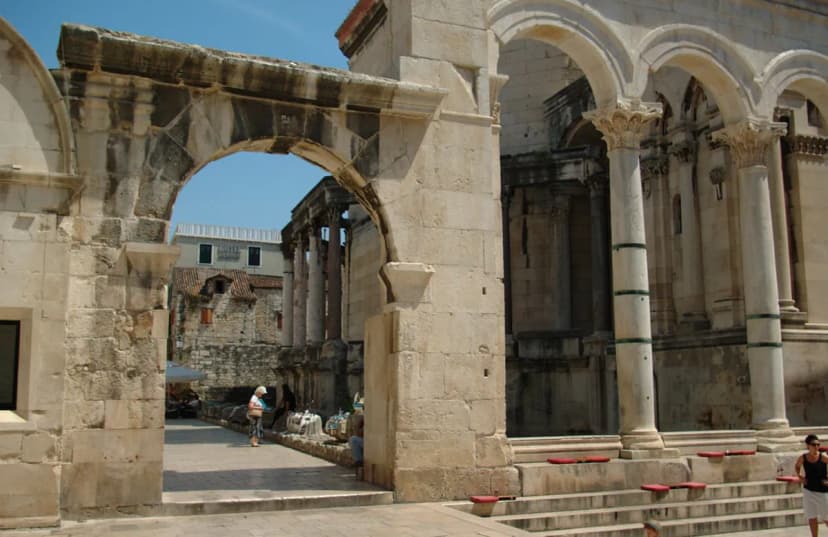
The Peristyle serves as the central square and the architectural heart of the entire palace complex. Towering granite columns and stone arches create a dramatic backdrop for public events and daily gatherings. The columns were imported from Egypt along with two black granite sphinxes — one remains intact near the entrance to the Cathedral, and it is over 3,500 years old, predating the palace itself by more than a millennium. This open-air courtyard once served as the formal entrance to the Emperor's private residential quarters and is still used for outdoor concerts and opera performances during the summer season.
The Cathedral of Saint Domnius is one of the oldest Catholic cathedrals in the world still in active use, and its origins are unlike any other. Built by Diocletian as his own mausoleum — an octagonal structure topped with a domed roof — it was consecrated as a Christian church in the 7th century, with bitter irony given that Diocletian had been one of history's most vigorous persecutors of Christians. The interior holds medieval choir stalls, a beautiful stone pulpit, and Roman-era relief carvings of Diocletian's face still visible in the frieze. Cathedral entrance costs €7 for the combined cathedral-and-tower ticket in 2026, which includes access to the treasury; the bell tower alone is €5. Both are open 8 AM–8 PM April through October.
The Cathedral's bell tower rises 57 metres above the Peristyle and was constructed between the 12th and 16th centuries in stages. Climbing its 183 steps rewards you with the finest panoramic views in the city — the red-tiled rooftops of Split spread in every direction, with the islands of Hvar and Brač visible on a clear day across the Adriatic. The climb is steep and the steps are narrow, but the view from the top is worth every effort. A standalone bell tower ticket costs €5 in 2026, or save with the combined cathedral-and-tower ticket at €7.
The Temple of Jupiter is a hidden gem tucked into a narrow lane just west of the Peristyle. This small but extraordinarily well-preserved Roman temple features a beautifully carved barrel-vaulted ceiling with deeply recessed stone coffers — one of the finest surviving examples of Roman decorative stonework in the Adriatic region. A headless black granite sphinx guards the entrance. Like the Cathedral, it was later Christianised and served as a baptistery, with a medieval stone font still in place inside. Admission is €4 in 2026, and many visitors overlook it entirely, making it one of the most peaceful spots in the palace.
The combined cathedral-and-tower ticket is €7 in 2026 and covers the Cathedral interior (treasury and crypt) plus the 57-metre bell tower — the best value for those wanting both. Jupiter's Temple is purchased separately for €4. All tickets are available at the booth on the Peristyle, with paid sites open 8 AM–8 PM April through October.
- The Golden Gate Entrance
- Location: Northern palace wall
- Significance: Imperial ceremonial entry; Grgur Ninski statue
- Cost: Free to walk through, 24 hours
- Tip: Best photo angle is from inside looking north
- Cathedral of Saint Domnius & Bell Tower
- Height: 57 metres, 183 steps
- Best for: Panoramic views + Roman mausoleum interior
- Cost: €7 combined cathedral+tower (or €5 tower only); open 8 AM–8 PM Apr–Oct
- Note: Very steep, narrow stairs to the top
- The Peristyle Square
- Activity: Coffee, photos, concerts, evening events
- Atmosphere: Historic and lively day and night
- Cost: Free public space
- Feature: Egyptian sphinxes over 3,500 years old
- Temple of Jupiter
- Location: Narrow lane west of Peristyle
- Best for: Finest Roman barrel-vault ceiling in Dalmatia
- Cost: €4 in 2026
- Tip: Easily missed — look for the sphinx outside
Navigating the Diocletian Palace Substructure
The substructures — locally called the cellars — are one of the most dramatic underground spaces in Europe and among the best-preserved Roman vaulted halls anywhere in the world. These underground chambers were designed to mirror the layout of the imperial apartments directly above them, with the same room divisions, the same corridors, and the same structural logic. Engineers built these massive vaulted halls partly to elevate the Emperor's living quarters above sea level and partly to provide the structural platform needed to support the enormous weight of the stone apartments above. What this means for visitors today is extraordinary: the underground plan is an almost perfect negative of the imperial residence that no longer exists above it.
Pop culture fans recognise these cellars immediately as a key filming location for Game of Thrones. The central vaulted hall served as the dragon pit where Daenerys Targaryen kept Rhaegal and Viserion in Season 3 and 4. The production team chose the space specifically for its atmosphere — the massive stone arches, the damp walls, and the darkness were perfect for the scene in which Daenerys locks her dragons away. You can walk through the exact hall used for filming, and a small exhibition nearby highlights Split's role in the production. If you are traveling on a Split 3-day itinerary, this stop is essential for fans of the show and non-fans alike.
The central portion of the cellars hosts a vibrant market filled with local artisan crafts. Vendors occupy the alcoves and side passages, selling handmade jewelry, stone carvings, lavender products, and traditional Croatian souvenirs in the cool Roman halls. This corridor functions as a natural shortcut between the Bronze Gate on the Riva promenade and the Peristyle above, so even if you are not shopping you will likely pass through it several times during your visit. The market vendors generally operate from around 9 AM to 8 PM in summer.
The deeper museum sections of the cellars require a paid admission ticket of €10 in 2026, which covers the eastern and western wings where the most archaeological material is displayed. These quieter wings offer a welcome break from the heat and the crowds of the upper streets. Informational plaques and display cases explain the function of each room, the archaeological findings uncovered during excavations in the 20th century, and the many different uses the spaces have served over the centuries — from a medieval rubbish dump to a salt warehouse to the cinematic dragon pit. Budget at least 45 minutes to fully explore the different wings of the underground complex at a relaxed pace.
Diocletian's Palace Self-Guided Tour Route: 4 Gates and Key Highlights
Following a logical route through the palace saves time, reduces backtracking, and ensures you do not miss the less obvious landmarks tucked into the residential quarter. The tour described below covers all four gates, the major monuments, and several hidden highlights in roughly two to three hours at an easy pace. You can extend it to a full half-day by adding the Underground Halls (Podrumi) and a bell tower climb. All palace streets are free; bring cash for monuments.
Start: Golden Gate (Porta Aurea) — Northern Wall. Begin at the Golden Gate on the northern wall, the grandest and most ceremonially significant of the four entrances. Arriving from Grgur Ninski Square, pause to study the two-storey arcade above the gate arch — the upper level originally housed soldier barracks during Diocletian's reign. Rub the great toe of Ivan Meštrović's famous bronze statue of Bishop Grgur Ninski, which stands just outside the gate; the tradition reportedly brings good luck. Step through the archway and you are immediately on the Cardo, the north-south main street of the Roman camp, heading toward the heart of the palace. The limestone beneath your feet is the original Roman paving, worn smooth by seventeen centuries of daily life.
Peristyle Square. The Cardo leads you directly into the Peristyle, the monumental ceremonial courtyard at the center of the palace. Six pink granite columns on the east and west sides frame the square, imported from Egypt along with the two black granite sphinxes nearby — one of which, still intact near the Cathedral steps, is over 3,500 years old. The Peristyle once served as the formal vestibule through which visitors approached the Emperor's private apartments; today it is a working public square where locals drink coffee at outdoor tables beside Roman columns. In summer, the Split Summer Festival holds outdoor opera and classical concerts here. This is the ticket booth hub: buy your combined cathedral-and-tower ticket (€7) or the Underground Halls ticket (€10) before heading inside the monuments.
Cathedral of Saint Domnius and Bell Tower. On the east side of the Peristyle stands the octagonal Cathedral, one of the world's oldest Catholic churches in continuous use — built as Diocletian's mausoleum, consecrated for Christian worship in the 7th century. Inside, look for the medieval carved wooden choir stalls dating from 1214, one of the finest examples of Romanesque woodcarving in Croatia, and the stone pulpit decorated with plaited relief patterns and a carved eagle lectern. Roman-era portrait reliefs on the upper frieze still depict Diocletian and his wife Prisca. The bell tower — accessible via a separate entrance at the base — rises 57 metres in 183 steep stone steps. The combined cathedral-and-tower ticket costs €7; the bell tower alone is €5. Both are open 8 AM–8 PM April through October.
Temple of Jupiter (Baptistery). Descend from the Peristyle and take the narrow lane heading west. Within thirty metres, look left for a headless black granite sphinx beside a low stone doorway — this marks the Temple of Jupiter, a remarkably intact Roman temple later repurposed as a Christian baptistery. The barrel-vaulted ceiling with deeply coffered stonework is considered the finest surviving Roman ceiling decoration in the entire Adriatic region. A medieval stone font remains inside where generations of Split residents were baptised. Admission is €4, open 8 AM–8 PM. Many visitors miss this monument entirely; that quiet is part of its appeal.
Vestibule. Return to the Peristyle and walk south through the central portal to reach the Vestibule, the circular domed foyer that once connected the public Peristyle to the Emperor's private apartments. The dome is now open to the sky — its Roman mosaics long gone — but the raw stonework of the circular drum and the massive corbelled cornice give a vivid sense of the original grandeur. Stand at the center and look straight up: the geometry is extraordinary. Local klapa singers often perform here in the evenings, using the natural reverb chamber to amplify their harmonies.
Iron Gate (Porta Ferrea) — Western Wall. Follow the Decumanus westward from the Peristyle and exit through the Iron Gate into People's Square (Pjaca), Split's main medieval public square. A Romanesque clocktower is integrated into the gate structure, added in the 15th century. The Town Hall loggia on the north side of the square dates from the same Venetian period. This gate was the commercial entrance to the palace in medieval times; the surrounding blocks still contain some of the oldest continuously inhabited buildings in the city.
Silver Gate (Porta Argentea) — Eastern Wall. Return along the Decumanus and exit east through the Silver Gate into the open-air morning market. Local vendors sell fresh produce, flowers, and seasonal ingredients here every morning from roughly 7 AM to 2 PM — an entirely authentic, non-tourist scene. The gate's original Roman stonework is partially visible above the medieval accretions on the outer face.
Bronze Gate (Porta Aenea) and Underground Halls (Podrumi). Walk south to the Riva promenade and enter through the Bronze Gate on the southern wall to descend into the Underground Halls (Podrumi). This entrance leads directly into the central vaulted corridor that runs beneath the former imperial apartments. The Podrumi ticket (€10, open 8 AM–8 PM Apr–Oct) grants access to the eastern and western wings with full archaeological displays. The central corridor — free to pass through — is lined with artisan craft stalls. Game of Thrones fans will recognise the main hall as the dragon pit from Seasons 3 and 4. Budget 45 minutes minimum for the full underground experience before emerging back onto the sun-lit Riva promenade. If you have more time in the region, consider one of the excellent day trips from Split to explore the nearby islands and Krka waterfalls.
Practical Tips for Your Palace Visit
The single most important piece of timing advice is this: arrive between 7 and 9 AM. Cruise ships dock in Split by mid-morning, typically from around 9:30 AM onward, and by noon the Peristyle and the main corridors become genuinely congested — dozens of tour groups moving through the narrow Roman lanes simultaneously. In the early morning those same streets are nearly empty. The limestone glows in the soft horizontal light, cafe chairs are being set out for the day, and local residents walk to the market through the Silver Gate exactly as they have done for generations. If you cannot manage a morning visit, late afternoon from around 5 PM onward is the next best window, when cruise passengers return to their ships and the heat begins to ease.
Comfortable, rubber-soled footwear is mandatory. The ancient limestone streets have been polished to a mirror finish by centuries of foot traffic, and they become dangerously slippery after rain or even heavy morning dew. Flip-flops and smooth leather soles are genuinely hazardous on the steeper sections. Sturdy walking shoes with grip allow you to explore the uneven terrain safely for three to five hours without difficulty.
For tickets in 2026, the combined cathedral-and-tower pass at €7 covers the Cathedral interior (treasury and crypt) plus the 57-metre bell tower — the best single-ticket value on site. The Underground Halls (Podrumi) cost €10 separately and are well worth it for the Game of Thrones filming locations and Roman engineering exhibits. The bell tower alone costs €5 if you only want the panoramic view. Jupiter's Temple costs €4. All paid monuments are open 8 AM–8 PM April through October; the palace streets themselves are free around the clock. The ticket booth sits directly on the Peristyle square. Guided tours lasting 60–90 minutes typically cost €15–25 per person and depart from the Peristyle; they add genuine depth by pointing out symbols and architectural details that are easy to walk past without explanation.
Staying hydrated is important during the summer months when temperatures inside the stone passages can exceed 30°C. Public drinking fountains provide fresh water near the Silver Gate and at several points along the Decumanus. Many small cafes around the Peristyle offer shaded outdoor seating where you can pause, cool down, and watch the city move around you. If you have additional days in the region, the day trips from Split to the islands of Hvar and Brač offer excellent contrast to the urban intensity of the palace.
- Ticketing Options (2026)
- Combined cathedral + bell tower: €7 (includes treasury and crypt)
- Bell tower only: €5 (183 steps, panoramic view)
- Underground Halls (Podrumi/cellars): €10
- Jupiter's Temple only: €4
- Palace streets: Free, 24 hours a day
- Paid sites open: 8 AM–8 PM April through October
- Best Photography Spots
- Spot 1: Peristyle steps at 7–8 AM (no crowds)
- Spot 2: Vestibule dome looking straight up
- Spot 3: Bell tower top for city panorama
- Spot 4: Golden Gate from inside, late afternoon light
Dining Inside the Palace Walls
Eating a meal inside Diocletian's Palace is one of the most atmospheric dining experiences in Croatia. Restaurants here occupy spaces that have functioned continuously since Roman times — vaulted stone rooms, candlelit courtyards, terraces overlooking medieval lanes. The palace has no shortage of places to eat, but the quality and price vary considerably depending on how close to the main tourist corridors you sit.
For the best value, seek out konobas — traditional Croatian taverns — in the northern half of the palace complex, away from the Peristyle. These family-run restaurants serve the Dalmatian staples: grilled fresh fish priced by the kilogram (typically €30–45/kg for sea bass or sea bream), peka-roasted lamb or octopus (slow-cooked under an iron bell lid, requires 24-hour advance order), black risotto with cuttlefish ink, and prstaci (date mussels in white wine). Main courses at a decent konoba typically run €15–25 in 2026.
On the higher end, several restaurants on and around the Peristyle have terrace seating directly overlooking the ancient columns. Expect to pay €25–40 for mains at these locations, but the setting during the evening — warm stone lit by soft lights, klapa singers performing in the Vestibule nearby — is genuinely extraordinary and worth the premium at least once during your stay.
For a quick and affordable option, the bakeries near the Iron Gate (western entrance) sell fresh burek — flaky pastry filled with meat or cheese — for around €2–3. The morning market just outside the Silver Gate (eastern entrance) offers fresh fruit, olives, local cheeses, and cured meats that make an excellent breakfast or picnic before exploring. Coffee at any of the Peristyle cafes costs €2–3 for an espresso, consistent with prices across Split's old town.
Wine is excellent throughout Dalmatia. The local white grape Pošip from the island of Korčula (around €25–35 a bottle in restaurants) pairs beautifully with seafood. The red grape Plavac Mali — a close relative of Zinfandel — is the dominant red of the region and works well with grilled meats. Most restaurants have a short but honest house wine option starting at around €12–15 per bottle. If you are planning to stay late and explore the city after dinner, the Split nightlife guide covers the best bars and clubs within and around the old town.
Hidden Corners and Local Secrets
The street named Pusti me da prodjem is famously known as the narrowest in the city. Its name translates to "Let me pass" because two people cannot walk through it simultaneously without turning sideways. Finding this tiny alley near the Temple of Jupiter is a fun challenge for many visitors and makes for a memorable photograph. It represents the dense, organic urban planning of the medieval era when residents carved new passages through the ancient Roman structure with whatever space they could find.
The Vestibule served as the grand circular foyer leading into the Emperor's private apartments. Looking straight up from the center of the circular room reveals a massive open oculus where the dome once featured glittering Roman mosaics — now long gone, but the quality of the stonework around the rim gives a sense of how magnificent it must have appeared. Local klapa groups often perform traditional a cappella singing here specifically because of the extraordinary acoustics. The circular geometry creates a natural reverb chamber that makes even a few voices sound like a choir. Hearing these haunting Croatian harmonies echo against the ancient stone walls is one of the most memorable experiences in Split.
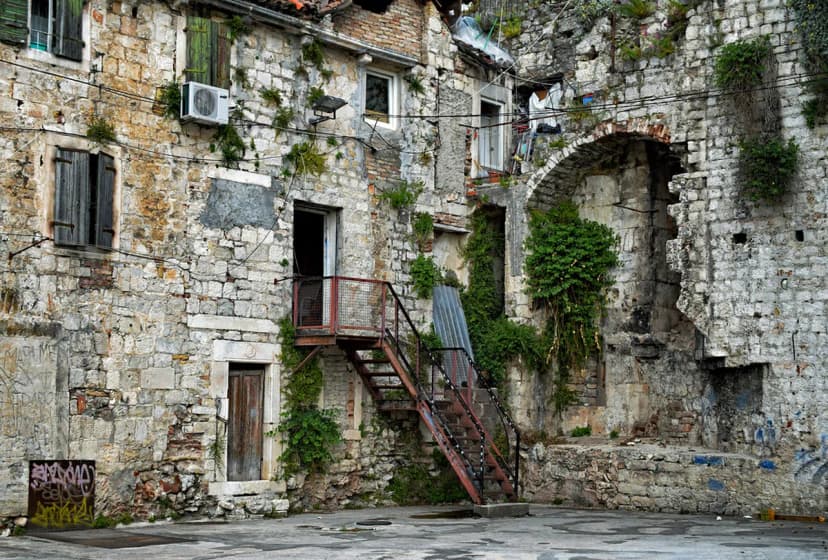
Many tourists rush between the Peristyle and the Golden Gate without exploring the residential courtyards tucked away behind the main thoroughfares. These quiet spaces — some barely wider than a doorway — often contain laundry hanging from medieval windows, a potted lemon tree wedged between Roman columns, or an elderly local sitting outside in the sun. Respecting the privacy of the residents is essential; these are genuinely people's homes, not stage sets. Walking slowly and quietly through these pockets gives you a glimpse of the authentic city life that has continued inside these walls for over thirteen centuries.
The view from the top of the Vestibule dome — accessed via a narrow staircase from a door on the southern side of the Peristyle — is far less known than the bell tower panorama but offers a completely different perspective. You stand at roughly the same level as the first-floor windows of the surrounding medieval buildings and look directly down into the circular space below while the rooftops of the old town spread around you. Ask locally or look for the discreet door; signage is minimal and many visitors never find it.
Frequently Asked Questions
Is there an entry fee for Diocletian's Palace?
The palace streets are free to enter 24 hours a day — all four gates (Golden, Silver, Iron, and Bronze) remain open around the clock with no admission charge. In 2026, the combined cathedral-and-tower ticket costs €7 (includes treasury, crypt, and 57-metre bell tower); the bell tower alone is €5. The Underground Halls (Podrumi) cost €10. Jupiter's Temple costs €4. Paid monuments are open 8 AM–8 PM April through October. Tickets are available at the booth on the Peristyle square.
What is the best time to visit Diocletian's Palace to avoid crowds?
The best time to visit is between 7 and 9 AM, before cruise ship passengers arrive. By mid-morning the Peristyle and main corridors become crowded with tour groups. Late afternoon from around 5 PM is also good, as day visitors begin to leave and the temperature drops. The palace is open 24 hours so even an evening stroll is worthwhile when the streets are quieter and dramatically lit.
Was Game of Thrones filmed inside Diocletian's Palace?
Yes. The Roman cellars beneath the palace served as the dragon pit where Daenerys Targaryen kept her dragons in Seasons 3 and 4 of Game of Thrones. The vaulted stone arches and atmospheric darkness made it an ideal filming location. The cellars are open to visitors with a €10 ticket in 2026, and a small exhibition highlights Split's role in the production.
How much time do I need to see Diocletian's Palace?
Allow three to five hours to see the main landmarks at a comfortable pace. This includes the Peristyle, Cathedral and bell tower, the cellars, and Jupiter's Temple, plus time for a coffee and browsing the artisan market underground. If you join a guided tour (60–90 minutes, typically €15–25 per person) and add lunch inside the palace, a full day is easy to fill.
Can you stay inside Diocletian's Palace?
Yes, several boutique hotels and privately rented apartments are located directly within the ancient Roman walls. Staying inside gives you the rare experience of exploring the palace after the day-trippers leave and the streets go quiet. Rates in 2026 range from around €80 per night for a simple apartment to over €200 for a boutique hotel room. Be aware that the palace can be noisy at night, especially on weekends in summer when the bars around the Peristyle stay open late.
Is Diocletian's Palace accessible for visitors with mobility issues?
The main squares including the Peristyle are accessible, and the Bronze Gate entrance from the Riva promenade is relatively level. However, many of the narrow medieval alleys have steps and heavily uneven limestone paving that is challenging for wheelchairs or walkers. The bell tower is not accessible (183 steep steps). The cellars offer a partially accessible route via the main corridor from the Bronze Gate. Visitors with mobility limitations should plan a route in advance and focus on the Peristyle, Vestibule, and the central cellar corridor.
What is the best route to see all four gates of Diocletian's Palace?
The most logical self-guided route enters through the Golden Gate (north), walks the Cardo south to the Peristyle, visits the Cathedral and bell tower (€7 combined), then takes the lane west to Jupiter's Temple (€4). From there, cross the Decumanus to exit through the Iron Gate (west) into People's Square, then return east along the Decumanus to exit through the Silver Gate (east) to the morning market. Finally, walk south to the Riva and enter through the Bronze Gate (south) to descend into the Underground Halls (€10). This loop takes two to three hours and covers all major monuments without doubling back.
Diocletian's Palace remains the crown jewel of Split and a testament to Roman architectural brilliance that few sites in Europe can match. Unlike a museum or a reconstructed ruin, this palace is genuinely alive — people wake up here every morning, hang laundry between Roman columns, and serve coffee in the shadow of stones placed seventeen centuries ago. Visiting this site offers a rare chance to see history not preserved behind glass but still in use, still inhabited, still evolving.
Whether you love ancient ruins, Croatian food and wine, Game of Thrones locations, or simply the pleasure of wandering beautiful streets without a fixed itinerary, the palace has something meaningful to offer. Come early, wear comfortable shoes, buy the combined ticket, climb the bell tower, and then let yourself get delightfully lost in the narrower lanes. The Split walking tour is an excellent companion to this guide if you want a structured route through the palace and surrounding old town. For those wanting to explore the wider region, the Split beach guide covers the best swimming spots within easy reach of the palace. Use this Split Diocletian Palace complete visitor guide to make the most of your 2026 visit to one of the Mediterranean's most extraordinary places.