Exploring the Historic Center: Your Bologna Old Town Guide (2026)
Bologna's old town covers roughly 2.5 km² of medieval streets anchored by Piazza Maggiore, sheltered by 38 km of UNESCO-listed porticoes, and reachable on foot from Bologna Centrale station in under 15 minutes at no entry cost.
In 2026, paid highlights include Asinelli Tower (€5, 498 steps), Palazzo d'Accursio art galleries (€6), Pinacoteca Nazionale (€8), and Museo di Palazzo Poggi (€5); Basilica di San Petronio, the Quadrilatero market, and all 38 km of porticoes are free.
Bologna is a city that captures the heart of every traveler who visits its ancient streets. Travelers call it the culinary capital of Italy for very good reasons, and the old town is where that reputation earns its keep. Our comprehensive bologna old town guide will help you find the best spots in this historic area.
Walking through the medieval streets feels like stepping back in time several centuries. Every corner reveals a new story or a hidden architectural treasure to admire. Red brick buildings and long porticoes define the unique character of this place, giving it a warm terracotta glow at sunset that photographers chase all year.
Planning your visit requires a bit of local knowledge to avoid the busiest crowds. This guide covers everything from massive basilicas to secret underground canals, with 2026 prices and hours so you can budget confidently before you arrive.
Exploring the Heart of Piazza Maggiore
Piazza Maggiore serves as the grand heart of the city center for locals and tourists alike. This square features some of the most impressive medieval buildings in all of Italy. Most visitors start their journey here to admire the massive Basilica di San Petronio, the fifth-largest church in the world by volume, which has been under construction since 1390 and remains unfinished to this day — a fact that only adds to its mystique.
The Fountain of Neptune stands proudly on the adjacent Piazza del Nettuno just a few steps away. Local legends say that students should not walk around the fountain before their exams. This bronze masterpiece was created by the Flemish sculptor Giambologna and completed in 1566. Standing 3.1 metres tall, the muscular Neptune is one of the finest examples of Mannerist bronze sculpture in Europe and one of Bologna's most photographed subjects.
Palazzo d'Accursio houses the city hall and several interesting art collections open to the public. In 2026, admission to the Collezioni Comunali d'Arte inside the palace is €6 for adults and €3 for concessions. The museum is open Tuesday to Sunday, 10:00–18:30, and closed on Mondays. You can climb the clock tower within the complex for a privileged view over the square, though access to the tower itself requires prior booking at the tourist office on the ground floor.
Basilica di San Petronio is free to enter, open daily 07:45–13:30 and 14:30–18:00. The main nave stretches 132 metres and the interior contains a famous sundial drawn across the marble floor — designed by Giovanni Domenico Cassini in 1655 and still accurate to this day. Plan at least 45 minutes to properly appreciate the frescoes, chapels, and the sheer scale of the structure.
In 2026, the city has expanded pedestrian zones around the square to reduce traffic and improve air quality. Via Rizzoli, the main street connecting the square to the Two Towers, is now fully pedestrianised seven days a week. These changes make walking between major landmarks safer and more pleasant. Arrive before 09:00 if you want the square to yourself for photography — by 10:30 tour groups begin arriving in numbers. The square hosts seasonal events including an outdoor Christmas market in December and a food festival in late September that fills every corner with local producers. Combining a visit here with a stroll to the university quarter makes for a full morning without any ticket fees.
- Basilica di San Petronio
- Type: Gothic church
- Hours: 07:45–13:30 and 14:30–18:00 daily
- Cost: Free entry
- Location: Piazza Maggiore
- Fountain of Neptune
- Type: Bronze statue
- Artist: Giambologna
- Built: 1566
- Cost: Free to view
- Palazzo d'Accursio Galleries
- Hours: Tue–Sun 10:00–18:30
- Adult ticket: €6 | Concession: €3
- Closed: Mondays
Climbing the Iconic Two Towers (Due Torri)
The Two Towers are the most famous symbols of the city skyline in northern Italy, and in 2026 they remain an unmissable part of any visit to the old town. Asinelli Tower is the taller of the two, standing at 97.2 metres, and remains open for climbers throughout the year. Its neighbour, Garisenda Tower, leans at a visible angle but is closed to the public for structural safety reasons — restoration scaffolding was still in place as of early 2026.
The entry fee to climb Asinelli Tower is €5 per person for adults in 2026, with children under 6 admitted free. Tickets must be booked in advance via the official Bologna Welcome portal — walk-in slots are rarely available during peak season (April to October). The tower is open Monday to Friday 10:00–18:00 and Saturday to Sunday 09:00–20:00. Last admission is 30 minutes before closing. Booking a morning slot between 09:00 and 11:00 gives you the best natural light for photographs of the terracotta rooftops stretching toward the Apennines.
The climb involves 498 wooden steps arranged inside a narrow spiral staircase. There is no elevator and no resting platform until near the top, so take it slowly and wear proper footwear with a grip sole. The ascent takes roughly 20–30 minutes for a moderately fit adult. The view from the top covers the entire historic centre, the hills of San Luca to the southwest, and on clear days extends toward the Po Valley and the Alps. Avoid climbing if you have mobility issues, heart conditions, or a strong fear of heights — the staircase is only about 60 cm wide in places.
At ground level, the towers are surrounded by a small pedestrian piazza with several cafes. A coffee at one of the benches here with the towers overhead costs around €1.50 for an espresso, making it one of the most atmospheric and affordable resting points in the city. The towers appear on virtually every postcard of Bologna and look particularly dramatic when lit from below after dark.
The Two Towers sit at the junction of Via Rizzoli and Strada Maggiore, roughly 400 metres east of Piazza Maggiore. If you want to see the towers as part of a structured itinerary, follow our Bologna 3-day itinerary for a day-by-day route that includes the towers, San Luca, and the Quadrilatero. Seeing the towers at sunset provides a magical warm-toned view of the city. Always check the weather forecast before purchasing your non-refundable tickets online. If you want to compare how Bologna's old town stacks up against another great Emilian city, read our Bologna vs Florence for a day trip comparison for practical travel tips.
Archiginnasio Library and the University Quarter
The Palazzo dell'Archiginnasio, just a two-minute walk south of Piazza Maggiore along Via dell'Archiginnasio, was the main seat of the University of Bologna from 1563 to 1803. Today it houses the Biblioteca Comunale dell'Archiginnasio — the city's central public library — and one of the most remarkable interiors in the old town: the Teatro Anatomico, a 17th-century anatomical theatre where medical students once watched cadaver dissections by candlelight. In 2026, entry to the anatomical theatre costs €3 per adult (€2 concessions), open Monday to Friday 10:00–18:00 and Saturday 10:00–14:00.
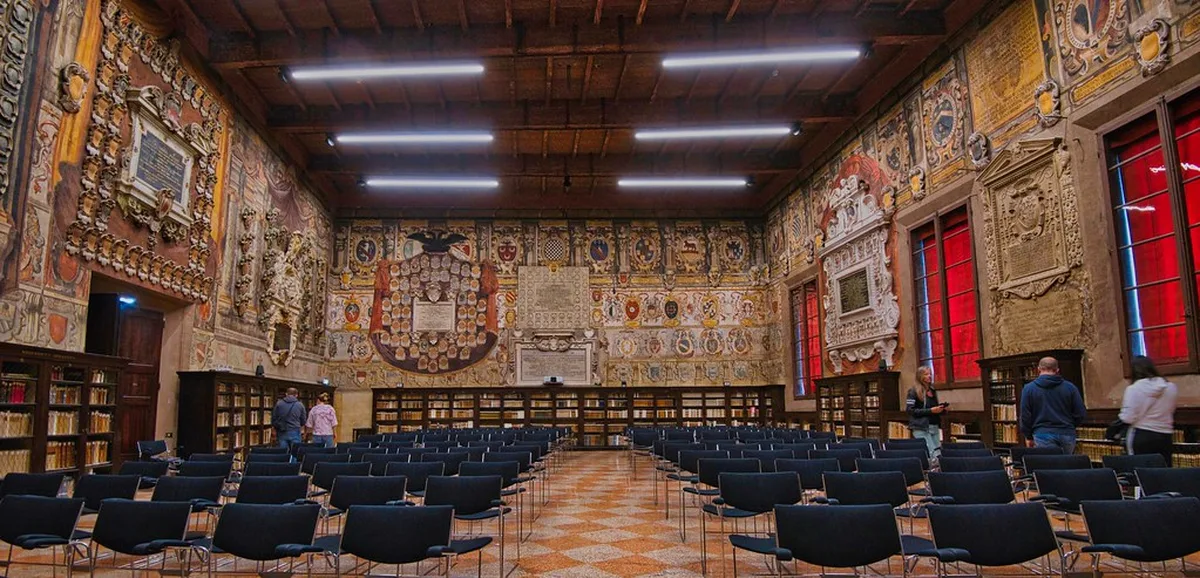
The building's exterior walls and internal courtyards are completely covered in coats of arms — over 6,000 carved shields representing the noble families and professors who studied or taught here across four centuries. This density of heraldic decoration is unmatched anywhere in Italy and gives the courtyard a visual richness that takes time to absorb properly. Entry to the main courtyard and library reading room is free; only the Teatro Anatomico charges admission. The library itself holds more than 900,000 volumes including illuminated medieval manuscripts and early printed books from the 15th century.
From the Archiginnasio, the university quarter extends northeast along Via Zamboni toward the main campus buildings. This area is one of the liveliest in the old town, populated by students, academics, and the cafes and bookshops that serve them. Via Zamboni 33 houses the main university administrative offices, and the street also contains the Teatro Comunale, Bologna's principal opera house, which stages productions from September to June with tickets typically ranging €20–80 depending on production and seat category.
The Museo di Palazzo Poggi at Via Zamboni 33 is one of the most underrated institutions in the entire city. It holds extraordinary scientific collections including 18th-century anatomical wax models used for medical teaching, Enlightenment-era natural history specimens, and some of the oldest preserved globes and navigation instruments in Europe. Entry is €5 (€3 concessions), open Monday to Friday 10:00–16:00 and weekends 10:00–18:00. Combine it with the Archiginnasio on the same half-day for an immersive dive into Bologna's intellectual history that most short-stay visitors completely miss.
The university quarter also contains the Orto Botanico dell'Università di Bologna on Via Irnerio, one of the oldest botanical gardens in Europe, established in 1568. Admission is €5 (€3 for students), open daily 09:00–13:00 and 14:00–18:00 from April to October and mornings only in winter. It is a quiet, photogenic escape from the bustle of the tourist centre, with centuries-old specimens of rare trees and a greenhouse dating from the 19th century. For a broader view of what to do across Bologna's neighbourhoods, our Bologna 3-day itinerary includes the university quarter as a dedicated half-day stop.
Using Your Bologna Old Town Guide for Dining
The Quadrilatero is the oldest market area in the heart of the historic city center, bounded by Via Rizzoli, Via Castiglione, Via Farini, and Via dell'Archiginnasio. This grid of narrow medieval streets has operated as a food market continuously for over 900 years. In 2026 it remains the single best place to experience Bologna's food culture in concentrated form. Streets like Via Pescherie Vecchie are packed with historic shops, fishmongers, and outdoor seating areas wedged between centuries-old portico columns.
You can smell fresh bread and cured meats as soon as you enter this district. Local vendors sell everything from handmade tortellini (€12–18 per 250 g) to aged Parmigiano-Reggiano (€18–26 per kg), balsamic vinegar from nearby Modena (€15–40 depending on age), and fresh mortadella sliced to order from enormous cylinders. Many shops offer vacuum-sealed packaging so you can transport delicacies safely in checked luggage. Expect to pay premium prices for high-quality goods in this tourist-friendly zone — but the quality justifies it.
Enjoy a classic Aperol Spritz at a terrace bar while watching the crowds pass by. Drinks typically cost €5–8 during aperitivo hour, which runs 18:00–20:00 most evenings. Many bars include a complimentary plate of olives, chips, and small bites with every drink order at no extra charge — this is the Bologna aperitivo tradition that local university students have refined over decades. For a full sit-down dinner, budget €25–40 per person including a glass of Sangiovese and a shared antipasto at a trattoria in the Quadrilatero.
The Mercato di Mezzo, a covered market inside the Quadrilatero, was restored in 2012 and now houses a street-food hall open daily 08:00–24:00. Stalls sell fresh pasta, arancini, craft beer, and local cheeses at counter seats for €8–15 per dish. It is more casual than the surrounding trattorias and perfect for a quick affordable lunch between sightseeing. For more tips on where to go after dinner, read our Bologna nightlife guide for top evening recommendations. The squares remain lively until midnight during the warm summer months, particularly around Via del Pratello to the west of the centre.
Walking Under the UNESCO Porticoes
Bologna is home to approximately 38 kilometres of covered walkways called porticoes — the largest such network of any city in the world. These architectural structures earned UNESCO World Heritage status in 2021, recognised as an outstanding example of an urban living tradition that has shaped the city for nearly 900 years. The porticoes provide shelter from the rain and shade during the hot summer months, turning the city into one of the most walkable in all of Italy regardless of the weather.
The longest single portico in the world leads up to the Sanctuary of the Madonna di San Luca on the Colle della Guardia hill southwest of the centre. This portico runs for 3.8 kilometres and passes through exactly 666 arches — a number that has attracted centuries of religious legend. The walk from Porta Saragozza, the starting point in the city walls, takes 60–90 minutes each way at a gentle pace. The sanctuary itself is open daily 07:00–12:30 and 14:30–19:00 and is free to enter, offering sweeping views across the city and toward the Apennine foothills.
Within the old town, the most architecturally varied porticoes run along Via dell'Indipendenza (from the station to Piazza Maggiore), Strada Maggiore (lined with medieval and Renaissance palaces), and Via Zamboni (in the university quarter). The porticoes along Via Zamboni were built partly by noble families as status symbols, each column decorated in a slightly different style to reflect individual wealth and taste. Walking the full length of Strada Maggiore from Piazza Maggiore to Porta Mazzini takes about 25 minutes and passes some of the finest private palaces in the city.
Walking these paths is one of the best free activities in the historic centre. Many locals use these routes for their daily morning exercise — the city even has an informal running community that uses the San Luca portico for weekend long runs. You will find different arch styles depending on the century of construction: wooden projections from the 12th century, stone arches from the 13th–15th century, and brick-faced colonnades from the Baroque period. The floor surfaces vary too — smooth flagstone in the centre, worn cobblestones near the university, and terracotta tile near residential streets. Wear comfortable walking shoes with ankle support because the uneven surfaces can be tricky after rain. If you plan to explore the surrounding region by train after walking the porticoes, our day trips from Bologna guide covers the best short excursions reachable in under 90 minutes.
Museums, Galleries, and Cultural Highlights
Bologna has one of the densest concentrations of museums in northern Italy, many of them clustered along the University of Bologna campus — the oldest continuously operating university in the world, founded in 1088. The university quarter along Via Zamboni is walkable from Piazza Maggiore in about 12 minutes and contains several museums that are easy to miss without a map.
The Museo Civico Medievale on Via Manzoni 4 holds an outstanding collection of medieval armour, sculpture, and decorative arts from 12th–16th century Bologna. Adult entry is €6, concessions €3, and the museum is open Tuesday to Sunday 10:00–18:30. Inside, highlights include bronze tombs of medieval professors, Gothic stained glass, and an ivory chess set dating from the 13th century. Allow 90 minutes for a thorough visit.
The Pinacoteca Nazionale (National Picture Gallery) on Via Belle Arti 56 houses the finest collection of Bolognese painting from the 13th to 18th century, including major works by Guido Reni, Annibale Carracci, and Francia. Admission in 2026 is €8 for adults, with EU citizens aged 18–25 paying €2, and under-18s admitted free. Opening hours are Tuesday to Sunday 09:00–19:00. The gallery underwent partial renovation in 2024 and several new rooms covering Carracci's work reopened in early 2026.
The Museo di Palazzo Poggi, run by the University of Bologna, holds extraordinary scientific collections including anatomical wax models used for 18th-century medical teaching, historic maps of the world, and natural history specimens collected during Enlightenment-era expeditions. Entry is €5 (€3 concessions), open Monday to Friday 10:00–16:00 and weekends 10:00–18:00. This is one of the most underrated museums in the entire city and rarely crowded even in peak season.
For visitors on a tight budget, the first Sunday of each month offers free entry to all civic museums in Bologna, including the Collezioni Comunali d'Arte in Palazzo d'Accursio and the Museo Civico Medievale. Arrive early as queues form by 10:30. The free Sunday policy is confirmed for 2026 under the national MiC (Ministry of Culture) programme. Visitors who want to explore the nightlife scene after a day of museum-hopping will find useful venue recommendations in our Bologna nightlife guide.
Hidden Secrets and Local Mistakes to Avoid
Driving into the historic center is restricted by the ZTL (Zona a Traffico Limitato) regulations for most vehicles. Automated cameras monitor every entrance gate and will trigger fines of €80–160 for unauthorized vehicles entering the zone between 07:00 and 20:00 on weekdays, and 07:00–14:00 on Saturdays. The restricted zone covers virtually the entire area inside the medieval city walls. Check the official city map and your hotel's instructions before attempting to drive into the centre.
Look for parking garages located just outside the main city walls for easier and cheaper access. Prices range from €2–4 per hour in most car parks, or €12–18 per day in the larger facilities near Porta Saragozza, Porta San Felice, and the FICO Eataly World complex to the east. For a full breakdown of options, read our guide to parking in Bologna before you arrive by car.
One secret that most tourists skip is the whispering gallery beneath the Podestà Palace. Stand in opposite diagonal corners of the ground-floor loggia and speak softly — the curved vaulted ceiling carries sound across 30 metres so clearly that your companion hears you as if standing next to them. This acoustic trick dates from the medieval period and was reputedly used for private confessions among dignitaries. The loggia is open during business hours at no cost.
Another hidden gem is the underground canal system that runs beneath the city. A small viewing window at Via Piella 16 (the so-called "Little Venice of Bologna") offers a glimpse of a medieval canal still flowing below street level. The canals once powered dozens of silk mills and dye works that made Bologna one of the wealthiest cities in medieval Europe. The view through the window is free and best appreciated in morning light before crowds arrive.
A common mistake is failing to book popular restaurants for weekend dinners in advance. Locals eat late — the best spots fill up quickly between 20:00 and 21:30. Call ahead or use the TheFork (LaFourchette) app to secure a table. Expect to pay €30–50 per person for a three-course dinner with wine at a mid-range trattoria in the centre. Budget-conscious visitors should eat lunch instead — the same restaurants often offer a fixed-price lunch (pranzo fisso) for €12–16 including a primo, secondo, water, and coffee.
Frequently Asked Questions
Is Bologna safe for tourists walking in the old town?
Bologna is generally very safe for tourists during the day and night. Standard precautions against pickpockets apply in crowded market areas like the Quadrilatero and around Piazza Maggiore, particularly in summer. The old town is well-lit and busy with locals until late evening, which naturally deters crime. Violent incidents directed at tourists are extremely rare. The area around Via Zamboni near the university is lively until 01:00 on weekends with a large student population. You can read more in our dedicated guide on is Bologna safe for tourists for detailed neighbourhood-level tips.
When is the best time to visit the Bologna old town?
Spring and autumn offer the most comfortable weather for walking under the porticoes and exploring Piazza Maggiore. April, May, and September are ideal months with temperatures ranging 15–22°C and many outdoor events including local food festivals. Summer (July–August) can reach 35°C with high humidity, making the shaded porticoes valuable but outdoor sightseeing tiring by midday. Winter brings regular fog and cold that can limit outdoor enjoyment but also means far fewer tourists at landmarks like Asinelli Tower (€5). The Christmas period (December) is charming with seasonal markets in Piazza Maggiore but draws large crowds on weekends.
How many days do I need in the Bologna historic center?
Two full days are enough to see the main landmarks — Piazza Maggiore, Basilica di San Petronio (free), Asinelli Tower (€5, 498 steps), the Quadrilatero market (free), and the Archiginnasio Teatro Anatomico (€3). If you want to hike the San Luca portico (3.8 km, 666 arches) and visit the Pinacoteca Nazionale (€8) or Museo Civico Medievale (€6), plan for three days. Three days also allows for a half-day day trip to Modena or Ferrara by train, both reachable in under 30 minutes from Bologna Centrale.
Can I reach the old town easily from the train station?
Bologna Centrale station is only a 15-minute walk from Piazza Maggiore — roughly 1.2 km in a straight line along Via dell'Indipendenza, a wide boulevard covered by porticoes the entire way. You stay completely dry even if it rains. Local bus lines 11, 14, 25, and 27 also connect the station to the centre in about 8 minutes for €1.50 per ride (purchased before boarding). Taxis queue outside the north exit and charge a flat rate of €8–10 to Piazza Maggiore. There is no need to hire a car for the old town — the ZTL restriction would prevent you from entering the historic zone without a special permit anyway.
How much does it cost to visit Bologna's main attractions in 2026?
Many of Bologna's outdoor landmarks are free: Piazza Maggiore, Basilica di San Petronio, the Quadrilatero market, and all 38 km of porticoes cost nothing to enjoy. Paid highlights in 2026 include Asinelli Tower (€5), Archiginnasio Teatro Anatomico (€3), Palazzo d'Accursio galleries (€6), Museo Civico Medievale (€6), Pinacoteca Nazionale (€8), and Museo di Palazzo Poggi (€5). On the first Sunday of each month, all civic museums offer free admission under the national MiC scheme. Budget €25–50 per person for dinner at a mid-range trattoria including wine, or €12–16 for a fixed-price lunch (pranzo fisso) at the same restaurants.
Why are Bologna's porticoes a UNESCO World Heritage Site?
Bologna's porticoes were inscribed on the UNESCO World Heritage List in 2021 under the criterion of an "outstanding example of a type of building or architectural ensemble that illustrates a significant stage in human history." The city has 38 km of covered walkways — the longest network in the world — dating from the 12th century to the 20th century. The porticoes represent a continuous urban living tradition linking private buildings to public street life over nearly 900 years. The most celebrated section is the 3.8 km portico to the Sanctuary of Madonna di San Luca, which passes through 666 arches on a single unbroken climb to the hilltop sanctuary.
What is the Archiginnasio Teatro Anatomico and is it worth visiting?
The Teatro Anatomico inside the Palazzo dell'Archiginnasio is a 17th-century anatomical theatre where medical students once observed cadaver dissections by candlelight. It is one of the best-preserved examples of this type of room in the world, with elaborately carved wooden galleries, a canopy of sculpted figures representing the faculties of medicine, and the original lecturer's chair. In 2026 it costs €3 per adult (€2 concessions) to enter and is open Monday to Friday 10:00–18:00 and Saturday 10:00–14:00. It is worth visiting for anyone interested in the history of science, medicine, or Baroque interior design — and is rarely crowded even during peak tourist season.
Bologna offers a unique mix of medieval history and modern Italian life that is hard to find elsewhere. Following this bologna old town guide will ensure you see the most important sites — from Piazza Maggiore and Asinelli Tower to the Archiginnasio and the UNESCO porticoes — while eating the best food in Emilia-Romagna. Remember to take your time and enjoy the slow pace of the local culture — the city rewards those who wander without a rigid schedule.
If you have extra time, there are many wonderful day trips from Bologna to nearby cities like Modena or Parma. These locations are easily reachable by train in under an hour from the central station. Exploring the wider Emilia-Romagna region adds even more depth to your Italian vacation experience. If you are deciding between Bologna and another Italian city for a quick visit, our Bologna vs Florence for a day trip guide helps you make the right choice based on your interests and travel style.
Stay updated with more travel tips and destination guides by visiting our main Italy hub for the latest articles. Bologna is waiting to welcome you with its warm terracotta colors, world-class food, and 900 years of architectural history.