Ultimate Girona Walking Tour Guide 2026: Medieval Magic on Foot
A self-guided Girona walking tour starts at Pont de Pedra and takes about 2 hours; the Colorful Houses and City Walls are free, the Cathedral costs €7, and the Arab Baths cost €4.50 — total budget €12–15.
The classic route covers the Colorful Houses (free), Cathedral (€7, 86 steps), Arab Baths (€4.50), and Roman City Walls (free) in a compact 2-hour loop starting and finishing at Pont de Pedra.
Girona stands as one of the most enchanting cities in Spain for travelers who love exploring on foot. The compact city center makes a walking tour the perfect way to see centuries of history in one afternoon. You will find Roman ruins, medieval walls, and colorful riverfront houses all within a short distance of each other. Planning your route carefully ensures you see the most famous landmarks without missing the hidden local gems that only locals know about.
Many visitors arrive from Barcelona for a quick trip, but the city deserves a deep and slow exploration. Wandering through the narrow stone alleys reveals a unique atmosphere that feels like stepping back in time by at least five centuries. This guide provides the essential details you need to navigate the steep stairs and historic corridors effectively, with 2026 admission prices in EUR, travel distances, and timing for every stop. Prepare your walking shoes for an unforgettable journey through the heart of Catalonia's medieval treasure.
Essential Landmarks for Your Girona Walking Tour
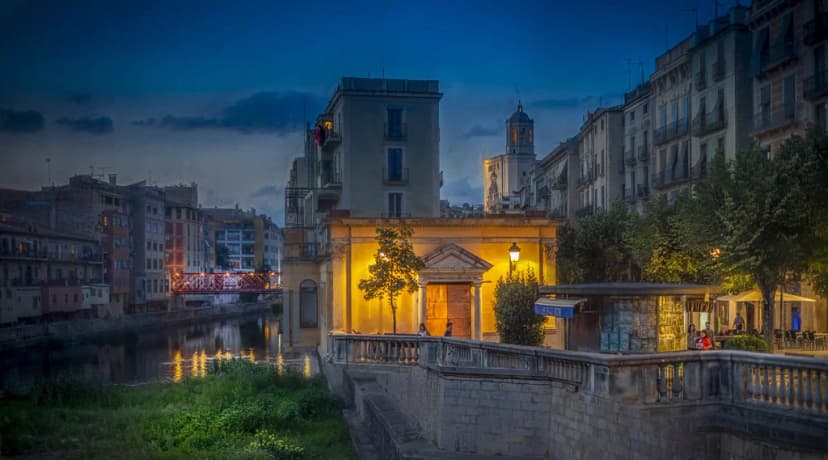
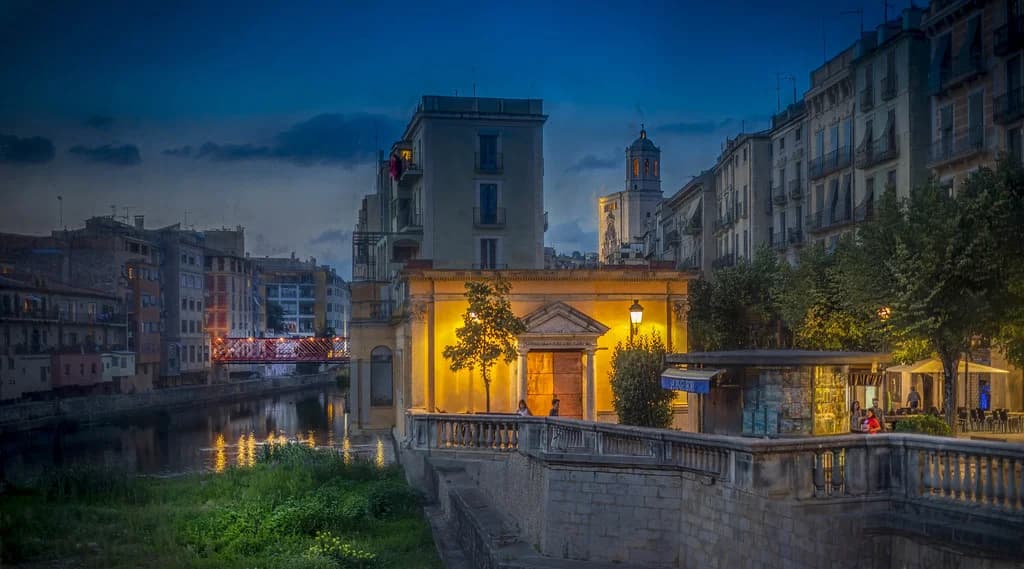
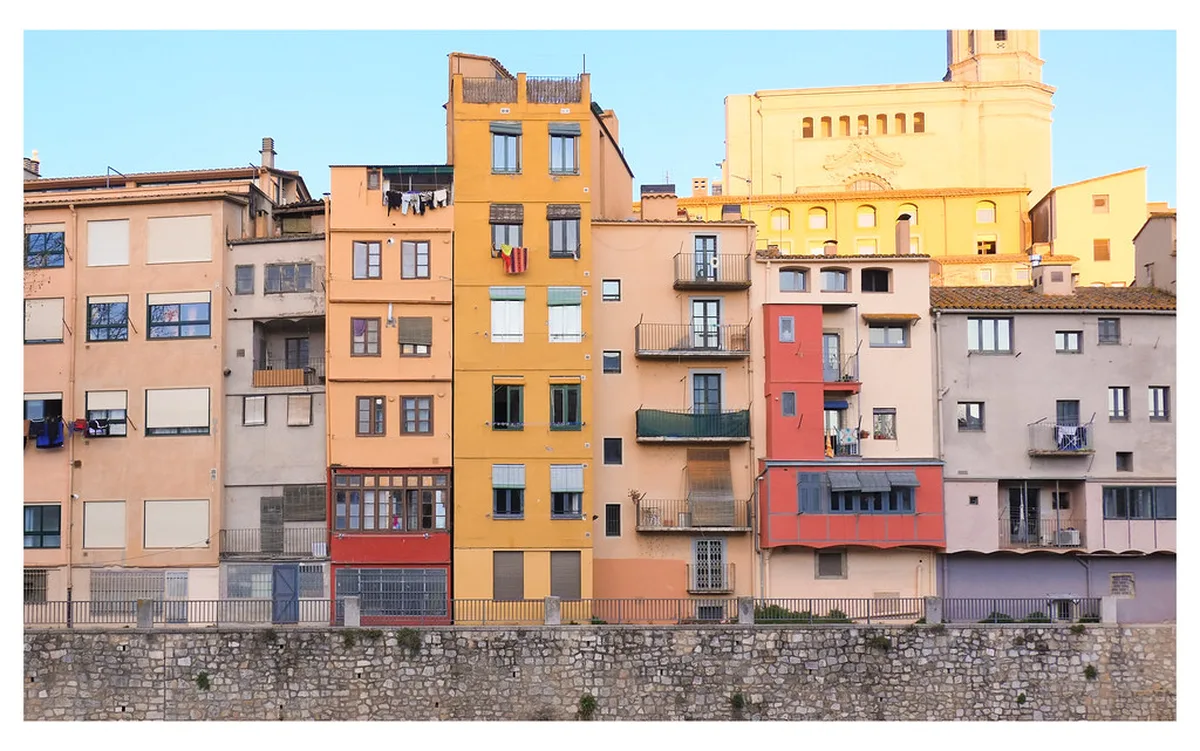
The best way to start your journey is at the Pont de les Peixateries Velles, also known as the Eiffel Bridge, right in the heart of the modern city. Gustave Eiffel designed this red iron structure in 1877, just a decade before he built his famous tower in Paris, and the structural DNA of both projects is immediately recognizable when you stand on it. From this vantage point, you can photograph the iconic hanging houses that line the Onyar River, a scene that appears on virtually every postcard sold in the city. These buildings feature bright shades of yellow, orange, and red that reflect beautifully on the water surface, especially in the golden light of early morning or late afternoon.
After crossing the bridge, follow Carrer de la Força north for about 300 metres to reach the base of the Girona Cathedral and its legendary staircase of 86 stone steps. The cathedral's Gothic nave is officially the widest single-nave Gothic structure in the world at 22.98 metres — wider even than the nave at Notre-Dame de Paris — and the interior produces an extraordinary sense of soaring, unified space. Admission in 2026 costs €7 for adults, which includes a well-produced audio guide available in ten languages; children under 16 enter free. Allow at least 45 minutes inside to properly admire the Romanesque cloister, the Treasury's stunning Tapestry of Creation, and the tomb of Ramón Berenguer II.
From the Cathedral, head north along the city wall footpath for approximately 200 metres to reach the Passeig de la Muralla entry point. Walking along these restored Roman and medieval ramparts offers panoramic views of the city skyline, the terracotta rooftops of the Old Town, and the distant Pyrenees mountains on clear days. Access to the walls is completely free and entry points are signposted throughout the Old Town. Expect to spend at least 40–50 minutes walking the full 1.9 km circuit of surviving wall sections, with frequent viewpoint platforms spaced every 150 metres or so.
Continue south along the walls toward the Torre Gironella, the highest defensive tower in the complex, which sits at the northeastern corner of the fortification. This 12th-century cylindrical tower once formed part of the city's Carolingian defensive perimeter and is surrounded by small terraced gardens where locals picnic in the evenings. The descent back into the Old Town from the tower takes you down a steep stone staircase that deposits you near the Col·legiata de Sant Feliu, Girona's second most important church. Entry to Sant Feliu costs €4 and reveals a remarkable collection of Roman sarcophagi reused as Christian altars in the nave.
- Eiffel Bridge (Pont de les Peixateries Velles)
- Type: Historic iron bridge, 1877
- Best for: River views, hanging house photography
- Where: Onyar River, central Girona
- Cost: Free access at all hours
- Girona Cathedral Interior
- Type: Gothic religious site, widest Gothic nave in the world
- Best for: Architecture, Treasury tapestry
- Where: Plaça de la Catedral (top of 86 steps)
- Cost: €7 adults, children free; audio guide included
- Roman Walls (Passeig de la Muralla)
- Type: Roman and medieval fortification, 1.9 km circuit
- Best for: City panoramas, Pyrenees views
- Where: Multiple entry points around the Old Town perimeter
- Cost: Free
- Col·legiata de Sant Feliu
- Type: Romanesque-Gothic church with Roman sarcophagi
- Best for: History, quiet atmosphere away from crowds
- Where: Plaça de Sant Feliu, directly below the Cathedral
- Cost: €4
Exploring the Historic Jewish Quarter and Medieval Alleys
The Jewish Quarter, known locally as El Call, remains one of the best-preserved medieval Jewish neighborhoods in all of Europe, comparable in historical integrity to the calls of Toledo and Barcelona but far less crowded. The quarter existed from the 9th century until the expulsion of the Jewish community from Spain in 1492, and the warren of streets it occupies has changed remarkably little in the intervening five centuries. Walking these narrow stone paths requires sturdy, closed-toe shoes with a firm grip because the medieval cobbles are often uneven, polished smooth by centuries of foot traffic, and particularly slippery after rain.
Enter El Call from Carrer de la Força, the main street of the Roman city (it once formed part of the Via Augusta connecting Rome to Cadiz), and look for the narrow alley of Carrer de les Calderers branching to the left. This passage runs through the heart of the old quarter and connects several internal courtyards that once served as communal gathering spaces. Continue deeper into the labyrinth toward Carrer del Bonastrug de Porta, which is named after a 13th-century rabbi and Kabbalistic scholar who was born in this very quarter — one of the most important figures in medieval Jewish philosophy.
Make sure to stop at the Museum of Jewish History (Museu d'Història dels Jueus) located at Carrer de la Força 8, right in the heart of El Call. This museum occupies the site of a medieval synagogue complex and displays an extraordinary collection of Hebrew inscriptions, ritual objects, and archaeological finds from Girona's Jewish community. General admission in 2026 is €4, though the museum is free on the first Sunday of each month and throughout the week for visitors aged under 16. Budget at least 45 minutes for the exhibition, which covers everything from Kabbalistic manuscripts to the architectural remains discovered beneath the building during restoration works.
After the museum, climb the steep Pujada de Sant Domènec staircase, a beloved photogenic lane that connects El Call to the upper city. The staircase is lined with medieval stone walls draped in seasonal climbing plants and provides a natural corridor between the Jewish Quarter and the Dominican convent complex above. Look for the small metal plaques embedded in the pavement and walls that mark the boundaries and key sites of the historic Jewish district — an open-air interpretation trail that is completely free to follow. Early morning visits, before 09:30, offer the best chance to experience these streets in peaceful solitude before the afternoon tour groups arrive from Barcelona and Figueres.
The Arab Baths (Banys Àrabs), accessible via Carrer del Rei En Ferran, sit just outside the edge of El Call and provide another 30 minutes of fascinating exploration. Built in the 12th century in the Romanesque style but clearly inspired by Islamic hammam architecture, the baths feature a remarkable central room with a small octagonal pool topped by a delicate skylight supported on slender columns. Admission is €4.50 in 2026. Despite the "Arab" name, the baths were built by Christian craftsmen and likely served the local nobility rather than a Muslim community. Directly adjacent to the Arab Baths, the Monastery of Sant Pere de Galligants houses the Archaeological Museum of Catalonia's Girona branch — admission €4.50, rich in Roman mosaics and medieval stonework, worth 30 minutes of your time. For more context on navigating the Old Town on foot, see our Girona Old Town guide.
Game of Thrones Filming Locations in Girona
Fans of the hit television series will recognize many corners of Girona from the sixth season, filmed here in September 2015. The production team chose the city specifically because its intact medieval fabric could convincingly portray multiple fictional cities within a single day's shooting, eliminating the need for expensive set construction. The result is that Game of Thrones effectively became Girona's most powerful marketing campaign, generating international interest that the city continues to benefit from in 2026.
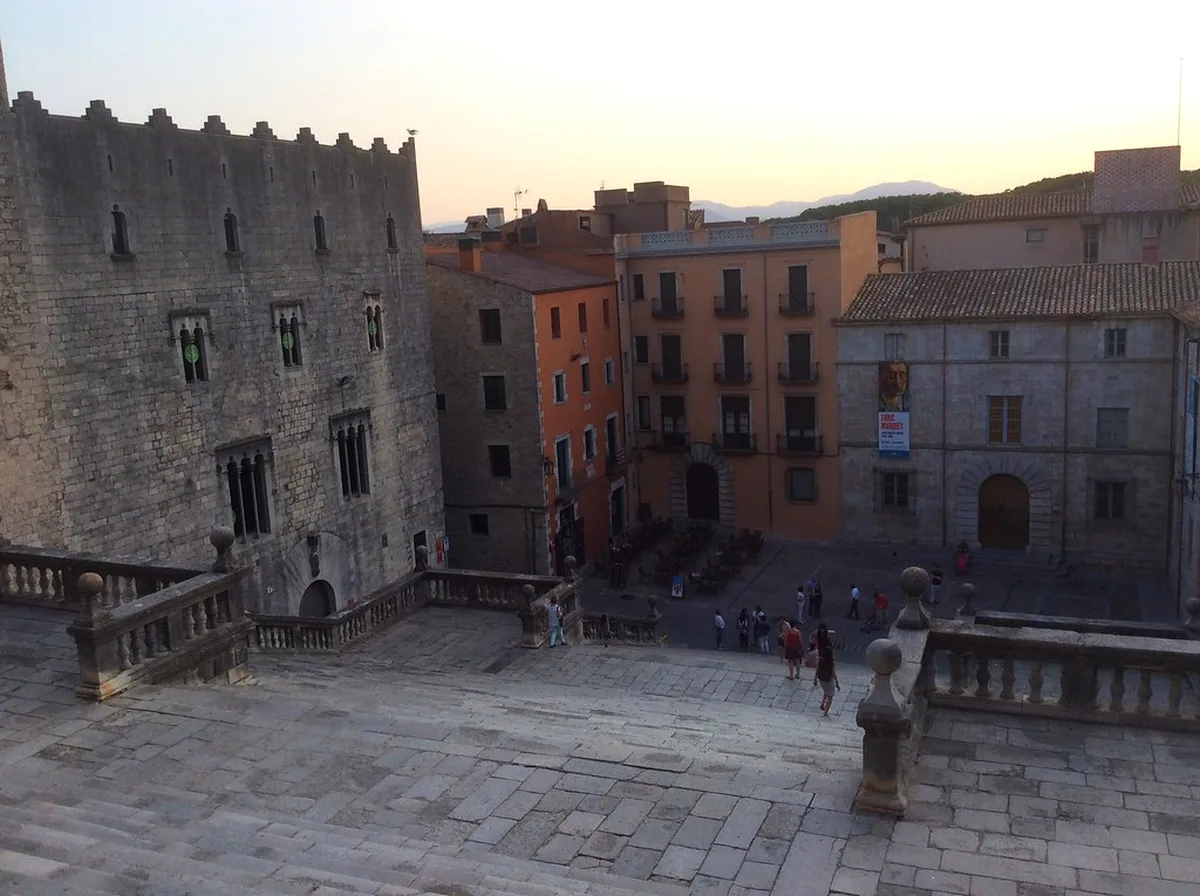
The grand staircase of the Girona Cathedral, with its 86 steps, served as the exterior of the Great Sept of Baelor in King's Landing during Season 6, Episodes 6–10. The scene where Cersei and Jaime Lannister watch Margaery Tyrell's walk of shame was filmed from the terrace directly in front of the main portal. Access to the staircase is free at all hours, and standing at the bottom looking up gives you a genuine sense of the imposing visual grammar the show used to convey power and religion. The stairs face southwest, making early morning the best time for photography without harsh shadows.
The narrow streets of El Call — specifically Carrer de la Força and the alleyways branching off it — were transformed into the city of Braavos for Arya Stark's training sequences. The House of Black and White exterior was filmed at the Portal de Sobreportes, the Roman triumphal arch at the northern end of Carrer de la Força. Look for the stone bridge at the Pont de Sant Feliu, near the Galligants River, where a significant chase scene was filmed across the narrow stone span. The bridge is a 15-minute walk from El Call, north along the river path, and is completely free to visit.
The Arab Baths appeared as the healing pools of the Red Temple of Volantis in Season 6, Episode 5 ("The Door"). The central room's octagonal pool and surrounding stone columns translated convincingly into an exotic eastern setting. Entry costs €4.50 and many visitors report the connection between real architecture and fictional world-building makes the visit significantly more engaging than it might otherwise be. The Col·legiata de Sant Feliu, immediately below the Cathedral, also featured as a King's Landing backdrop in exterior establishing shots throughout the season.
Many local shops near Plaça de la Catedral sell Game of Thrones–themed maps (typically €2–3) that plot every confirmed filming location with GPS coordinates. The Tourist Office on Rambla de la Llibertat offers free printed location guides in English, Spanish, and Catalan. Local walking guides specializing in the Game of Thrones tour run 90-minute sessions for €15 per person, departing from Plaça de la Catedral at 11:00 and 16:00 daily from April through October 2026. Even non-fans will discover that the filming locations coincide almost perfectly with the most historically significant sites in the city, making the Game of Thrones route an efficient way to cover the highlights.
Practical Logistics for Your Girona Walking Route
The terrain in the Old Town is genuinely challenging: the historic center sits on a hillside, and most of the interesting sites require climbing steep stone staircases or navigating ramps with irregular surfaces. The ascent from the Onyar River level to the top of the Roman walls involves roughly 80 metres of elevation gain, equivalent to climbing an eight-story building. Wear comfortable closed-toe sneakers or light hiking shoes with rubber soles that grip damp stone; leather-soled shoes and flip-flops are genuinely dangerous on the polished medieval cobblestones, particularly after rainfall.
Bring a refillable water bottle — Girona's tap water is safe to drink and there are several public fountains with fresh drinking water marked on the free city map distributed by the Tourist Office. Public restrooms are limited in the historic center, so plan bathroom breaks around cafe stops. The terraces around Plaça de la Independència, a 10-minute walk south of the Cathedral on flat ground, offer numerous cafes with clean facilities; a coffee costs €1.50–2.00 and effectively purchases restroom access. The square itself is architecturally interesting — a 19th-century neoclassical arcade that provides welcome shade in summer.
If you visit between June and August, begin your walk before 10:00 AM to avoid peak heat. The stone buildings and narrow alleys act as heat traps in the afternoon, with temperatures in El Call regularly reaching 32–35°C on summer afternoons. The Roman walls offer some breeze but are almost entirely exposed to direct sun. A light hat and SPF 50 sunscreen are non-negotiable for summer visits to the wall circuit. Winter visitors (November through February) will find much smaller crowds and pleasantly cool temperatures around 10–15°C, ideal walking weather, though some smaller museums reduce their hours from January through March; always check official websites for 2026 seasonal schedules before you travel.
The Tourist Office is located on Rambla de la Llibertat 1, right next to the Pont de Pedra bridge on the eastern bank of the Onyar River. Staff speak English, French, Spanish, and Catalan, and the office stocks free city maps, walking route leaflets, and accommodation lists. Opening hours in 2026 are Monday–Friday 09:00–19:00, Saturday 09:00–14:00 and 15:00–19:00, Sunday 10:00–14:00. Luggage storage is available at Girona train station (approximately 800 metres south of the Old Town) for €5 per bag per day, a useful option for day-trippers arriving from Barcelona by train. The Girona–Barcelona intercity train takes approximately 38 minutes on the high-speed service and departs every 30 minutes throughout the day.
Choosing Between Guided and Self-Guided Tours
A self-guided Girona walking tour offers the ultimate flexibility for travelers who prefer to move at their own pace, backtrack to favorite spots, and linger without feeling rushed by a group schedule. A quality free printed guide or a downloaded offline map (Google Maps works well in the Old Town) costs nothing and covers all the main landmarks. The Tourist Office walking route leaflet, available free at Rambla de la Llibertat 1, maps a well-sequenced 3.5 km circuit that most visitors complete in 3–4 hours including stops. The main tradeoff with self-guiding is the absence of local context: many of the sites' most interesting historical layers are invisible without someone to explain them.
Joining a free walking tour is the most popular option among solo travelers and budget-conscious visitors in 2026. These tip-based tours depart daily from the Pont de Pedra at 10:00 and 16:00 (confirm current schedules at gironafreetour.com). The standard tour lasts approximately 2 hours and covers the Eiffel Bridge, Cathedral steps, El Call, and the Arab Baths. The recommended tip is €10–15 per person for a good guide; well-reviewed guides on this circuit often speak excellent English and include Game of Thrones anecdotes throughout. Group sizes typically range from 10 to 25 people, which is manageable in the narrower alleys.
Paid guided tours from licensed operators such as Girona Explorers (gironaexplorers.com) cost €15–22 per person for a standard 2-hour group session. These tours are capped at smaller group sizes (typically 8–12 people), include more detailed historical commentary, and often access sites — such as the Cathedral Treasury and the Museum of Jewish History — that free tour guides walk past without entering. Small-group tours also allow for more questions and a slower pace through El Call. Private tours for couples or families cost €80–120 for up to 4 people for a 2-hour customized session and are worth considering if your group has strong specific interests in Jewish history, Game of Thrones locations, or Catalan food culture.
Game of Thrones–specific walking tours run 90 minutes for €15 per person and are available April through October 2026 from Plaça de la Catedral. Food and market tours, which incorporate stops at the Mercat del Lleó (Girona's covered food market), run approximately 3 hours for €35–45 per person including tastings and are bookable through the Tourist Office. Booking any paid tour at least 48 hours in advance is strongly recommended for travel in May (Flower Festival season), July, and August when Girona is at peak tourist capacity and most tours sell out. For context on planning your broader time in the city, see our Girona Old Town guide and day trips from Girona for excursions to nearby Costa Brava beaches and Dalí sites.
Self-Guided Evening Walk: Cathedral, Walls, and Jewish Quarter by Night
Girona transforms after 19:00 in summer (after 17:00 in winter) as the day-trip crowds from Barcelona and the Costa Brava hotels return to their bases, leaving the Old Town to residents and overnight guests. An evening walking circuit is one of the best-kept secrets of the city and costs almost nothing beyond the optional nightcap. The golden and amber stone of the cathedral facade, illuminated against a deep blue twilight sky, is arguably the most beautiful sight the city offers — and it is free to stand on the staircase at any hour.
Start your evening walk at approximately 20:00 in summer (18:30 in winter) at the Pont de Pedra, the oldest surviving bridge in the city (1856), located 200 metres south of the Eiffel Bridge. The riverfront Onyar houses are lit from below at night, creating mirror-perfect reflections in the calm water. Walk north along the eastern bank of the Onyar for 400 metres, crossing each of the four historic bridges in sequence: Pont de Pedra, Pont del Carme, Pont de les Peixateries Velles (the Eiffel Bridge), and Pont de Sant Agustí. This river promenade is entirely flat and ideal for visitors with limited mobility who want to see the hanging houses without tackling the Old Town hills.
From the northern end of the river promenade, turn east into the Old Town via Carrer dels Ciutadans and climb the well-lit stone ramp toward Plaça de la Catedral. The staircase is illuminated at night and takes about 8 minutes at a leisurely pace. The Cathedral square is often nearly empty after 20:00, allowing you to stand at the top of the 86 steps in genuine solitude — the same vantage point that hundreds of Game of Thrones fans crowd during the day. The cathedral exterior is floodlit until 23:00, and the square has several stone benches where you can sit and take in the view at no cost.
Descend from the Cathedral via the northern staircase into El Call for the evening stretch of the walk. By 21:00 in summer the alleys of the Jewish Quarter are dramatically lit by wall-mounted lanterns that cast deep shadows across the stone walls, creating a completely different atmosphere from the daytime experience. The recommended evening route through El Call: Plaça dels Lledoners → Carrer de la Força (north) → Carrer de les Calderers → Pujada de Sant Domènec. This loop takes approximately 25 minutes and deposits you back near the Cathedral. End the walk with a glass of local Empordà wine (typically €4.50–5.50 per glass) at one of the wine bars on Carrer de la Força — Bar Espresso Girona and La Pepita are both well-regarded options open until midnight, with prices clearly displayed outside in EUR. For ideas on exploring further afield the next morning, see our Girona beach guide for the nearest Costa Brava beaches just 30 minutes away.
Complete Self-Guided Girona Walking Tour Route 2026
This step-by-step self-guided route covers the essential highlights of Girona Old Town in approximately 2 hours, starting and finishing at Pont de Pedra. The total walking distance is around 3 km, with a cumulative elevation gain of roughly 80 metres as you climb from river level up to the Cathedral and City Walls. Bring comfortable shoes, a full water bottle, and €12–15 in cash to cover all paid admissions on the route. Every numbered stop below includes the distance from the previous stop, the admission cost in EUR, and a recommended time allowance.
- Stop 1 — Pont de Pedra (Start, Free, 5 min): Begin at the oldest surviving bridge in Girona (1856), located at the eastern end of Rambla de la Llibertat. The view from here along the Onyar River frames the famous Colorful Houses — the yellow, orange, and red hanging buildings that are Girona's most-photographed image. Photography is best in morning light before 10:00. The Tourist Office is 50 metres to your right on Rambla de la Llibertat 1; pick up a free printed map before you start.
- Stop 2 — Colorful Houses / Pont de les Peixateries Velles (150 m, Free, 10 min): Walk 150 metres north along the riverbank to reach the Eiffel Bridge (Pont de les Peixateries Velles), which provides the best angle for photographing the Colorful Houses. Gustave Eiffel designed this red iron structure in 1877; the same engineer who built the Eiffel Tower in Paris. Stand at the centre of the bridge and look both north and south for the full riverfront panorama. Access is free at all hours.
- Stop 3 — Girona Cathedral (300 m from Pont de Pedra, €7, 45 min): Cross the Eiffel Bridge into the Old Town and follow Carrer de la Força north for 300 metres to the base of the Cathedral's 86 stone steps. The climb takes about 3 minutes and brings you to Plaça de la Catedral with sweeping views over the city. Admission in 2026 is €7 for adults (children under 16 free), which includes an audio guide in 10 languages. Inside, the Gothic nave is the widest single-nave Gothic structure in the world at 22.98 metres. Allow 45 minutes to see the Romanesque cloister, Tapestry of Creation in the Treasury, and the tomb of Ramón Berenguer II. This stop is also one of the main Game of Thrones filming locations — the 86 steps served as the Great Sept of Baelor in Season 6.
- Stop 4 — Roman City Walls / Passeig de la Muralla (200 m from Cathedral, Free, 40 min): From the Cathedral, walk 200 metres north to the signposted entry point for the Passeig de la Muralla, Girona's restored Roman and medieval ramparts. Walking the full 1.9 km circuit of surviving wall sections takes approximately 40–50 minutes at a leisurely pace. The walls are free to access at any time and provide panoramic views of the Old Town rooftops, the green Pyrenean foothills, and on clear days the snow-capped peaks beyond Olot. Viewpoint platforms are spaced every 150 metres. Descend from the walls via the Torre Gironella staircase in the northeast corner.
- Stop 5 — Arab Baths / Banys Àrabs (400 m from Walls exit, €4.50, 30 min): From the Torre Gironella descent, follow Carrer del Rei En Ferran south for 400 metres to the Arab Baths. Built in the 12th century, the baths feature a beautiful central chamber with an octagonal pool topped by a delicate skylight supported on slender columns. Despite the name, the baths were built by Christian craftsmen and served the local nobility. Admission is €4.50 in 2026. The baths are open Tuesday–Sunday 10:00–18:00 (closed Mondays). Next door, the Monastery of Sant Pere de Galligants houses the Archaeological Museum of Catalonia (€4.50, 30 min if interested in Roman mosaics and medieval stonework).
- Stop 6 — El Call Jewish Quarter (300 m from Arab Baths, Free walk / €4 museum, 30 min): Return south through Carrer de la Força into El Call, one of the best-preserved medieval Jewish quarters in Europe. Explore the narrow stone alleys of Carrer de les Calderers and Carrer del Bonastrug de Porta at your own pace — the walking is free. If time allows, stop at the Museum of Jewish History at Carrer de la Força 8 (admission €4, free first Sunday of the month). The museum displays Hebrew inscriptions, ritual objects, and archaeological remains from Girona's Jewish community, which existed here from the 9th century until the 1492 expulsion.
- Stop 7 — Pont de Pedra (Return, 400 m, Free): From the southern end of El Call, walk 400 metres south along Carrer de la Força back to the Onyar River and Pont de Pedra to complete the loop. Total walking distance: approximately 3 km. Total time including all stops: 2 hours. Total admission costs: Cathedral €7 + Arab Baths €4.50 = €11.50, or €12–15 with the Museum of Jewish History.
For a deeper exploration of the area around each stop on this route, our Girona Old Town guide covers the history, architecture, and insider tips for every neighborhood you pass through. If you plan to stay overnight after the walking tour, the Girona beach guide covers the Costa Brava beaches just 30 minutes from the city center — the perfect next-day excursion after your walking tour.
Frequently Asked Questions
How long does a typical Girona walking tour take?
A free walking tour covers the highlights in approximately 2 hours. A self-guided tour at a relaxed pace, including the Cathedral interior, Jewish Quarter, and Roman walls, takes 3–4 hours. If you add the Arab Baths and the Archaeological Museum, allow a full 5 hours. Evening-only walks along the river and through El Call take about 1.5 hours.
Is Girona walkable for people with limited mobility?
The Old Town is challenging for people with limited mobility due to steep staircases and uneven cobblestones — the Cathedral alone requires climbing 86 steps. The riverfront promenade between Pont de Pedra and Pont de Sant Agustí is completely flat and fully accessible. The lower sections of El Call near Carrer de la Força are also relatively manageable. The Girona Tourist Office on Rambla de la Llibertat can provide an accessibility-focused route map on request.
What should I wear for a walking tour in Girona?
Wear comfortable closed-toe walking shoes with rubber soles that grip wet stone — leather soles and flip-flops are genuinely hazardous on the medieval cobblestones, especially after rain. In summer (June–August) bring a hat, sunscreen SPF 50, and a refillable water bottle as the wall circuit is fully exposed to sun. In winter bring a light jacket as temperatures drop to 8–12°C in the evenings. A small daypack for a water bottle, sunscreen, and a camera is recommended.
How much does a Girona walking tour cost in 2026?
A self-guided walk using the free Tourist Office leaflet costs nothing beyond site admissions: Cathedral €7, Arab Baths €4.50, Museum of Jewish History €4, Sant Pere de Galligants €4.50. Free walking tours are tip-based; the standard tip is €10–15 per person. Guided group tours from licensed operators cost €15–22 per person. Private tours for up to 4 people cost €80–120. Game of Thrones specialist tours cost €15 per person.
What are the main Game of Thrones filming locations in Girona?
The Cathedral staircase (86 steps) served as the Great Sept of Baelor in King's Landing during Season 6. The Jewish Quarter streets — especially Carrer de la Força and the Portal de Sobreportes arch — were used for Arya's Braavos sequences. The Arab Baths appeared as the Red Temple of Volantis (Season 6, Episode 5). The Pont de Sant Feliu, over the Galligants River, was the site of a major chase scene. All locations except the Arab Baths are free to visit at any hour.
When is the best time of year to do a walking tour in Girona?
April, May, and October are ideal: temperatures are 16–22°C, crowds are manageable, and all sites are fully open. May hosts the Temps de Flors flower festival (usually the second or third week of the month) when the Old Town is decorated with elaborate floral installations — spectacular but very busy, so book guided tours weeks in advance. July and August are the hottest and most crowded months; if visiting then, start your walk before 10:00 AM. January and February offer solitude and cool walking weather but some smaller venues have reduced hours.
Are the Girona Colorful Houses free to see?
Yes, viewing the Girona Colorful Houses (the painted riverside buildings along the Onyar River) is completely free. The best viewpoint is from the Pont de les Peixateries Velles (Eiffel Bridge) or from Pont de Pedra. Both bridges are free to access at any hour. The Colorful Houses are most photogenic in morning light before 10:00 AM when the facades are directly lit and reflections in the river are calmest. There is no ticket or charge to walk along the riverbank promenades on either side of the Onyar.
What is the total budget for a 2-hour self-guided Girona walking tour?
A 2-hour self-guided Girona walking tour costs €12–15 per adult in 2026. The breakdown: Colorful Houses (free), Roman City Walls (free), Girona Cathedral (€7, includes audio guide), Arab Baths (€4.50). Optional additions that extend the budget: Museum of Jewish History (€4), Sant Pere de Galligants Archaeological Museum (€4.50), Col·legiata de Sant Feliu (€4). Children under 16 enter the Cathedral free. The first Sunday of each month, the Museum of Jewish History is free for all visitors.
Girona is a city that reveals its best secrets to those who explore it on foot, whether that means following a knowledgeable guide through the Jewish Quarter at midday or standing alone at the top of the Cathedral staircase at dusk. From the heights of the Roman walls to the lantern-lit depths of El Call after dark, every hour of the day offers a different and rewarding perspective. With free walking tour options from €10–15 in tips, guided sessions from €15–22, and a self-guided circuit that costs only the entry fees you choose to pay, the city is genuinely accessible to every budget. Use our Girona Old Town guide to plan the full Old Town experience and our day trips from Girona page to extend your Catalonia adventure. Enjoy your walk through this medieval masterpiece and soak in the unique atmosphere that makes Girona one of the most rewarding small cities in all of Spain.