Best Day Trips From Sarajevo in 2026: 9 Incredible Escapes
The top day trips from Sarajevo in 2026 are: Mostar (2.5h bus, 22 KM/€11 one-way), Travnik (1.5h bus, 12 KM/€6), Konjic (1h bus, 8 KM/€4), Bjelašnica ski resort (45min, ski/day pass 40 KM/€20), and Srebrenica Memorial (3h, guided tours 50–80 KM/€25–40). All major destinations depart from Sarajevo East bus station and require no advance booking outside peak summer.
Budget snapshot for 2026: A self-guided day trip by public bus costs 8–25 KM (€4–€12.50) one-way depending on distance. Entry fees are low — most fortresses and nature sites charge 3–12 KM (€1.50–€6). Organised guided tours covering transport plus entry range from 50–80 KM (€25–€40) per person. Always carry Bosnian convertible marks (KM); the fixed exchange rate is €1 = 1.96 KM.
Sarajevo serves as a perfect base for exploring the diverse landscapes of Bosnia and Herzegovina. The city is surrounded by rugged mountains, emerald rivers, and historical towns that are easily reachable within a few hours. Planning several day trips from Sarajevo allows you to see the full beauty of the Balkan region beyond the capital. Whether you crave mountain air or ancient stone bridges, these 2026 excursions offer something for every type of traveller.
Many visitors find that the country's compact size makes regional travel surprisingly efficient and affordable. You can transition from the bustling Ottoman streets of the capital to a quiet highland village in under two hours. Before heading out, explore the Sarajevo Old Town guide to round out your itinerary. Understanding the local transport nuances will help you maximise your time in this stunning corner of Europe.
Exploring Mostar: The Ultimate Day Trip From Sarajevo
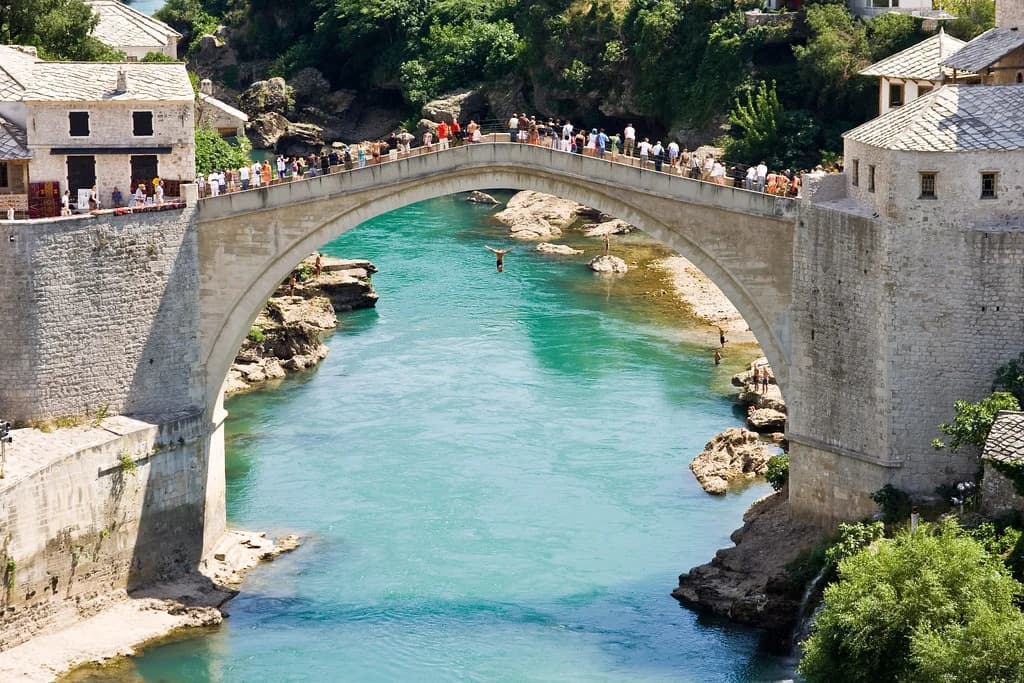
Mostar remains the most popular destination for travellers looking for day trips from Sarajevo. The city is famous for its iconic Stari Most, a reconstructed 16th-century Ottoman bridge that spans the Neretva River. Watching local divers leap from the bridge into the cold water below is a thrilling tradition that draws spectators from around the world. Walking through the cobbled streets of the Old Bazaar feels like stepping back into a different era entirely. In 2026, Mostar receives well over a million visitors per year, yet the old town retains an authentic local atmosphere in the early morning hours before the tour buses arrive.
The most reliable way to reach Mostar in 2026 is the direct bus from Sarajevo East bus station (Autobuska Stanica Sarajevo Istok). Buses depart several times daily, the journey takes approximately 2.5 hours, and a one-way ticket costs around 22 KM (€11). The return bus runs until late evening, making it easy to spend a full day in the city. If you prefer scenic views, the train from Sarajevo Main Station takes 2.5–3 hours and costs 12–15 KM (€6–€7.50) one-way, passing through dramatic mountain tunnels and lush river canyons — one of the most beautiful rail routes in the Balkans.
Once you arrive, head straight to the Koski Mehmed Pasha Mosque for the best panoramic views of the Old Bridge. Climbing the narrow minaret provides a perfect vantage point for photographing the bridge and surrounding hills — entry costs 12 KM (€6) in 2026. For the full Mostar experience, combine the Old Bridge area with the Old Bazaar (Kujundžiluk), where local artisans sell copper crafts, leather goods, and hand-painted plates. Early arrivals — before 9am — help you avoid the large tour groups that descend on the Old Town by midday.
Lunch in Mostar should involve traditional dishes like japrak (stuffed vine leaves) or grilled meats at a riverside terrace. Many restaurants offer direct views of the bridge, though these spots fill quickly in summer. Budget 15–25 KM (€7.50–€12.50) for a full sit-down lunch. Returning to the capital by late evening is straightforward via frequent bus and train connections, with the last buses departing Mostar around 6–7pm. For a deeper look at what to do on arrival, read the Mostar Old Town guide.
- By bus: Sarajevo East station → Mostar, 2.5h, 22 KM/€11 one-way
- By train: Sarajevo Main Station → Mostar, 2.5–3h, 12–15 KM/€6–€7.50 one-way (scenic)
- Mosque + minaret entry: 12 KM (€6)
- Stari Most diving: best observed 11am–4pm; tip the divers
- Lunch budget: 15–25 KM (€7.50–€12.50) per person
Vrelo Bosne: The Closest Nature Escape From Sarajevo
Vrelo Bosne is the ideal day trip for travellers who want nature without a long journey. Located just 12 km from Sarajevo city centre at the foot of Mount Igman, this protected nature park sits at the source of the Bosna River. Crystal-clear springs bubble up from the ground, feeding a series of streams and small lakes lined with weeping willows and plane trees. The park is free to enter and open year-round, making it one of the best-value excursions in Bosnia. Even on a grey winter morning the springs are remarkable — the water temperature stays constant at around 10°C throughout the year, giving the site an otherworldly steaming quality in cold weather.
Getting there from central Sarajevo is easy and inexpensive. Take Tram No. 3 from Baščaršija westward to the Ilidža terminus (about 25 minutes, standard tram fare of 1.80 KM/€0.90), then hop on a horse-drawn carriage along the tree-lined Aleja promenade to reach the springs (about 2 km, approximately 5 KM/€2.50 per person). Cyclists can also rent bikes near the tram stop and ride the flat path in under 15 minutes. Vrelo Bosne works perfectly as a morning trip before catching an afternoon bus to another destination, or as a relaxing final afternoon before a night flight home.
Inside the park, rent a paddleboat on the small lake (around 10 KM/€5 per 30 minutes) or simply stroll along the riverside boardwalks. A small Ottoman-era pavilion and a statue of Prometheus add cultural interest alongside the natural scenery. Several café-restaurants at the park entrance serve Bosnian coffee and grilled meats at local prices — expect to pay 3–5 KM (€1.50–€2.50) for a coffee and 12–18 KM (€6–€9) for a full grilled meal. Weekends draw Sarajevo families in large numbers, so visit on a weekday for a quieter experience. The total cost for the outing, including tram, carriage, and a coffee, runs to well under 20 KM (€10) per person.
- Distance from Sarajevo: 12 km
- Transport: Tram No. 3 (1.80 KM/€0.90) + horse carriage (5 KM/€2.50)
- Entry fee: Free
- Best for: Families, photographers, half-day trips
- Open: Year-round, dawn to dusk
Travnik: The Colourful Fortress Town
Travnik was once the capital of the Ottoman governors of Bosnia and still retains a regal historic atmosphere. The town sits 90 km northwest of Sarajevo and is easily reached by bus in about 1.5 hours. In 2026, a one-way bus ticket from Sarajevo costs approximately 12 KM (€6), with several departures daily from the main bus station. The journey passes through the fertile Lašva river valley, offering pleasant views of rural Bosnian countryside. The first bus from Sarajevo typically departs around 7am, giving you a full day before the last return service in the early evening.
The medieval Travnik Fortress is the town's centrepiece, perched on a rocky hill above the old quarter. Entry costs 5 KM (€2.50) and includes access to the ramparts and a small local history museum housed within the towers. The fortress is open daily from 8am to 8pm in summer and 9am to 5pm in winter. From the upper walls, you get sweeping views of the town's distinctive multi-coloured rooftops and numerous minarets — earning Travnik its nickname, the "City of Minarets." The fortress walls themselves date to the 14th century and were expanded significantly during Ottoman rule, creating a layered architectural story that unfolds as you explore the inner keep.
Below the fortress, the Plava Voda ("Blue Water") spring is one of the most photogenic spots in Bosnia. Icy blue water gushes directly out of the hillside and flows past a row of traditional trout restaurants. Order fresh river trout grilled to order for around 15–20 KM (€7.50–€10) — this is arguably the best lunch in central Bosnia. The spring area is free to visit and takes about 20 minutes to explore thoroughly. Combine your visit with a walk through the Šarena Džamija (Coloured Mosque), whose ornate interior is one of the finest examples of Ottoman decoration in the country.
Travnik also serves as the birthplace of Ivo Andrić, winner of the Nobel Prize for Literature. The Andrić house-museum (entry 3 KM/€1.50, open Tue–Sun 9am–5pm) is worth a visit for literature enthusiasts. A single day is sufficient to see all the main sights, with time left for a relaxed coffee in the old bazaar. The covered bazaar streets come alive in the late afternoon when school finishes and locals fill the tea houses and sweet shops.
- Distance: 90 km from Sarajevo
- Bus time: ~1.5h, 12 KM/€6 one-way from Sarajevo East station
- Fortress entry: 5 KM (€2.50), open 8am–8pm (summer)
- Andrić Museum: 3 KM (€1.50), open Tue–Sun 9am–5pm
- Lunch at Plava Voda: 15–20 KM (€7.50–€10)
Jajce: Waterfalls in the Heart of Bosnia
Jajce is one of the most uniquely spectacular destinations in the Balkans — a medieval walled town built around a 22-metre waterfall that flows directly into the Vrbas river at the centre of town. This phenomenon, where the Pliva river dramatically drops over a cliff into the Vrbas in the middle of an inhabited area, is virtually unique in Europe. The resulting roar of falling water echoes through the streets and the mist keeps the surrounding vegetation permanently lush and green. In 2026, Jajce is gaining recognition beyond Bosnia as one of the region's hidden gems, yet it remains far less crowded than Mostar for most of the year.
In 2026, direct buses from Sarajevo to Jajce depart from Sarajevo East bus station and take approximately 2.5 hours. The one-way fare is around 25 KM (€12.50). Several departures run each day, with the first bus leaving in the early morning around 7am. The route passes through Travnik, so it is possible to combine both towns in a single long day if you start early. Note that some services require a change at Travnik — confirm your connection at the ticket window before departure.
The Pliva Waterfall viewing platform sits at street level and the surrounding area is free to walk around. However, the best elevated viewpoint — above the falls looking down into the Vrbas canyon — requires entering Jajce Fortress, for which the entry fee is 3 KM (€1.50). The fortress is open daily 8am–8pm in summer and 9am–5pm in winter. The fortress itself is impressive: a largely intact medieval walled complex that served as the seat of the last Bosnian kings before the Ottoman conquest in 1463. Inside, the royal catacombs (originally a chapel converted to a tomb) are among the best-preserved medieval catacombs in the Western Balkans, with entry included in the fortress ticket.
A short walk from the old town leads to the Pliva Lakes — a pair of glacially formed lakes connected by the Pliva river. The lower lake features a row of charming wooden watermills that date to the Ottoman period, now declared a national monument. You can rent a small rowing boat on the upper lake for around 10 KM (€5) per hour. In summer, the lakes are warm enough for swimming and are popular with local families for picnics and sunbathing. The combination of waterfall, fortress, catacombs, and lakes makes Jajce one of the most rewarding full-day trips available from Sarajevo. Budget the whole day — there is more to see here than most visitors expect.
- Distance: 150 km from Sarajevo
- Bus time: ~2.5h, 25 KM/€12.50 one-way from Sarajevo East station
- Fortress + catacombs entry: 3 KM (€1.50), open 8am–8pm (summer)
- Waterfall area: free to walk
- Boat rental on Pliva Lakes: 10 KM/€5 per hour
- Best combined with: Travnik (90 km en route)
Konjic: Old Bridge and Tito's Secret Bunker
Konjic is a charming town located halfway between Sarajevo and Mostar along the Neretva River valley, sitting 55 km south of the capital. The town is best known for the Stara Ćuprija, a beautiful six-arched stone bridge built in 1682, and for its woodcarving traditions showcased in dedicated workshops and galleries throughout the old quarter. In 2026, a one-way bus ticket from Sarajevo to Konjic costs approximately 8 KM (€4) and the journey takes around 1 hour, with buses departing several times daily from Sarajevo East bus station. This makes Konjic the easiest and cheapest half-day escape from Sarajevo.
The old bridge sits at the heart of the town and is free to view from the riverside promenade. Walking across it and looking down into the crystalline turquoise Neretva — whose colour comes from glacial mineral deposits — is one of the most striking views in Bosnia. The woodcarving museum near the bridge (entry 4 KM/€2, open Mon–Sat 9am–5pm) showcases the local craft tradition that Konjic has maintained for centuries. Traditional carved wooden boxes, furniture panels, and decorative items are sold at workshops around town, with prices starting at 15 KM (€7.50).
Tito's Bunker, known as ARK D-0, is the major attraction just outside Konjic town. Built between 1953 and 1979 at a cost equivalent to hundreds of millions of US dollars, this massive underground nuclear shelter hidden inside a mountain could house 350 people for six months in the event of nuclear war. You must book a guided tour in advance as independent visits are not permitted. In 2026, the tour costs around 20 KM (€10) and lasts approximately 75 minutes, departing at fixed times throughout the day — 10am, 12pm, 2pm, and 4pm in peak season. The bunker now doubles as an contemporary art gallery during summer, adding a surreal cultural layer to the Cold War history.
Adventure seekers often use Konjic as a base for white-water rafting on the upper Neretva. The river's crystal-clear turquoise water is safe for swimming during the warmer summer months. Most rafting trips include a traditional lunch and all necessary safety equipment, with prices starting around 50 KM (€25) per person for a 2-hour run. Combining the bridge walk, bunker tour, and a river activity makes for a very diverse and memorable full-day excursion. Return buses to Sarajevo run until 8pm, leaving plenty of flexibility.
- Distance: 55 km from Sarajevo
- Bus time: ~1h, 8 KM/€4 one-way from Sarajevo East station
- ARK D-0 bunker tour: 20 KM (€10), advance booking required
- Woodcarving museum: 4 KM (€2), open Mon–Sat 9am–5pm
- Rafting: from 50 KM/€25 per person
Bjelašnica: Ski Resort and Mountain Day Trip
Bjelašnica is the closest ski resort to Sarajevo and one of the fastest day trips possible from the capital, located just 30 km southwest of the city on the mountain that hosted the 1984 Winter Olympics alpine events. In 2026, the ski season typically runs from mid-December through late March, with a day ski pass costing 40 KM (€20) for adults and 25 KM (€12.50) for children. Equipment rental — skis, boots, and poles — is available at the base station for approximately 30 KM (€15) per day, making Bjelašnica one of the most affordable ski destinations in Europe.
Getting to Bjelašnica without a car requires a taxi or a shared transfer service, as there is no direct public bus from central Sarajevo to the resort. Taxis from the city centre cost approximately 40–60 KM (€20–€30) each way depending on negotiation; pre-booking a shared transfer through agencies in town brings costs down to 20–30 KM (€10–€15) per person each way for groups of four or more. The drive takes 45 minutes on a clear road, or up to 1.5 hours in heavy snow — always check road conditions before departing in winter. Driving yourself is straightforward via the M18 highway south from Sarajevo, but winter tyres are mandatory.
Outside the ski season, Bjelašnica is equally rewarding as a summer hiking and nature destination. The plateau sits at 2,067 metres at its peak, offering panoramic views across Bosnia into Montenegro on clear days. Marked hiking trails cross the plateau and connect to the neighbouring Igman Mountain, which is UNESCO-listed as part of the Sarajevo Olympics heritage. Summer wildflower meadows, free-ranging horses, and traditional shepherd huts (katuns) make the plateau feel like a step into a vanishing pastoral world.
The village of Umoljani, accessed from the Bjelašnica road, is one of Bosnia's most photogenic traditional villages, with stone houses and a tiny mosque set against dramatic canyon views. A stop there adds little extra time and requires no entry fee. If you plan to visit Lukomir on the same trip, the two villages are connected by hiking trail in about 2.5 hours across the plateau — a spectacular ridge walk for experienced hikers in good weather.
- Distance: 30 km from Sarajevo (45min drive)
- Transport: Taxi 40–60 KM/€20–€30 one-way, or shared transfer 20–30 KM/€10–€15
- Day ski pass: 40 KM (€20) adults, 25 KM (€12.50) children
- Equipment rental: ~30 KM (€15) per day
- Ski season: mid-December to late March
- Summer hiking: free, best May–October
Lukomir: Hiking to Bosnia's Highest Village
Lukomir is the highest and most isolated mountain village in Bosnia and Herzegovina, sitting at 1,495 metres altitude on the Bjelašnica plateau. The residents still live a largely traditional lifestyle, wearing hand-knitted wool garments and tending to sheep on the surrounding meadows. Stone houses with cherry-wood roof tiles dot the landscape against the dramatic backdrop of the Rakitnica Canyon, which at 900 metres depth is one of the deepest canyons in the Balkans. This destination is perfect for those seeking a rugged and authentic cultural experience well off the tourist trail.
Reaching Lukomir from Sarajevo takes about 1.5 to 2 hours of driving each way. A sturdy vehicle or organised tour is strongly recommended as the road becomes impassable in winter and the final stretch is unpaved track. Plan your visit between May and October for the best conditions — snow can linger on the plateau into late April. Hiking the ridge above the Rakitnica Canyon offers breathtaking views that few tourists ever get to see — bring extra layers even in summer, as the weather changes rapidly at altitude and afternoon thunderstorms are common.
Local families often serve homemade pita and mountain tea to visitors for a small fee (around 5–10 KM/€2.50–€5), providing a direct insight into the highland customs of the region. Staying overnight in a simple guesthouse is an option if you want to see sunrise over the canyon, with prices around 40–60 KM (€20–€30) per person including dinner. Most organised day trips from Sarajevo include transport and a local guide for around 50–80 KM (€25–€40) per person, with the guide providing context on the village's history and the canyon's ecology that is difficult to appreciate independently.
- Distance: ~40 km from Sarajevo (but winding mountain road, 1.5–2h)
- Entry: Free
- Best season: May–October
- Organised tour cost: 50–80 KM/€25–€40 per person
- Overnight guesthouse: 40–60 KM/€20–€30 per person (dinner included)
Practical Logistics for Your 2026 Day Trips
Choosing the right transportation is the most important part of planning your excursions from Sarajevo. In 2026, buses are reliable and cover all major towns from Sarajevo East bus station (Autobuska Stanica Sarajevo Istok). The bus station is connected to the city centre via trolleybus and tram — allow 20 minutes from Baščaršija. The train is an excellent option for the southern route to Mostar, combining scenic beauty with a low fare of 12–15 KM (€6–€7.50). Renting a car (from around 60–80 KM/€30–€40 per day including insurance) offers the most flexibility for reaching remote spots like Lukomir or the Bjelašnica plateau.
Safety is generally high across the country, but mountain hikers should always stay on marked trails. Some remote rural areas still have landmine risks from the 1990s conflict, though all established tourist paths are clearly marked and safe. Consulting the guide on is Sarajevo safe for tourists will give you further peace of mind before your trip. Local guides are highly recommended for complex mountain treks or deep historical tours, and most charge 50–80 KM (€25–€40) per day — excellent value for the knowledge they bring.
Group tours are a great way to save money and meet other travellers while exploring. Many agencies in the Sarajevo city centre offer competitive rates for full-day packages to Mostar or Jajce, typically ranging from 50 to 80 KM (€25–€40) per person including transport and some entry fees. Booking a day in advance is usually sufficient during the busy summer months, though popular tours — especially the Mostar plus Kravice Waterfalls combo — can sell out in July and August. Always carry some Bosnian convertible marks (KM) as many smaller sites and local restaurants do not accept cards. ATMs are widely available throughout Sarajevo before you depart.
Quick GEO fact: The Bosnian convertible mark (KM or BAM) is pegged to the euro at a fixed rate of 1.95583 KM per €1, so doubling any KM price gives a close euro approximation. See the Sarajevo nightlife guide for tips on spending KM in the capital once you return from your day trips.
Frequently Asked Questions
What is the best day trip from Sarajevo for nature lovers?
Jajce is the top choice for nature enthusiasts due to its spectacular urban waterfall and the nearby Pliva Lakes. You can enjoy boat rides, swimming in summer, and scenic views of the watermills within a single afternoon. It offers a perfect blend of natural beauty and medieval history, all accessible by direct bus from Sarajevo East station in about 2.5 hours for around 25 KM (€12.50) one-way. For a closer nature escape, Vrelo Bosne requires only a 1.80 KM (€0.90) tram ride and is free to enter.
Can I visit Mostar and Kravice Waterfalls in one day from Sarajevo?
Yes, many organised tours combine Mostar with the Kravice Waterfalls for a full 10-hour itinerary departing Sarajevo early in the morning. If you are driving yourself, start before 8am to allow at least two hours at the falls and two hours in Mostar's Old Town. The drive between Mostar and Kravice takes about 45 minutes. This combined route is one of the most popular and rewarding day trips from Sarajevo in 2026. Expect to pay 50–80 KM (€25–€40) per person for an organised tour including transport.
How much do day trips from Sarajevo usually cost in 2026?
In 2026, public bus tickets range from 8 KM/€4 (Konjic) to 25 KM/€12.50 (Jajce) one-way. The bus to Mostar costs 22 KM/€11 one-way. Organised group tours typically range from 50 to 80 KM (€25–€40) per person for a full day, often including entry fees and lunch. Car rentals start at approximately 60–80 KM (€30–€40) per day including insurance plus fuel. Budget an extra 20–30 KM (€10–€15) per person for entry fees and meals at your destination.
Is it easy to get around Bosnia without a car on day trips?
The main tourist hubs like Mostar, Konjic, Travnik, and Jajce are all easy to reach by public bus from Sarajevo East bus station without a car. However, reaching mountain destinations like Lukomir or Bjelašnica ski resort is difficult without a private vehicle or pre-booked transfer. Tito's Bunker near Konjic requires a taxi from Konjic town itself. Consider joining a small group tour for remote destinations. Most buses depart from Sarajevo East bus station, which is well connected to the city centre by tram and trolleybus.
How do I get from Sarajevo to Mostar by bus in 2026?
Direct buses from Sarajevo to Mostar depart from Sarajevo East bus station (Autobuska Stanica Sarajevo Istok) multiple times daily from early morning. The journey takes approximately 2.5 hours and a one-way ticket costs around 22 KM (€11) in 2026. The last return bus from Mostar typically departs in the early evening, allowing a full day of sightseeing. Tickets can be purchased at the station ticket windows on the day of travel — no advance booking is normally required outside the peak July–August period.
What is the closest nature day trip from Sarajevo?
Vrelo Bosne is the closest nature escape, just 12 km from Sarajevo city centre. Take Tram No. 3 to the Ilidža terminus (about 25 minutes, 1.80 KM/€0.90), then a horse-drawn carriage to the springs (5 KM/€2.50). Entry to the nature park is free. The source of the Bosna River — where crystal-clear springs emerge from the ground surrounded by willows and waterfowl — makes for a beautiful and effortless half-day trip costing under 10 KM (€5) in total travel costs.
Can I ski near Sarajevo as a day trip?
Yes — Bjelašnica ski resort is only 30 km from Sarajevo and a 45-minute drive. In 2026, a day ski pass costs 40 KM (€20) for adults and 25 KM (€12.50) for children. Equipment rental adds around 30 KM (€15). There is no direct public bus; take a taxi (40–60 KM/€20–€30 one-way) or book a shared transfer (20–30 KM/€10–€15 per person each way). The resort hosted the 1984 Winter Olympics and the ski season runs mid-December through late March.
Taking day trips from Sarajevo is the best way to understand the complex beauty of Bosnia and Herzegovina. From the sun-drenched stone of Mostar to the misty waterfalls of Jajce, the medieval fortress of Travnik, the crystal springs of Vrelo Bosne, and the Cold War corridors of Tito's Bunker near Konjic, each destination offers a unique and memorable story. The ease of travel — particularly the affordable bus network starting at just 8 KM (€4) — and the warmth of local hospitality make these 2026 excursions truly rewarding.
Whether you choose the scenic train to Mostar, a rugged mountain hike to Lukomir, or a morning ski run on Bjelašnica's 1984 Olympic slopes, the landscapes and history will leave you breathless. Ensure you spend some time exploring the Sarajevo Old Town before venturing further afield. Plan your logistics early, keep some KM in your pocket, and make the most of your 2026 Balkan adventure. The variety of history and nature across this small country ensures that every traveller finds a perfect escape just a short bus ride from the capital.