Discover Belgium's History with a Ghent Old Town Guide
Ghent Old Town is free to explore on foot: the Graslei and Korenlei quays, St. Nicholas Church, and St. Michael's Bridge panorama cost nothing — Gravensteen Castle charges €14 and the Ghent Altarpiece at St. Bavo's Cathedral costs €6 (Mon–Sat 9AM–5PM).
Graffiti Street (Werregarenstraatje) is Ghent's most colourful free attraction: this narrow laneway near the Belfry is legally covered floor-to-ceiling in ever-changing street art and takes under five minutes to walk — no entry fee, open 24 hours.
Ghent feels like a living museum where medieval towers meet vibrant modern life. Walking through these cobblestone streets offers a rare glimpse into a powerful trading past that shaped all of northern Europe. A detailed Ghent old town guide helps you navigate the winding alleys and majestic squares with ease, ensuring you spend time on the best experiences rather than guessing which alley leads where. Early planning for 2026 ensures you catch the best seasonal festivals, museum openings, and the warm golden light that bathes the stone facades every evening along the Leie river.
Essential Landmarks in Ghent Old Town
The historic center of Ghent represents one of the best-preserved medieval landscapes in all of Europe, and unlike Bruges it remains a fully functioning city rather than a heritage theme park. Walking through the car-free zone allows you to appreciate the architectural detail without constant traffic noise. Most major landmarks sit within a compact radius around Korenmarkt square, so you can visit four or five in a single morning without any transit.
St. Bavo's Cathedral is the undisputed centerpiece of the old town. Inside, the Adoration of the Mystic Lamb — the 1432 polyptych altarpiece by Hubert and Jan van Eyck — is widely considered one of the most important paintings in Western art history. Since 2020 it has been displayed in a purpose-built visitor pavilion within the cathedral with museum-quality lighting and contextual panels. Entry to the Altarpiece pavilion costs €6 in 2026 (separate from the free entry to the main nave). Arrive before 9:30 AM to beat the guided tour groups that arrive from Brussels and Amsterdam mid-morning. The Altarpiece pavilion is open from 09:00 to 17:00 Monday to Saturday and 13:00 to 17:00 on Sundays.
Gravensteen Castle (Castle of the Counts) is one of the most complete medieval fortresses in the Low Countries. It was built in 1180 by Philip of Alsace and served variously as a court, prison, and cotton factory before the city rescued it in 1887. Entry costs €14 for adults in 2026 and includes an audio guide. Every day at noon the castle runs a short interactive demonstration of its historic torture instruments — unsettling but genuinely informative about medieval justice. The rooftop terrace offers a different perspective on the skyline than St. Michael's Bridge and is worth the climb regardless of the exhibition. Opening hours are 09:00 to 18:00 daily, with last entry at 17:30.
The Ghent Belfry stands 91 metres tall and is a UNESCO World Heritage Site alongside the belfries of Bruges and Mons. It was built in the 14th century as a symbol of the city's civic independence from feudal control — its bells rang to summon citizens to hear important proclamations. Climbing the narrow internal staircase (or taking the small elevator for part of the way) costs €8 in 2026. The panoramic platform at the top gives a 360-degree view across the entire medieval skyline: you can trace the Leie canal, spot the Patershol neighbourhood's rooftops, and see the towers of both St. Bavo's and St. Nicholas from a single vantage point. The Belfry is open daily from 10:00 to 18:00. Buy tickets online to skip the queue.
St. Nicholas Church is the oldest of Ghent's three towers and entrance is free. The church was built between the 13th and 15th centuries in Scheldt Gothic style and contains several notable baroque altarpieces. It sits directly on the Korenmarkt and makes a natural first stop before heading to the Belfry and Cathedral. Restoration work on parts of the exterior is ongoing in 2026 but the interior remains fully accessible.
Graffiti Street (Werregarenstraatje) is a narrow cobbled alley running parallel to the Belfry that the city has officially designated as a legal graffiti zone since the 1990s. Every surface — walls, doors, drainpipes, and even the pavement — is covered in layered street art that changes constantly as artists add new work over old. Entry is free and the lane is open at all hours. It takes under five minutes to walk end to end, but many visitors spend 20–30 minutes photographing individual pieces. It is particularly atmospheric at night when the painted surfaces catch the amber glow of the lanterns at each end.
- St. Bavo's Cathedral — Ghent Altarpiece pavilion: €6 | Open 09:00–17:00 Mon–Sat, 13:00–17:00 Sun
- Gravensteen Castle: €14 | Open 09:00–18:00 daily | Noon interactive demo included
- Ghent Belfry: €8 | Open 10:00–18:00 daily | UNESCO World Heritage Site
- St. Nicholas Church: Free | Open 10:00–17:00 daily
- Graffiti Street (Werregarenstraatje): Free | Open 24 hours
The Ghent Altarpiece: Visiting the World's Most Stolen Artwork
The Adoration of the Mystic Lamb — commonly called the Ghent Altarpiece — is a 24-panel polyptych completed in 1432 by brothers Hubert and Jan van Eyck. It is housed in a purpose-built climate-controlled pavilion inside St. Bavo's Cathedral and admission costs €6 in 2026. The pavilion is open Monday to Saturday from 09:00 to 17:00, and on Sundays from 13:00 to 17:00. Arriving before 10:00 on weekday mornings gives you the best chance of studying the panels without guided-tour groups crowding the viewing area.
The altarpiece holds the extraordinary distinction of being the most frequently stolen artwork in history. Since its completion in 1432 it has been looted, hidden, secretly sold, dismembered for separate resale, and moved across borders no fewer than 13 recorded times. Napoleon's forces took the central panels to Paris. Prussian collectors acquired six panels in 1816. The Nazi occupation saw the entire work evacuated to southern Austria, where Allied forces discovered it in a salt mine in 1945. One panel — The Just Judges — was stolen in 1934 and has never been recovered; the panel on display today is a 1945 reproduction painted by Jef Van der Veken. The mystery of the missing original remains one of Belgium's most enduring cultural unsolved cases.
The restoration project that ran from 2012 to 2020 was one of the most scientifically rigorous conservation interventions ever undertaken on a medieval painting. Conservators from the Royal Institute for Cultural Heritage (KIK-IRPA) removed centuries of varnish and overpaint, revealing colours of startling intensity underneath — vivid crimsons, ultramarine blues, and flesh tones of extraordinary precision. Digital macro-photography of every centimetre taken during the restoration is now publicly accessible via the Closer to Van Eyck online archive, but seeing the original in person — under the pavilion's controlled daylight-mimicking LED illumination — is a fundamentally different experience from any reproduction.
The open configuration of the altarpiece (all 24 panels fully visible) is what visitors see inside the pavilion. The closed configuration — showing the Annunciation scene in grisaille on the outer panels — can only be seen when the altarpiece is closed, which happens on specific liturgical dates. Check the Visit Gent calendar before your trip if you want to see both states. Photography inside the pavilion is permitted without flash. A multilingual audio guide is included in the €6 admission and runs approximately 45 minutes for the full commentary.
Combining the Altarpiece visit with the rest of St. Bavo's Cathedral adds little extra time — the main nave is free to enter and contains several other notable works, including a marble pulpit by Laurent Delvaux and paintings by Rubens. Allow 60–90 minutes total for the cathedral and Altarpiece pavilion together. After your visit, the Belfry is a four-minute walk south along Sint-Baafsplein square, making the two an obvious pairing for a morning in the old town.
Exploring Graslei and Korenlei Waterfronts
Graslei and Korenlei are the two most photographed quays in the entire city — and both are completely free to visit. They face each other across the Leie river at the point where Ghent's medieval grain harbour once operated, and the guildhall facades on the Graslei side are among the finest examples of Flemish Gothic and Romanesque civic architecture anywhere in Europe. On sunny afternoons locals spread out across the grass banks and stone steps with takeaway drinks, making this one of the most sociable public spaces in Belgium.
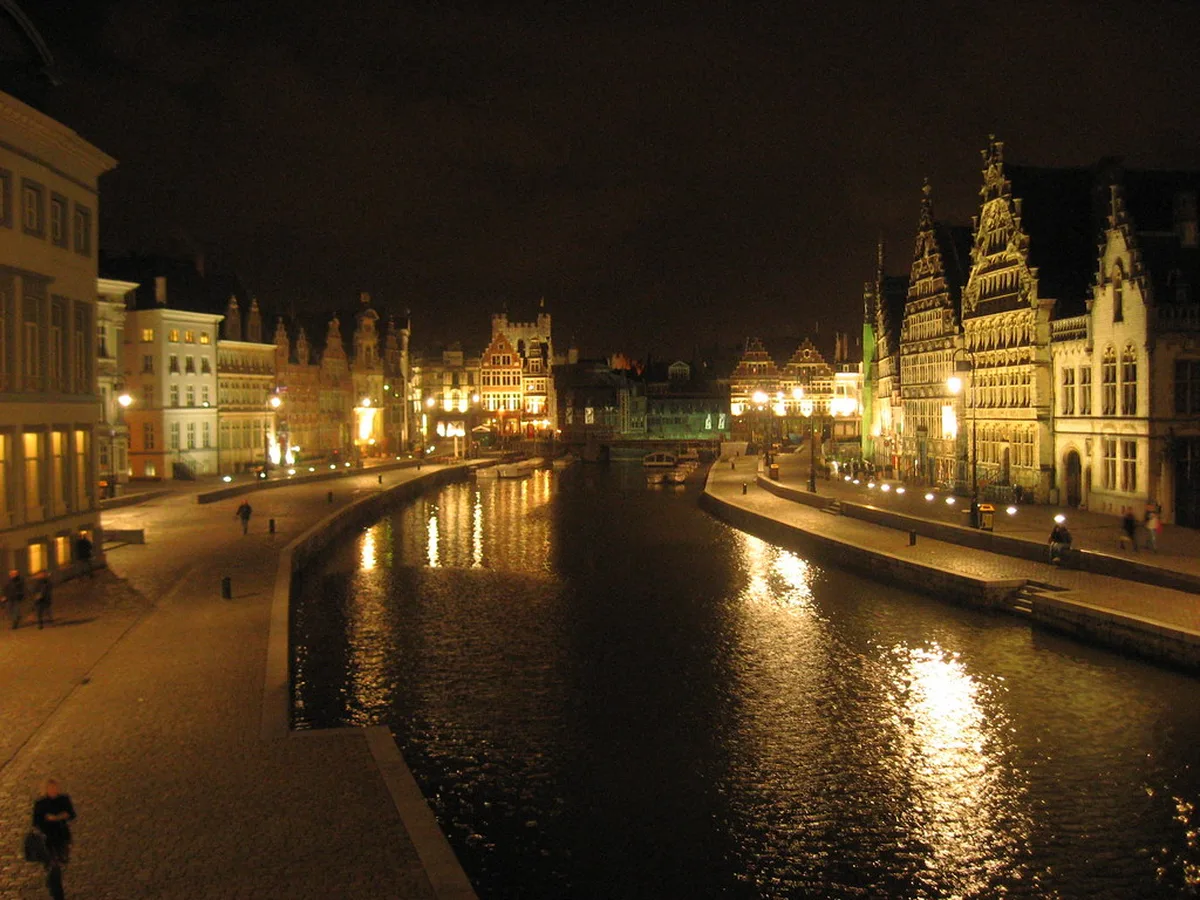
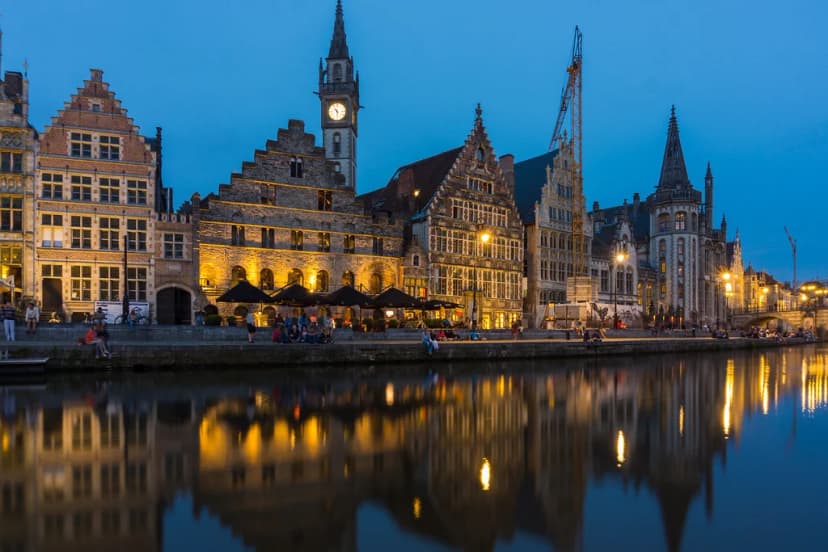
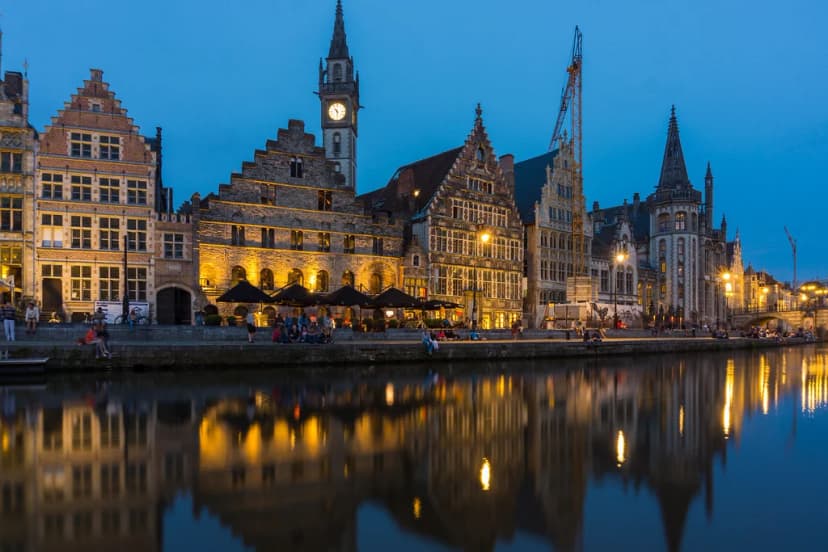
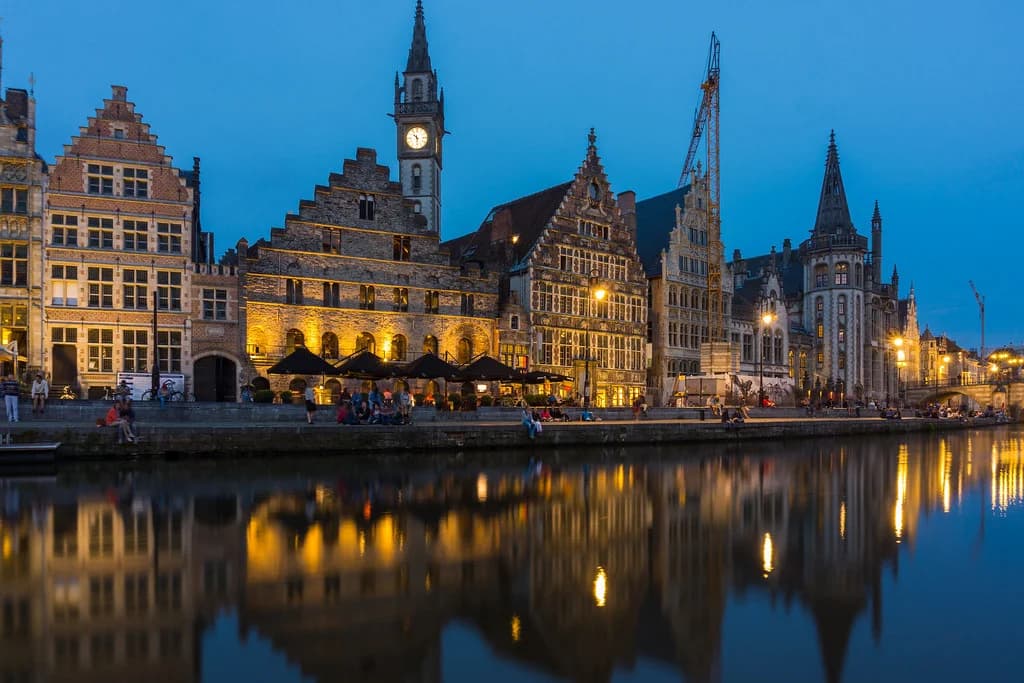
The best time to photograph the Graslei is at golden hour, roughly 60–90 minutes before sunset, when warm light hits the pale stone facades and reflects off the dark canal water. The shot from the Graslei steps looking back toward St. Michael's Bridge captures all three medieval towers in one frame and is the single most reproduced image of the city. At this same spot in the early morning (before 09:00) you will have the quayside almost entirely to yourself.
From the Korenlei side, a 40-minute boat tour departs regularly from the quay and costs around €10 per adult in 2026. The boat passes under the medieval stone bridges, through the Patershol neighbourhood waterway, and past the back of Gravensteen Castle, giving architectural angles impossible to see on foot. Evening departures are particularly atmospheric as the guildhalls are illuminated with warm uplighting from around 21:00 in summer. Tickets can be purchased directly at the embarkation point — no advance booking required outside July and August.
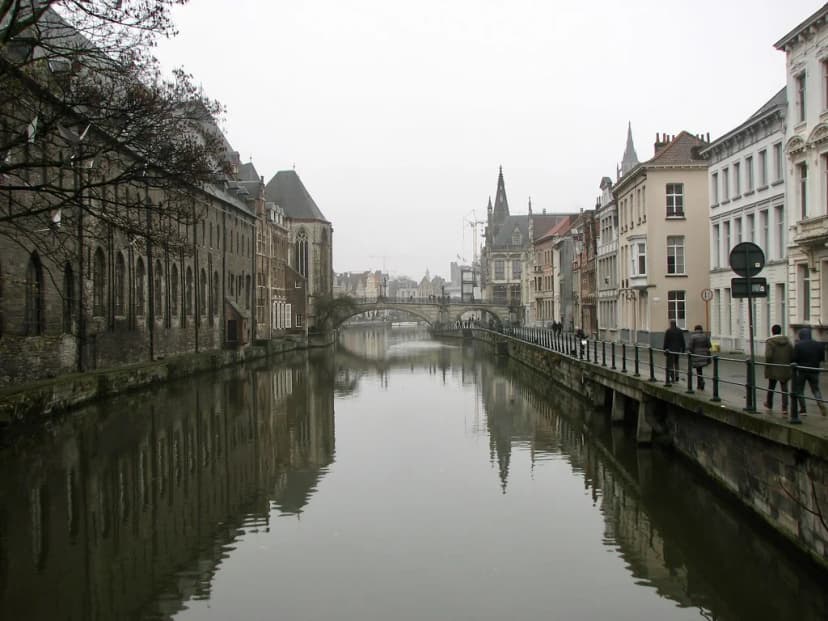
Walking east along the Korenlei toward St. Michael's Bridge takes about three minutes and deposits you at the city's definitive panoramic viewpoint. The bridge itself is flat and wide, designed specifically to give an unobstructed sightline across the water to the three towers of St. Nicholas, the Belfry, and St. Bavo's arranged in a diagonal line. This viewpoint appears in practically every travel article about Ghent for a reason: it works in all lighting conditions and all seasons. Linger here at dusk for the full effect of the city's floodlighting programme.
The Graslei and Korenlei district also has some of the best café terraces in the old town. Expect to pay €4–6 for a local Gentse Gruut beer or €3–4 for a coffee at the canalside bars. The terrace spots fill quickly on summer evenings, so arrive by 18:00 if you want a seat directly on the waterfront. If you are planning a longer stay in the city and want to explore beyond the quayside, our Ghent nightlife guide covers the best bars and live music venues in the Patershol and university quarter.
Ghent Cuisine and Local Food Guide
Ghent has one of the most distinctive local food cultures in Belgium, built around a handful of dishes and sweets that you will not find in this form anywhere else in the country. The city is also notably the most vegetarian-friendly destination in Flanders, having introduced a weekly "veggie day" for city employees back in 2009 — a policy that catalysed a broader restaurant culture of plant-based options. That said, the traditional meat dishes remain essential eating for first-time visitors.
Gentse stoverij is the city's signature beef stew, slow-braised in local Belgian ale with a thick crust of bread spread with mustard placed on top during cooking. The bread dissolves into the sauce, adding body and a faint sharpness that distinguishes this version from the generic Flemish carbonnade you find elsewhere. Expect to pay €16–22 for a generous main-course portion at most traditional restaurants in the Patershol neighbourhood. The dish is typically served with frites and a small salad. Waterzooi — a creamy soup-stew made with chicken or freshwater fish — costs €18–24 and is another must-order.
Cuberdons (also called "neuzekes" or "little noses") are cone-shaped purple sweets with a raspberry gel centre and a firm outer shell that dissolves on contact with saliva. They have been made in Ghent since the 1870s and are now protected as a regional speciality. The most famous vendor is the long-running cuberdon stall at the Vrijdagmarkt square, where a 200g bag costs around €8. Buy them fresh — they harden and lose their gel centre within a few days, so the ones sold in tourist shops are almost always past their best.
The Patershol neighbourhood, located immediately north of Gravensteen Castle, is the best area for dinner. The neighbourhood occupies a dense grid of alleyways that were once the domain of the leather-tanning trade and later fell into near-dereliction before being gentrified in the 1980s into one of the city's most atmospheric dining quarters. Restaurants here range from traditional Flemish taverns serving stoverij and waterzooi to French bistros, Italian trattorias, and a handful of genuinely creative Belgian-fusion kitchens. Most tables fill by 19:30 on weekends — book ahead or aim to arrive at 18:30 for a walk-in spot.
The Vrijdagmarkt (Friday Market) square hosts a general market on Fridays from 07:00 to 13:00 (free to browse) and a larger antiques and flea market on Sundays from 07:00 to 13:00. The square itself is always open and is flanked by the historic socialist workers' union building "Ons Huis" — a reminder of Ghent's strong labour-movement history.
For a quick lunch on the move, Ghent's many friteries serve the Belgian standard of frites with a wide selection of sauces for €3–5 a cone. The local favourite accompaniment is stoofvleessaus — the same stoverij meat used as a thick gravy on top of the fries, sold at several stands near the Vrijdagmarkt for around €6.
Hidden Gems: Design Museum and the Arts Quarter
Beyond the three towers and the quayside, Ghent has a secondary cultural district centred on the STAM city museum, the Museum of Fine Arts (MSK), and the Design Museum Ghent. The Design Museum reopened after a major renovation and expansion and is now housed in a striking contemporary building adjacent to its original 18th-century townhouse. Entry costs €14 in 2026. The permanent collection covers European decorative arts and design from 1600 to the present, with particular depth in Art Nouveau — relevant given Ghent's place in that movement — and 20th-century Flemish industrial design. Temporary exhibitions rotate quarterly and often draw international attention.
The Museum of Fine Arts (MSK) on Citadelpark costs €12 and holds an excellent collection of Flemish masters including works by Hieronymus Bosch, Rogier van der Weyden, and Rubens. It is quieter than the Cathedral and Belfry and appeals to visitors who want depth over landmark-checking. The MSK and the adjacent SMAK (contemporary art museum, €12) share a combined ticket for €18 — good value if you plan to spend a half-day in the Arts Quarter.
One genuinely under-visited spot in the old town itself is Gravensteen's rooftop (included in the €14 castle entry). Most visitors rush through the dungeon and torture chamber displays and leave without climbing to the top of the keep, but the view from up there — looking down directly into the Patershol neighbourhood — is unlike anything else in the city. Aim for early afternoon when the lighting hits the stepped gable rooftops at their best angle.
The STAM city museum uses the entire former Bijloke abbey complex, dating from the 13th century, as its building. The museum traces Ghent's history from prehistoric settlement through the medieval textile boom to the industrial revolution and modern city planning. Entry costs €9. It is located a short walk from the old town core, about 15 minutes on foot from the Belfry, and is rarely crowded even in peak summer.
For visitors who want to understand how Ghent relates to the wider region, the city makes an excellent base for exploring Flanders. Our day trips from Ghent guide covers the best excursions to Bruges, Antwerp, and the Flemish countryside, all reachable within 30–45 minutes by train from Gent-Sint-Pieters station.
Practical Tips for Navigating the Center
Ghent operates a strict low-emission zone (LEZ) to protect its historic air quality and heritage buildings. Drivers must register their vehicles online at the official city portal before entering the designated zone or face automatic fines of €150 for a first offence, issued to the vehicle's registered owner. Most modern petrol cars (Euro 4+, post-2006) and diesel cars (Euro 6, post-2015) are permitted; older vehicles are not. Check your vehicle's emission standard before you travel to avoid a surprise fine in 2026.
Parking within the old town is notoriously difficult and expensive. On-street spaces in the center cost €3–4 per hour with a strict two-hour maximum, and many spaces are resident-only. The smarter approach for day visitors is to use the "Park + Ride" facilities on the city's outskirts, which offer free or low-cost parking combined with a tram or bus connection. The P+R at Gentbrugge and Wondelgem are the most convenient for visitors arriving from Brussels or Bruges. Our full guide on parking in Ghent covers every option in detail, including the underground car parks closest to the historic core for those who prefer to drive in.
Within the old town, walking is the most efficient transport mode — the four main landmarks (Gravensteen, the three towers, Graslei/Korenlei) form a triangle coverable on foot in under 20 minutes at a relaxed pace. Tram lines 1 and 2 connect Gent-Sint-Pieters railway station to Korenmarkt in around 10 minutes and run every 6–8 minutes throughout the day. A single tram ticket costs €2.50 purchased in advance via the De Lijn app (€3 on board). Day passes cost €7 and are worthwhile if you plan to visit the Arts Quarter and return to the station multiple times.
Gent-Sint-Pieters is the main railway hub and has direct IC trains from Brussels-South (journey time 32 minutes, departures every 30 minutes, tickets from €8.60 with a go.pass or standard single around €12.80). Trains from Bruges take 25 minutes and run hourly. The smaller Gent-Dampoort station, closer to the old town for some visitors, has slower regional connections. If you are combining Ghent with a visit to Antwerp, see our day trips from Ghent guide for routing options.
The city's official Visit Gent app (free, iOS and Android) includes an offline map of the historic centre with walking routes, real-time museum opening hours, and a live events calendar. It is genuinely useful and more reliable than generic mapping apps for navigating the pedestrianised zones.
Walking Tour Advice for Every Traveler
Exploring on foot remains the most effective way to see every hidden architectural detail in the old town. Our Ghent walking tour helps you find spots that tour buses simply cannot reach, including the narrow guild alleyways off Graslei and the 12th-century brickwork details visible only when you stop and look up. Wear comfortable flat-soled shoes: the historic cobblestones are beautiful but uneven, and wet Belgian weather makes them slippery enough to cause genuine falls in standard tourist sandals or leather-soled shoes.
The optimal self-guided walking sequence for first-time visitors in 2026 starts at St. Michael's Bridge (panoramic photo opportunity, no cost), then moves to Graslei for a morning coffee at the canalside terraces, then east to St. Bavo's Cathedral (arrive before 10:00 for the Altarpiece pavilion at €6, Mon–Sat 9AM–5PM), then north to the Belfry (buy tickets online the night before at €8), across to St. Nicholas Church (free, five minutes inside is enough), and finally northwest to Gravensteen Castle (€14, aim for noon if you want the interactive demonstration). After the castle, detour through Werregarenstraatje (Graffiti Street, free) and then walk three minutes south into the Patershol neighbourhood for lunch. The entire route is approximately 3 kilometres and takes 4–5 hours with entry stops.
Most major attractions sit within a compact area reachable in under 20 minutes of walking from any central point. This density makes Ghent an ideal destination for those who dislike long transit times between sites, and it also makes the city forgiving of spontaneous detours — if you see an interesting alley or a café with good reviews, you can follow it without significantly disrupting your plan. Plan your route to include the Vrijdagmarkt for a taste of local market life and history: the square is open at all times and the surrounding streets contain some of the city's best independent shops and bars.
If you are travelling with children, note that Gravensteen Castle is particularly engaging for younger visitors due to its dungeon, ramparts, and the noon interactive demonstration. The boat tours from Korenlei are also well-suited to families and take roughly 40 minutes with commentary in multiple languages. If you want to compare Ghent with the other great historic city of Flanders, our Bruges vs Ghent guide lays out the differences in character, cost, and crowd levels to help you decide where to spend more time.
Frequently Asked Questions
Is one day enough to see the Ghent old town?
One full day (09:00–20:00) is enough to visit all four paid landmarks — St. Bavo's Altarpiece (€6, Mon–Sat 9AM–5PM), Belfry (€8), Gravensteen Castle (€14), and St. Nicholas Church (free) — plus Graffiti Street (free), and the Graslei and Korenlei quays. Budget around €28–35 for entry fees and €20–30 for a sit-down meal. Staying overnight lets you experience the city's evening illuminations and the nightlife around the canals, which transforms the atmosphere entirely.
What is the best way to get to the Ghent historic center?
Taking the train to Gent-Sint-Pieters station is the fastest and cheapest option. Direct IC trains run from Brussels-South every 30 minutes (32-minute journey, from €8.60 with a go.pass or €12.80 standard single). From the station, tram lines 1 or 2 reach Korenmarkt in about 10 minutes for €2.50 (De Lijn app). Driving into the center requires prior online registration for the low-emission zone — failure to register results in a €150 fine.
How much does it cost to visit the Ghent Altarpiece in 2026?
The Ghent Altarpiece (Adoration of the Mystic Lamb) costs €6 per adult in 2026. It is displayed in a dedicated climate-controlled pavilion inside St. Bavo's Cathedral, which opens Monday to Saturday 09:00–17:00 and Sunday 13:00–17:00. Entry to the main nave of the cathedral is free. An audio guide is included in the €6 admission. Arrive before 10:00 to avoid guided tour groups from Brussels and Amsterdam.
Are museums in the old town open on Mondays?
Gravensteen Castle (€14) and the Belfry (€8) are open seven days a week, including Mondays, from 09:00 and 10:00 respectively. The Design Museum Ghent is closed on Mondays. St. Bavo's Cathedral Altarpiece pavilion (€6) is open Monday to Saturday but not available Sunday morning — Sunday hours are 13:00–17:00 only. Always verify hours on the official Visit Gent website before a Monday visit, as seasonal adjustments apply.
What is Ghent's most famous local food?
Ghent's two most iconic foods are Gentse stoverij — a beef stew slow-braised in Belgian ale with mustard bread, served for €16–22 in traditional restaurants — and cuberdons, cone-shaped raspberry sweets sold fresh at the Vrijdagmarkt stall for around €8 per 200g. Waterzooi (creamy chicken or fish soup-stew, €18–24) is a third essential dish. The best area for a full meal is the Patershol neighbourhood, immediately north of Gravensteen Castle.
Is Ghent worth visiting if I have already been to Bruges?
Yes — Ghent is meaningfully different from Bruges. It is a larger, more lived-in city with a stronger arts and food scene, a functioning university quarter, and far fewer day-trippers. Gravensteen Castle (€14) is more complete and engaging than anything in Bruges, the Ghent Altarpiece (€6) is one of the most important paintings in European history, and the Graslei is arguably as beautiful as Bruges' Rozenhoedkaai. The two cities make ideal partners on a Belgium itinerary, as the train journey between them takes only 25 minutes.
Where is the best viewpoint in Ghent old town?
St. Michael's Bridge is the classic ground-level viewpoint, giving an unobstructed photograph of all three medieval towers reflected in the Leie canal — best at golden hour (60–90 minutes before sunset) or early morning before 09:00. For an elevated view, the Belfry's observation platform (€8) at 91 metres is the highest publicly accessible point in the historic center and offers a 360-degree panorama. Gravensteen's rooftop (included in the €14 entry) gives a unique close-range view down into the Patershol neighbourhood's stepped gables. All three viewpoints are free or included in standard entry fees.
What is Graffiti Street in Ghent and how do I find it?
Graffiti Street — officially Werregarenstraatje — is a narrow alley near the Belfry that the city has designated as a legal open-air street art space since the 1990s. Every surface is covered in constantly changing murals and tags. Entry is completely free and the lane is accessible 24 hours a day. To find it, walk from the Belfry toward the Vrijdagmarkt and look for the alley entrance on the right. It takes under five minutes to walk through but is worth lingering to photograph individual pieces.
Ghent offers a perfect blend of medieval grandeur and modern Belgian culture within its compact historic core — all walkable, all remarkably affordable compared to western European capitals.
Following this Ghent old town guide ensures you see the best sites while avoiding common travel mistakes like missing the Ghent Altarpiece (€6, Mon–Sat 9AM–5PM), skipping Gravensteen Castle (€14, open daily from 9AM), overlooking free Graffiti Street, or arriving in high summer without booking entry to major landmarks online.
For more Belgium planning, our Bruges vs Ghent comparison helps you balance your itinerary, and our day trips from Ghent guide covers Bruges, Antwerp, and the surrounding Flemish countryside.
The memories of these golden quays and ancient stone towers will stay with you long after you leave Flanders.