Experience History on a Mostar Walking Tour
In 2026, a self-guided Mostar walking tour takes 2 to 2.5 hours, covers roughly 2 km, and costs as little as 4 KM (€2) for entry to Bišćevića House. Key stops are Stari Most, Kujundžiluk bazaar, Koski Mehmed Pasha Mosque (12 KM/€6), Kriva Ćuprija, and the Bulevar front line. Free tip-based tours depart Spanish Square daily at 10:00 AM and 3:00 PM — plan to tip 10–20 KM (€5–10) per person.
Mostar's Old Town is compact and fully walkable without a guide. The main self-guided route runs from Stari Most north through the Kujundžiluk bazaar to Koski Mehmed Pasha Mosque, then west across Lučki Most to Spanish Square and the Bulevar. Every major landmark is within 15 minutes on foot. Bring small-denomination Bosnian Marks (KM) — many entry points and stalls do not accept cards.
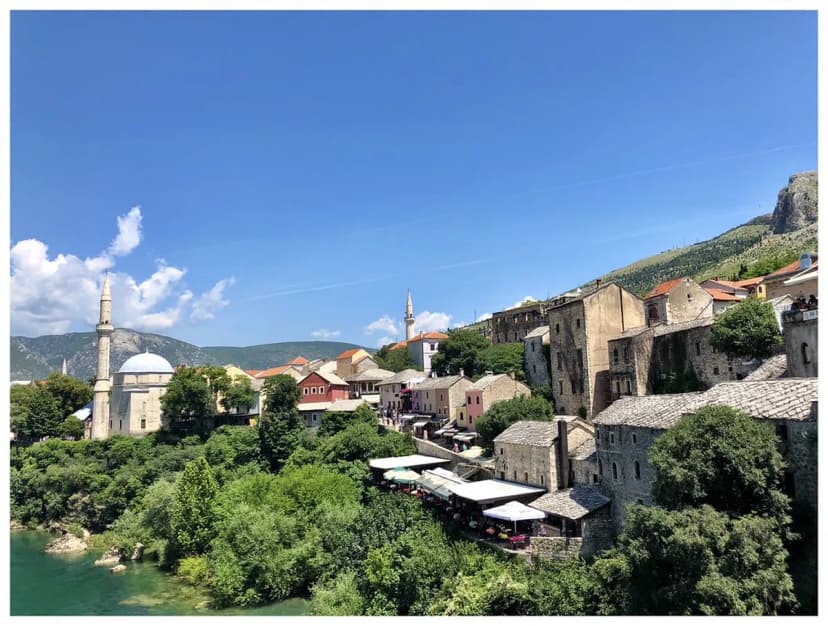
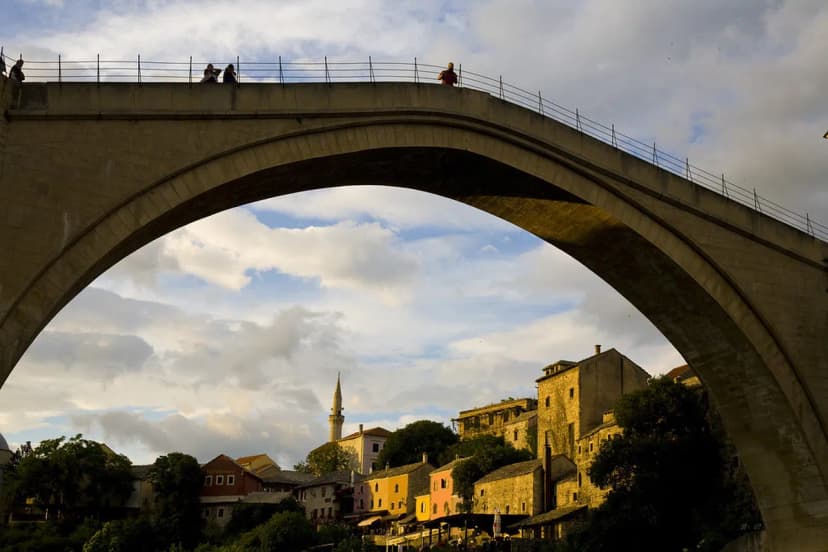
Walking through Mostar feels like stepping into a living history book where East meets West. The iconic Stari Most bridge stands as a symbol of resilience and beauty above the Neretva River. A Mostar walking tour allows you to uncover layers of Ottoman architecture and recent wartime history in a single afternoon. Visitors consistently find that the streets themselves — cobblestone, narrow, and full of stories — are as compelling as any single landmark.
Complete Self-Guided 2-Hour Mostar Walking Tour Route
This numbered route follows the logic used by every major walking tour operator in Mostar in 2026 — it is the most efficient sequence for seeing the city's essential landmarks without backtracking. The total walking distance is approximately 2 km. Allow 2 hours at a moderate pace, or up to 3 hours if you linger in the bazaar or climb the mosque minaret. Wear rubber-soled shoes: the Old Town's limestone cobblestones are slippery even when dry.
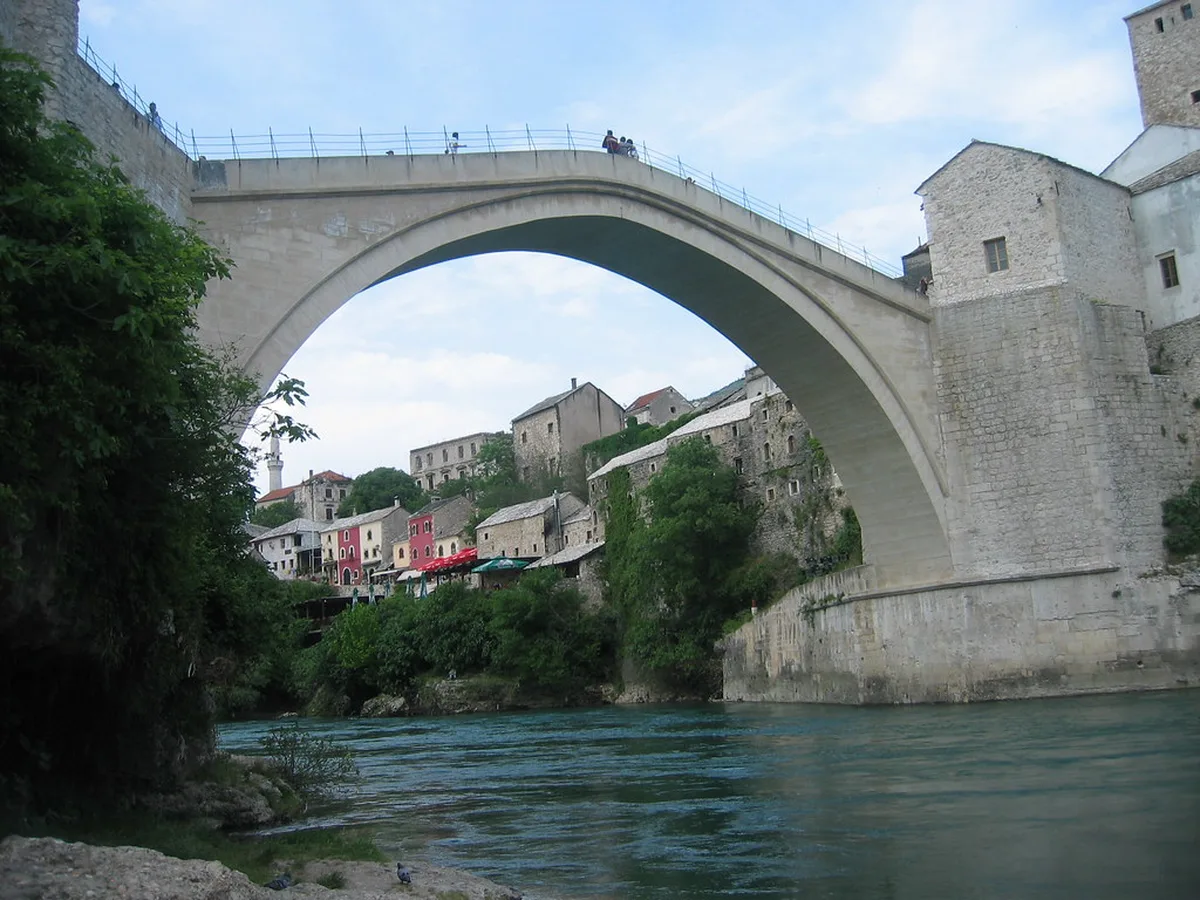
- Stop 1 — Stari Most (Old Bridge) — 20 min — Free to walk across
Start at the southern end of Stari Most on the east bank. Cross the 29-metre stone arch in both directions, descend the stone steps to the riverbank for the classic upstream photograph, and read the commemorative plaque on the south side. This 16th-century Ottoman bridge was rebuilt in 2004 using original limestone after its deliberate destruction in 1993. Local divers jump from the apex for tips — usually after collecting around 30–50 KM (€15–25) from onlookers. Do not tip in advance. - Stop 2 — Kriva Ćuprija (Crooked Bridge) — 10 min — Free
Walk 100 metres south along the riverbank to the smaller Kriva Ćuprija. This single-arch Ottoman bridge predates Stari Most by several decades and served as a design prototype. The shaded stone alcove beside the bridge is cooler than the busy main plaza and offers an excellent composition for bridge photography. - Stop 3 — Bišćevića House (Bišćević Turkish House) — 15 min — 4 KM (€2)
From Kriva Ćuprija, walk 80 metres north along Bišćevića Street to the 17th-century Bišćević Turkish House, one of Mostar's best-preserved Ottoman residential buildings. Entry costs 4 KM (€2). Inside, carved wooden ceilings, traditional seating areas (divanhane), and a garden courtyard overlooking the Neretva River illustrate how affluent Ottoman families lived. The ground floor houses a small museum of household artefacts. This stop is frequently skipped by rushed day-trippers — it is quiet, authentic, and entirely worth the entry fee. - Stop 4 — Kujundžiluk Bazaar — 25–30 min — Free to walk through
Head back north along the riverbank to enter the Kujundžiluk bazaar lane at its southern end near the Old Bridge. The 200-metre cobblestone lane runs directly north toward the mosque area. Browse hand-hammered copper workshops, Turkish lamp stalls, hand-woven rugs, and colourful ceramics. Traditional Bosnian coffee sets (džezva and fildžan) start at 40 KM (€20). Bargaining is standard when buying multiple items. - Stop 5 — Koski Mehmed Pasha Mosque — 15 min — 12 KM (€6)
At the northern end of the bazaar, turn right (east) to reach the Koski Mehmed Pasha Mosque entrance. Entry costs 12 KM (€6) and includes the courtyard, prayer hall, and minaret climb. The minaret top gives the best panoramic view of the Old Town roofline and the Neretva below. Wear modest clothing — covered shoulders and knees — at this active place of worship. - Stop 6 — Lučki Most — 10 min — Free
Walk north along the riverbank roughly 400 metres to Lučki Most, the modern road bridge. Standing here provides a striking downstream view of Stari Most's stone arch against the river canyon — often less crowded than the bridge itself. The contrast between this functional concrete span and the Ottoman masterpiece downstream captures Mostar's duality better than any single image. - Stop 7 — Spanish Square (Španski Trg) — 10 min
From Lučki Most, walk west along Onešćukova Street to Spanish Square. This broad open plaza is the social hub of modern Mostar and the daily meeting point for free walking tours (10:00 AM and 3:00 PM). Small cafes around the square serve Bosnian coffee (kafa) and cevapi at 6–10 KM (€3–5) — significantly less than tourist-facing restaurants in the bazaar. - Stop 8 — The Bulevar (Wartime Front Line) — 15 min — Free
Head south along the Bulevar from Spanish Square to Musala Square. This rebuilt commercial boulevard was the wartime front line dividing Croat and Bosniak communities from 1992 to 1995. Key sights: the Sniper Tower (Neretva Bank Building) on the west side, war memorial murals on building facades, and Musala Square at the southern end. The full Bulevar walk takes 15 minutes at a slow pace with stops.
Total recommended timing: approximately 2 hours walking and sightseeing. Add 30–45 minutes for bazaar shopping, the Bišćević Turkish House interior, or a coffee break at Spanish Square. The route is circular — from Musala Square at the south end of the Bulevar, it is a 10-minute walk back to Stari Most via Maršala Tita Street.
Essential Sights on Your Mostar Walking Tour
The self-guided route covers Mostar's most historically and architecturally significant stops in a logical sequence. Each section below gives you specific detail on what to see, how long to allow, and exactly what you will pay in 2026. Entry prices are listed in KM (Bosnian Marks, written locally as "KM") with the euro equivalent in parentheses. The exchange rate is fixed at 2 KM to €1.
Stari Most (Old Bridge) — Allow 20 Minutes
The Stari Most bridge remains the most famous landmark and your natural starting point. This 16th-century Ottoman masterpiece was deliberately destroyed by artillery fire in November 1993 and painstakingly rebuilt using original Tenelija limestone quarried from the same source, reopening in 2004. The bridge is 29 metres long and rises 24 metres above the Neretva River at its apex. You can watch brave local divers jump from the peak for tips — they wait until they have collected enough from onlookers, typically 30–50 KM (€15–25) per dive.
Spend at least 20 minutes here: walk across both directions, descend to the riverbank via the stone steps on the east bank for the classic upstream photograph, and read the commemorative plaque on the south approach. The plaque records the original construction date (1566) alongside the reconstruction (2004) and is one of the most photographed texts in Bosnia and Herzegovina.
Just 100 metres south along the riverbank, the Kriva Ćuprija (Crooked Bridge) offers a smaller, quieter version of the main span. Built in the 1550s as a test of the design and construction method, it predates Stari Most by roughly a decade and served as a working model for Ottoman engineers before they tackled the larger crossing. This shaded riverside spot stays noticeably cooler than the bridge plaza in summer and is less visited despite being free and historically significant.
Bišćevića House (Bišćević Turkish House) — Allow 15 Minutes — 4 KM (€2)
The Bišćević Turkish House on Bišćevića Street is one of the best-preserved 17th-century Ottoman residential buildings in Bosnia and Herzegovina. Entry costs just 4 KM (€2), making it exceptional value for what you get: original carved wooden ceilings (tavanica), a divanhane (covered balcony-lounge) overlooking the Neretva River, traditional kilim textiles on the floor, and a serene courtyard garden. The ground-floor rooms house authentic household objects — copper utensils, oil lamps, embroidered fabrics — that bring Ottoman daily life into focus far better than any signage could. The building remained in the same family for generations and survived both the Second World War and the 1990s conflict largely intact.
Koski Mehmed Pasha Mosque — Allow 15 Minutes — 12 KM (€6)
Climbing the minaret at the Koski Mehmed Pasha Mosque provides the best panoramic views of the Old Town roofline and the river below. In 2026, entry costs 12 KM (€6) and includes access to the courtyard, prayer hall interior, and minaret. The mosque was built in 1617 by Ottoman official Koski Mehmed Pasha and sits on the east bank of the Neretva just north of the bazaar. Wear modest clothing — covered shoulders and knees are required — when entering this active place of worship. Photography of the prayer hall interior is generally permitted outside prayer times. Check our Mostar Old Town guide for detailed advice on visiting all of the city's religious sites respectfully.
Exploring the Old Bazaar and Artisan Shops
Walking through the Kujundžiluk bazaar is the sensory centrepiece of any Mostar walking tour. Plan 25 to 30 minutes for a thorough browse — longer if you intend to buy. The bazaar runs roughly 200 metres along the east side of the river, and its narrow cobblestone lane connects Stari Most directly to the mosque area, making it a natural corridor rather than a detour. The lane is named Kujundžiluk after the kujundžija — the Ottoman word for coppersmith — and the craft is still practised here today.
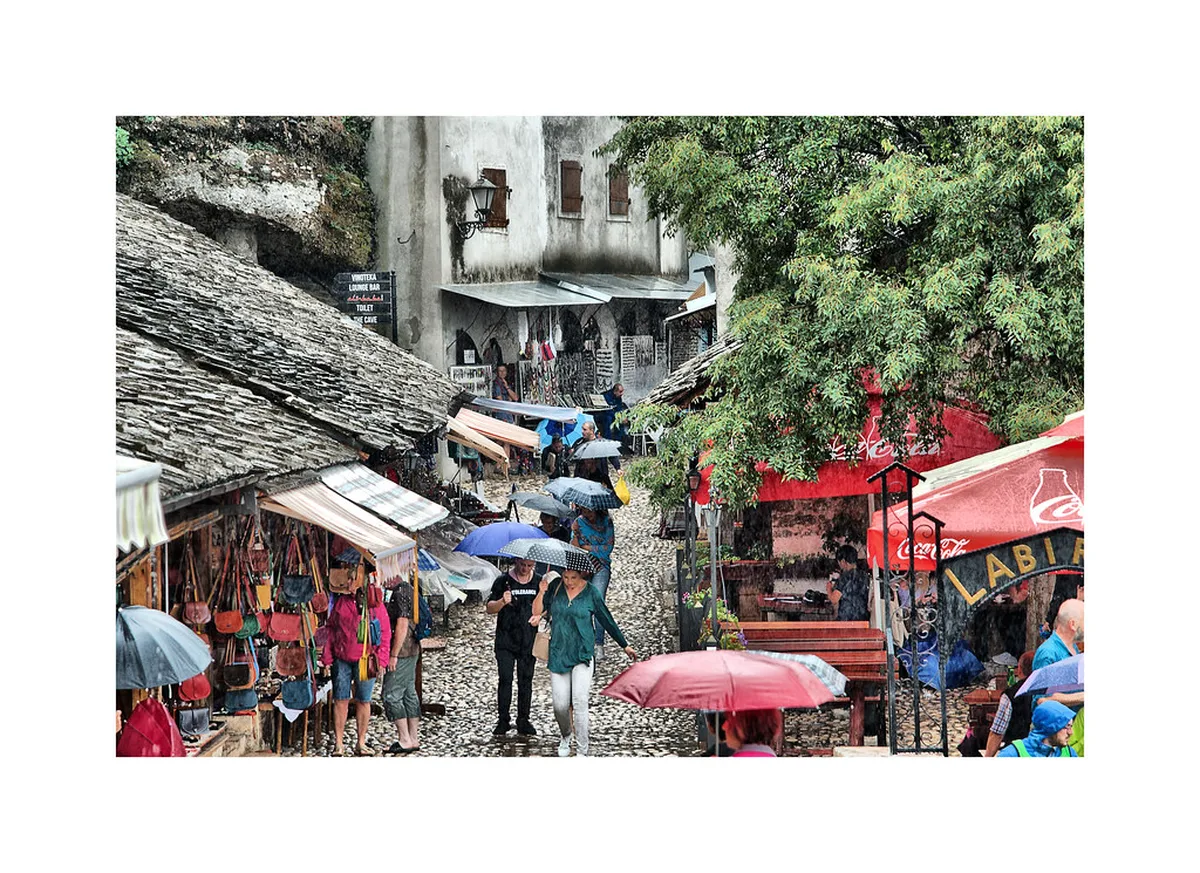
Copper workers still hammer out intricate designs on plates, trays, and coffee sets in small workshops fronting the lane. You will hear the rhythmic clinking of metal tools as you move through the colourful stalls. Many artisans speak enough English to explain their craft and will often let you try hammering a small piece under their supervision. These workshops have been producing the same patterns since the Ottoman period — this is not a tourist reconstruction but a genuinely living craft tradition that has survived war and economic disruption.
The stalls also display Turkish lamps, hand-woven rugs, colourful ceramics, silver jewellery, and Yugoslav-era memorabilia. Bargaining is standard practice, particularly when buying multiple items from one vendor. Local guides can help you identify genuine handmade goods versus mass-produced imports. Supporting traditional craftspeople directly helps preserve the cultural heritage of the bazaar for future visitors to enjoy.
- Traditional Bosnian Coffee Sets (džezva and fildžan)
- Type: Hand-hammered copper
- Cost: 40–100 KM (€20–50) in 2026
- Location: Kujundžiluk Bazaar
- Handwoven Textiles and Carpets
- Type: Kilims and scarves
- Material: Natural wool
- Cost: 30–150 KM (€15–75) depending on size
- Best for: Home decor or a lasting souvenir
Lučki Most and Spanish Square: Where Old Meets New
After the bazaar and mosque, continue north along the riverbank approximately 400 metres to Lučki Most — the modern road bridge that replaced a wartime crossing. Standing on Lučki Most gives you a striking visual contrast: the elegant stone arch of Stari Most visible downstream, framed by the canyon walls of the Neretva gorge, and the functional concrete structure beneath your feet. This juxtaposition captures Mostar's duality — ancient Ottoman craftsmanship alongside post-war reconstruction — better than almost any single view in the city.
Lučki Most is the new bridge in Mostar rebuilt after the 1990s war. It sits approximately 400 metres north of Stari Most along the east bank and provides a clear downstream viewpoint for photographing the Old Bridge in context without the crowds found on the bridge itself. Entry is free; the walk from the Old Bridge takes about 10 minutes.
From Lučki Most, a short walk west along Onešćukova Street brings you to the Spanish Square (Španski Trg), a broad open plaza that serves as the social hub of modern Mostar. This is also where free walking tours meet each day at 10:00 AM and 3:00 PM. Small cafes around the square offer Bosnian coffee (kafa) and cevapi at 6–10 KM (€3–5) — significantly lower prices than the tourist-facing restaurants in the bazaar. The square is fully flat and paved, offering a comfortable rest stop between the riverside walk and the Bulevar.
If you are planning day trips from Mostar to destinations like Kravice Waterfalls, Blagaj Tekija, or Počitelj, check our day trips from Mostar guide — many depart from the bus station near Spanish Square.
The Bulevar: Walking Mostar's Former Front Line
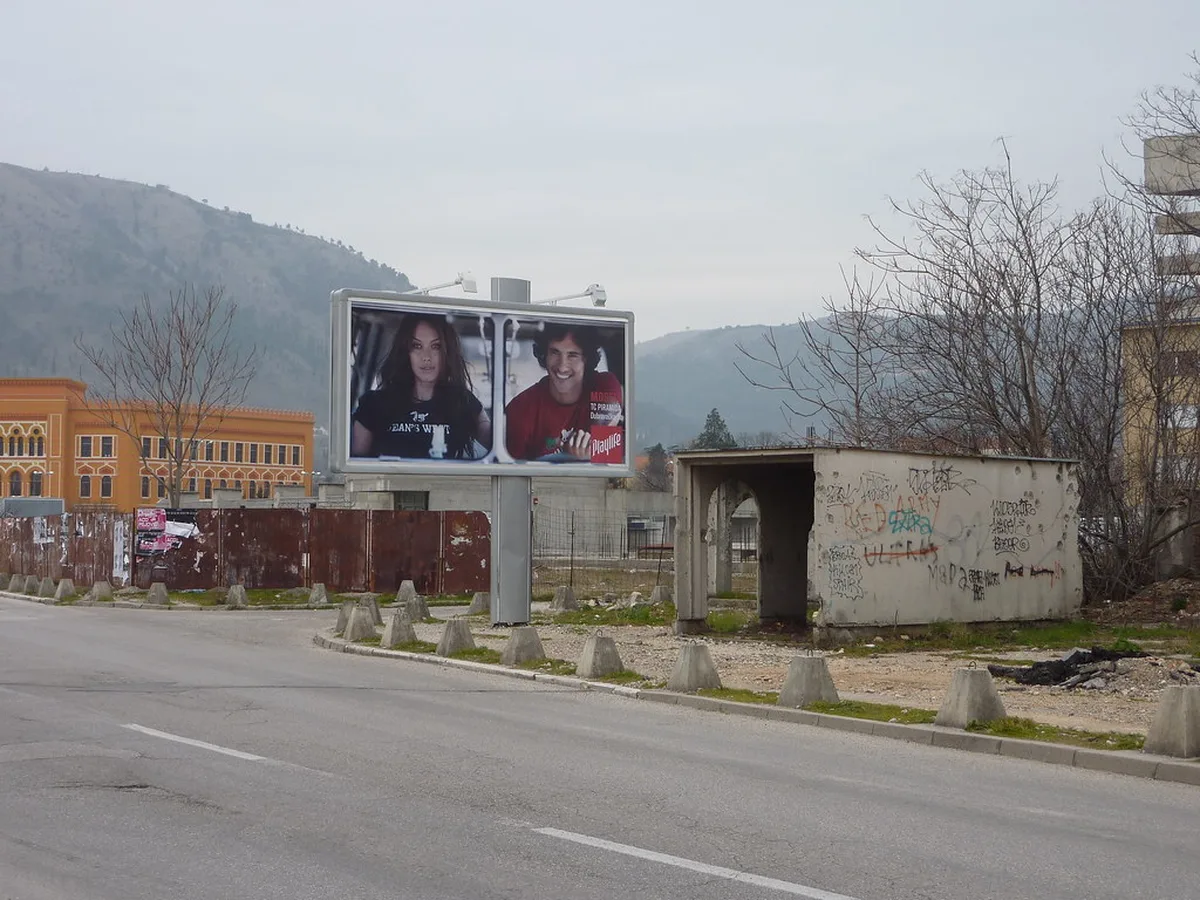
From Spanish Square, head south along the Bulevar — Mostar's main boulevard and its wartime front line from 1992 to 1995. During the siege, the Bulevar separated Croat forces on the west bank from Bosniak defenders on the east. Buildings on both sides were gutted by artillery and sniper fire; many stood as hollow shells for more than a decade after the war ended. Today the street has been reconstructed as a busy commercial avenue lined with shops, cafes, and banks, but the scars remain visible for those who know what to look for.
The Bulevar in Mostar was the wartime front line during the 1992–1995 Bosnian War, splitting the city between Croat and Bosniak communities. Today it is a rebuilt commercial avenue approximately 700 metres long, walkable in about 15 minutes, with visible war-era murals, the Sniper Tower, and pocket memorials embedded between reconstructed storefronts.
Key sites to pause at along the Bulevar include:
- Sniper Tower (Neretva Bank Building): The most photographed wartime relic in Mostar. This brutalist concrete tower on the west side of the Bulevar was used by snipers during the conflict. It remains structurally unstable — entry is not possible or advisable — but it is dramatic viewed from the pavement. The ground-floor exterior shows distinctive bullet-pock markings and the internal floors are visible through blown-out window frames. Locals call it simply "the Sniper Tower."
- War Memorial Murals: Several large-format murals along the Bulevar commemorate victims and resistance fighters from both communities. Some are on building facades; others are integrated into small pocket parks between reconstructed storefronts. Two of the most striking murals are found on the west side of the boulevard, roughly 200 metres south of Spanish Square.
- Musala Square: At the southern end of the Bulevar, Musala Square anchors the rebuilt Bosniak side of the city. The square has been fully reconstructed and features a central fountain — a pleasant place to sit and reflect before returning to the Old Town. The contrast with wartime photographs displayed in nearby galleries and walking tour narrations is deliberate and sobering.
Walking the full Bulevar from Spanish Square to Musala Square takes roughly 15 minutes at a slow pace with stops. Free walking tour guides — especially those from companies focused on conflict history, such as the Bosnian/Croat/Serb perspective tours — spend substantial time here, which is one reason the guided option is worth considering if the wartime history is your primary interest. From Musala Square, Maršala Tita Street leads directly back east to Stari Most in approximately 10 minutes on foot.
Practical Tips for Navigating Mostar on Foot
Wearing sturdy shoes with a rubber sole and good grip is essential — the limestone cobblestones throughout the Old Town are extraordinarily slippery, even when completely dry. Avoid flip-flops, smooth-soled sandals, or any footwear with a hard heel. If you are travelling with children or anyone with limited mobility, note that the gradient near the base of Stari Most is steep and the stones are uneven in both direction and height.
Early morning (before 9:00 AM) or late afternoon (after 5:00 PM) visits minimise both crowd congestion and heat. Temperatures in Mostar regularly exceed 35 °C in July and August — the city sits in a river valley that traps heat exceptionally well. Drinking fountains with fresh mountain water are located near the Old Bridge and along the bazaar lane. Always carry small-denomination Bosnian Marks (KM) for entry fees, tips, and small purchases; many Old Town stalls and smaller entry points do not accept cards. ATMs are available near Spanish Square and on Maršala Tita Street.
Understanding the local safety landscape matters for travellers planning to explore independently. While Mostar is generally very safe, the Bulevar area is still transitioning and some building interiors are dangerous. Read our full guide on whether Mostar is safe for tourists before you go — it covers specific areas to be aware of and general street safety at night. The Old Town itself is exceptionally safe, including after dark.
For 2026, the recommended self-guided timing breakdown and entry costs are:
- Stari Most and Kriva Ćuprija: 20 minutes — Free
- Bišćevića House (Bišćević Turkish House): 15 minutes — 4 KM (€2)
- Kujundžiluk bazaar: 25–30 minutes browsing — Free to walk through
- Koski Mehmed Pasha Mosque: 15 minutes — 12 KM (€6)
- Walk to Lučki Most and Spanish Square: 10 minutes — Free
- Bulevar front line walk: 15 minutes — Free
- Total entry costs: 16 KM (€8) per person for the Old Bridge Museum + mosque + Bišćević House
- Total walking time: approximately 2 hours at a relaxed pace
Free Walking Tours in Mostar: What to Expect in 2026
Several operators run tip-based free walking tours of Mostar departing twice daily from Spanish Square (Španski Trg). These tours are not literally free — a tip of 10–20 KM (€5–10) per person is the standard and expected contribution in 2026, and guides depend on it for their income — but there is no mandatory upfront fee and you pay only what you feel the experience was worth.
Meeting point: Spanish Square (Španski Trg), on the west side of the Bulevar, clearly signposted. Departure times: 10:00 AM and 3:00 PM daily (confirm schedules in peak season as additional departures are sometimes added in July and August). Duration: approximately 2.5 hours. No booking is required — simply arrive a few minutes early.
The guides on free walking tours in Mostar typically grew up in the city and provide first-person perspectives on the war and its aftermath that no outside guide can replicate. Tours from companies such as Mostar Free Walking Tours, Sandal Tan Man, and GURUwalk-listed guides cover the medieval Old Town, the Ottoman-to-modern transition, and the Bulevar conflict history. Several tours specifically address the Bosniak, Croat, and Serb perspectives on the 1992–1995 siege, which adds significant depth for visitors interested in Balkan contemporary history. The Old Bridge Museum on the north tower of Stari Most (entry approximately 10 KM/€5 separately) complements the walking tour with archival footage and original bridge stonework on display.
If you prefer a structured private tour, local agencies quote 2026 group tour prices at 30–50 KM (€15–25) per person for a 2- to 2.5-hour session. Private tours run 120–180 KM (€60–90) for up to four people and can be customised to focus on specific themes — wartime history, Ottoman architecture, or culinary stops at authentic konobas. Book directly with local guides rather than through international platforms to keep more of your money in the local economy.
Hidden Gems and War History Landmarks
Beyond the Bulevar, the Partisan Memorial Cemetery offers a unique look at Yugoslav-era brutalist architecture and socialist-style landscaping. Designed by Bogdan Bogdanović and completed in 1965, it sits on a hill 10 minutes on foot from the Old Town and provides a quiet space for reflection. The terraced concrete design, abstract stone sculptures, and surrounding cypress trees create a genuinely striking ensemble. Getting here requires a 15-minute uphill walk from the Old Town, so most group tours skip it, but independent travellers with comfortable shoes will find it worthwhile. Entry is free.
The Old Bridge Museum inside the north tower of Stari Most (entry approximately 10 KM/€5 in 2026) displays original stonework from the destroyed 16th-century bridge alongside archival photographs and video footage of both the destruction and the reconstruction. It is a sobering and informative complement to walking across the bridge itself. Allow 20–30 minutes inside.
Small cafes near Spanish Square serve traditional Bosnian coffee (kafa) and burek at 4–8 KM (€2–4) — prices far below those in the bazaar. These are the places where Mostar residents actually sit, making them a much more authentic slice of daily life than the tourist-facing spots overlooking the Old Bridge. If you have time after the Bulevar walk, Musala Square has a pleasant fountain area ideal for a break before returning to the Old Town. For a broader Mostar neighbourhood exploration, see our Mostar Old Town guide which covers the city's religious sites, street art, and architectural contrasts in detail.
Frequently Asked Questions
How long does a Mostar walking tour take?
A self-guided Mostar walking tour takes approximately 2 to 2.5 hours at a relaxed pace, covering roughly 2 km from Stari Most through Kujundžiluk bazaar, Bišćevića House, Koski Mehmed Pasha Mosque, Lučki Most, Spanish Square, and the Bulevar. Guided free walking tours from Spanish Square last approximately 2.5 hours. Adding the Partisan Memorial Cemetery or extensive bazaar shopping extends the walk to 3 hours or more.
Are there free walking tours in Mostar?
Yes. Several operators run tip-based free walking tours in Mostar in 2026. They depart from Spanish Square (Španski Trg) at 10:00 AM and 3:00 PM daily and last approximately 2.5 hours. No upfront fee is charged, but a tip of 10–20 KM (€5–10) per person is expected — guides earn their income through tips. Tours cover the Old Town, Ottoman history, Bišćevića House, and the Bulevar wartime front line.
What is the best time of day for a Mostar walking tour?
The best time for a Mostar walking tour is before 9:00 AM or after 5:00 PM. Morning tours avoid peak midday heat (Mostar regularly hits 35 °C in summer) and the largest influx of day-trippers arriving by bus. Late afternoon offers golden-hour light ideal for photographs of Stari Most. The 3:00 PM free walking tour from Spanish Square catches the softening afternoon sun on the Old Town's limestone buildings.
What does a walking tour of Mostar cost in 2026?
Self-guided walking in Mostar is mostly free. Key entry fees in 2026: Koski Mehmed Pasha Mosque — 12 KM (€6); Bišćević Turkish House (Bišćevića House) — 4 KM (€2); Old Bridge Museum — approximately 10 KM (€5). Total self-guided entry cost: around 26 KM (€13) per person if you visit all three. Group walking tours cost 30–50 KM (€15–25) per person. Free tip-based tours from Spanish Square are free upfront — plan to tip 10–20 KM (€5–10).
Is the terrain in Mostar difficult to walk on?
The Old Town of Mostar has very uneven, polished limestone cobblestones that are slippery even when dry. The terrain is not difficult for able-bodied walkers wearing sturdy rubber-soled shoes, but flip-flops or smooth soles are genuinely dangerous. The descent to the riverbank near Stari Most is steep. People with significant mobility limitations may find several sections challenging; the Bulevar itself is flat and fully paved, and Spanish Square is accessible.
What is the Bulevar in Mostar and why should I walk it?
The Bulevar is Mostar's main boulevard and was the wartime front line separating Croat and Bosniak communities during the 1992–1995 Bosnian War. Today it is a rebuilt commercial street approximately 700 metres long but retains powerful markers of the conflict: the Sniper Tower (Neretva Bank Building), war memorial murals, and Musala Square. Walking the Bulevar takes about 15 minutes and provides essential context for understanding modern Mostar beyond the picturesque Ottoman Old Town.
What is Bišćevića House and is it worth visiting in Mostar?
The Bišćević Turkish House (Bišćevića House) on Bišćevića Street is a 17th-century Ottoman residential building and one of the best-preserved examples in Bosnia and Herzegovina. Entry costs just 4 KM (€2) in 2026. Inside, carved wooden ceilings, a divanhane (covered river-facing balcony), traditional kilim textiles, and original copper household objects illustrate Ottoman domestic life authentically. The garden courtyard overlooking the Neretva River is peaceful and rarely crowded. It is exceptional value and a genuine highlight for visitors who seek authentic history beyond the main tourist circuit.
A Mostar walking tour in 2026 rewards visitors who go beyond the postcard view of Stari Most. The complete self-guided route — from the Old Bridge and Kriva Ćuprija through Bišćevića House, the Kujundžiluk bazaar, and Koski Mehmed Pasha Mosque to Lučki Most, Spanish Square, and the Bulevar's wartime front line — reveals a city still actively reconciling its Ottoman and recent past. Wear comfortable rubber-soled shoes, bring Bosnian Marks (KM) for the 16 KM (€8) in entry fees, and consider joining a free walking tour from Spanish Square to hear the human stories behind the stones. For broader planning, see our Mostar Old Town guide and our Mostar safety guide before you go.