Explore the Best Rhodes Walking Tour Routes in 2026
The self-guided Rhodes Old Town walking tour takes 2–3 hours and is free to wander. Key paid stops in 2026: Palace of the Grand Masters €8, Archaeological Museum €8, old town walls tour €8; Street of Knights and Jewish Quarter are free.
Start at Liberty Gate and follow the Street of the Knights (free) south to the Palace of the Grand Masters (€8). Continue to the Archaeological Museum (€8), then the Jewish Quarter (free). Allow 2–3 hours for the core circuit; a full day covers the moat and harbor too.
Walking through the cobblestone streets of Rhodes feels like stepping back into a medieval dream. A self-guided Rhodes walking tour allows you to discover hidden alleys at your own pace. Most visitors start their journey within the massive stone walls of the Old Town — a UNESCO World Heritage site offering layers of history from the Knights Hospitaller era through Ottoman rule and Italian occupation. The city is compact enough that a single day on foot covers all major landmarks, yet rich enough that repeat walkers still uncover new details on every visit.
Sturdy walking shoes are essential for navigating the maze of the historic center. The old kalderimi (pebble-paved paths) become slippery near ancient stone fortifications after even light rain. Starting your journey early — ideally by 8:30 AM — helps you avoid the intense midday sun and the wave of visitors that disembarks from cruise ships berthed at Kolona Harbour. For more context on the historic district itself, see our detailed Rhodes Old Town guide.
Planning Your Rhodes Walking Tour
Rhodes is a city best explored on foot. Its narrow streets and pedestrianised historic zones make walking both easier and more rewarding than any other form of transport. You can comfortably cover the main historical highlights — Old Town, Street of the Knights, Mandraki Harbor, and the moat — in about four to five hours of walking, with pauses for photos and coffee.
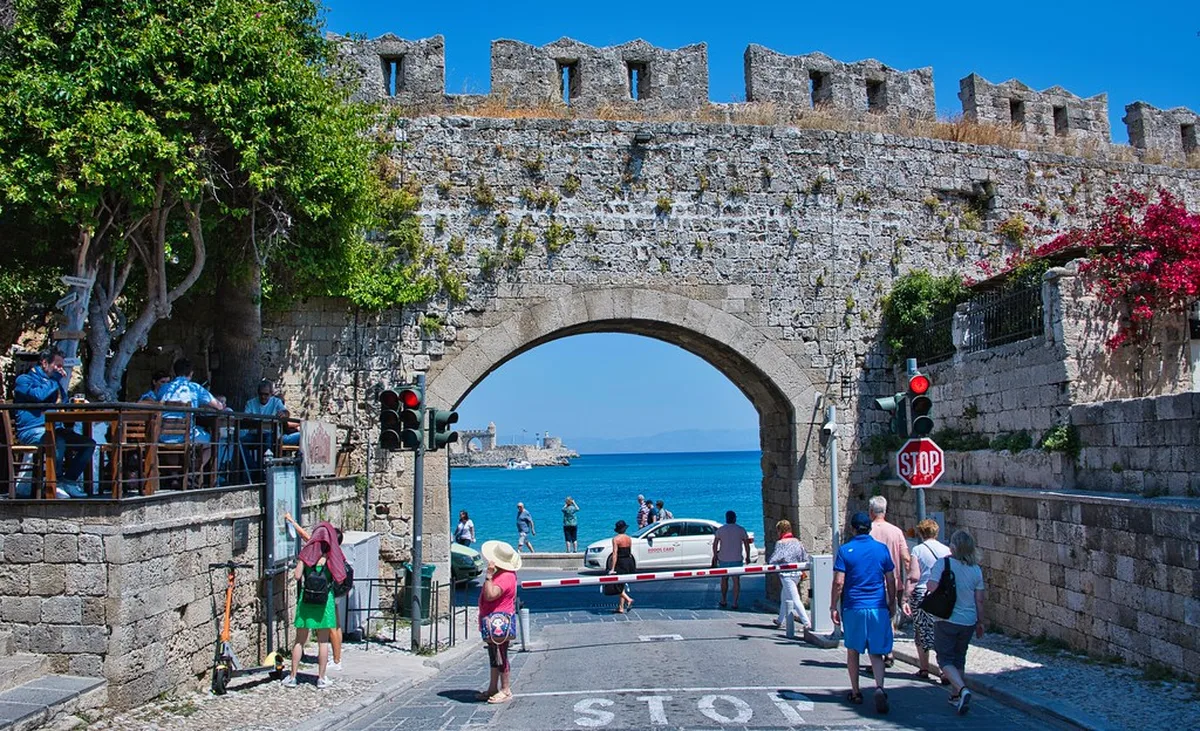
The Liberty Gate (Pyli Eleftherias) serves as the most popular starting point for walking routes. From here, you step immediately into Plateia Symi, where you can pick up a free paper map from the information kiosk open daily 9 AM–3 PM. A GPS travel app such as Maps.me loaded with offline tiles is useful for navigating the 200-plus lanes that branch off the main arteries. Many travellers find that getting briefly lost is actually the most memorable part of the experience.
The full self-guided route described in this article covers approximately 6 km of walking distance. Allow 30–45 minutes of rest stops on top of walking time. The route begins at Liberty Gate, moves south along the Street of the Knights to the Palace of the Grand Masters, continues northeast through the Jewish Quarter and the Roloi Clock Tower, then exits through the Marine Gate to reach Mandraki Harbor. From the harbor the route swings back around to the moat entrance near the Gate of Saint John, completing a loose loop.
Consider the season carefully when planning. Summer temperatures regularly exceed 32 °C by noon, making a pre-9 AM start mandatory if you want to walk comfortably. Spring (April–May) and autumn (September–October) are the best seasons — temperatures stay in the 20–26 °C range, crowds are thinner, and all museums maintain full hours. In winter, most key landmarks stay open but operating hours may shorten to 8:30 AM–3 PM. The moat walk is accessible year-round at no cost and is particularly beautiful in March when wildflowers carpet the grass.
Budget tip: the only paid entries on the main circuit are the Palace of the Grand Masters (€8 adults, €4 reduced) and the Archaeological Museum (€8 adults). The Street of the Knights, the moat, Mandraki Harbor, and the Jewish Quarter are all free. A combined ticket covering both museums costs €14 and is available at either door — worthwhile if you plan to spend time in both.
Top Landmarks on a Rhodes Walking Tour
The Palace of the Grand Masters (Palati tou Megalou Magistrou) serves as the crown jewel of the medieval fortifications and the focal point of any walking route through Rhodes Town. Entry costs €8 for adults in 2026 (reduced €4 for students and EU seniors). Allow at least two hours inside: the ground floor contains 24 rooms displaying Byzantine and medieval artifacts, Hellenistic mosaic floors rescued from Kos, and an impressive collection of Knights-era weaponry. The upper terraces offer sweeping views over the red-tiled rooftops of the Old Town toward the Aegean horizon.
Walk south from the palace along the Street of the Knights (Odos Ippoton) — arguably the best-preserved medieval street in Europe. Running 200 metres in a near-straight line, it was divided into seven sections called Inns, each representing a different linguistic nation of the Hospitaller order: France, England, Germany, Provence, Auvergne, Spain, and Italy. The carved stone facades carry Gothic-arched doorways, heraldic shields, and decorative windows. The street is free to walk and takes 20–30 minutes to explore properly if you pause to photograph each inn's facade. The French Inn, at the northern end, is the most ornate and is often used as a backdrop for wedding photographs.
Continuing north from the Street of the Knights, you reach Plateia Argyrokastrou and the Archaeological Museum (€8 adults), housed in the 15th-century Hospital of the Knights. The collection is compact but excellent, containing the famous Marine Venus statue — a 1st-century BCE marble sculpture retrieved from the harbour — along with Mycenaean grave goods, Geometric-period ceramics, and an extensive coin collection. Budget 60–90 minutes here.
The Roloi Clock Tower sits a short walk east and charges a modest €5 to climb to its viewing platform. The ascent rewards you with a 360-degree panorama: the medieval walls to the south and west, the turquoise harbour to the north, and the minaret of the Suleiman Mosque directly below. It is the best single viewpoint in the Old Town and takes only 20 minutes including the climb.
- Palace of the Grand Masters
- Cost: €8 adults / €4 reduced
- Time: 2 hours
- Best for: History lovers, panoramic rooftop views
- Street of the Knights
- Cost: Free
- Time: 20–30 minutes
- Best for: Medieval architecture photography
- Archaeological Museum
- Cost: €8 adults / €14 combined with Palace
- Time: 60–90 minutes
- Best for: Ancient sculpture, Mycenaean finds
- Roloi Clock Tower
- Cost: €5
- Time: 20 minutes
- Best for: Best panoramic view in Old Town
Complete 3-Hour Self-Guided Rhodes Old Town Walking Tour Route
This numbered route covers the essential Old Town circuit in 2–3 hours of walking, starting from the Liberty Gate and looping back through the Marine Gate to Mandraki Harbor. Total walking distance is approximately 3.5 km. Comfortable shoes are essential — the kalderimi pebble paving is beautiful but tiring underfoot. Start by 8:30 AM to beat the cruise-ship crowds that typically arrive after 10 AM. Download an offline map before you set out; many alley junctions inside the Old Town are unmarked. The route below follows a logical south-to-north then eastward arc that minimises backtracking.
- Stop 1 — Liberty Gate (Pyli Eleftherias), 0 min
Start here. Pick up a free paper map from the information kiosk (open 9 AM–3 PM daily). This gate on the northwestern wall is the main pedestrian entry point for walkers arriving from Mandraki Harbor. Free entry. Allow 5 minutes to orient yourself at Plateia Symi just inside the gate before heading south. - Stop 2 — Archaeological Museum, 10 min from Liberty Gate, ~200 m
Walk south along Ippoton Street and turn into Plateia Argyrokastrou. The 15th-century Hospital of the Knights now houses the Archaeological Museum (€8 adults in 2026). The star exhibit is the Marine Venus, a 1st-century BCE marble sculpture recovered from the harbour. The Mycenaean grave goods and extensive coin collection round out a compact but high-quality collection. Allow 60–90 minutes. Opening hours: 8 AM–8 PM (summer), 8:30 AM–3 PM (winter). - Stop 3 — Street of the Knights (Odos Ippoton), 15 min from museum, ~100 m
From the museum turn south onto the Street of the Knights, one of the best-preserved medieval streets in Europe. The 200-metre cobbled lane is lined with seven stone Inns, each representing a different linguistic nation of the Knights Hospitaller: France, England, Germany, Provence, Auvergne, Spain, and Italy. Entry is free. The French Inn at the northern end is the most ornate — its carved Gothic doorway and heraldic shields reward a close look. Allow 20–30 minutes to walk the full length and photograph each facade properly. - Stop 4 — Palace of the Grand Masters, 5 min from Street of Knights, ~100 m
At the top of the Street of the Knights stands the Palace of the Grand Masters (€8 adults, €4 reduced in 2026). The ground floor displays 24 rooms of Byzantine and medieval artifacts, rescued Hellenistic mosaic floors from Kos, and Knights-era weaponry. Rooftop terraces offer sweeping views over the Old Town toward the Aegean. Allow 90–120 minutes. Open 8 AM daily in summer — arrive at opening to have the mosaic rooms to yourself before cruise groups arrive around 10 AM. - Stop 5 — Roloi Clock Tower, 8 min from Palace, ~300 m east
Walk east along Orfeos Street past the Suleiman Mosque to the Roloi Clock Tower. Climb to the viewing platform (€5) for the best 360-degree panorama in the Old Town: medieval walls to the south and west, turquoise harbour to the north, and the minaret of the Suleiman Mosque directly below. Allow 20 minutes including the climb. Ideal photography timing is mid-morning when the light falls from the east across the rooftops. - Stop 6 — Jewish Quarter (Ovriaki), 10 min from Roloi, ~400 m southeast
Head southeast to the Square of the Jewish Martyrs (Plateia ton Evreon Martyron), named for the 1,700 Rhodian Jews deported to Auschwitz in 1944. A bronze seahorse fountain marks the square's centre. The Kahal Shalom Synagogue (built 1577, oldest operating synagogue in Greece) is open in summer from 9 AM to 3 PM — entry is free, donations welcome. The surrounding lanes on Dossiadou and Perikleous streets mix Byzantine, Ottoman, and Sephardic architectural details found nowhere else in Rhodes. Allow 20–30 minutes to explore. Free. - Stop 7 — Marine Gate and Mandraki Harbor, 10 min from Jewish Quarter, ~500 m north
Walk north through the Old Town and exit via the Marine Gate onto the waterfront promenade. The transition from medieval stone lanes to the open Aegean harbor is one of the most dramatic moments of the walk. Two bronze deer statues (a stag and a doe) mark the narrow harbor entrance — the symbol of the island and a classic photo stop. From here you can extend the route north to the three stone windmills (20 min round trip) or return west to Liberty Gate, completing the loop. Free.
Total time: 3 hours of active touring (museum entry times included). Total cost: €16 (Archaeological Museum €8 + Palace €8) or €13 if skipping the Roloi Tower climb. Rest stops and refreshments add €5–10. This route is the most time-efficient way to see all the headline Old Town attractions without doubling back. For a deeper dive into the district's history, architecture, and practical logistics, see our complete Rhodes Old Town guide. If you are visiting multiple Greek islands, you can also find destination overviews in our Greece travel guide.
Exploring Mandraki Harbor and Modern Rhodes
Leaving the Old Town through the Marine Gate brings you out onto the Mandraki waterfront — a striking transition from medieval stone lanes to sun-drenched Aegean promenade. The harbor is historically significant as the supposed site of the Colossus of Rhodes, one of the Seven Wonders of the Ancient World, though modern archaeology has placed the statue's exact location in dispute. Today, two bronze deer statues (a stag and a doe) mark the narrow harbor entrance on short pillars — a symbol of the island and a classic photo stop.
Walk north along the quayside to admire the row of three restored stone windmills standing on the breakwater. These were built in the 14th century by the Knights to mill grain arriving by merchant ship and were operational until the early 20th century. The walk out to the windmills and back takes about 20 minutes and offers an excellent vantage point for photographing the city skyline. At the breakwater's tip sits the Fort of Saint Nicholas (Agios Nikolaos), a circular tower built in 1464–1467; admission is usually free and the interior is occasionally open for exhibitions.
Along the harbor's western edge runs a colonnaded promenade flanked by imposing Italian Rationalist buildings — legacy of the Dodecanese's Italian occupation (1912–1943). The New Market (Nea Agora), a large hexagonal building with an open interior courtyard, contains cafes, souvenir shops, and a small produce market. It is the best place to pick up a cold freddo espresso (around €3.50) before continuing your walk. The main post office, the Town Hall, and the Palace of the Dodecanese Governor all occupy this same stretch — each architecturally distinct but part of the same Mussolini-era urban planning scheme.
From Mandraki it is a ten-minute walk east along Koundourioti Street to Plateia Rimini, the main modern square, where you can catch local buses to beaches further afield. Alternatively, head back toward the Old Town walls via the beach promenade to reach the moat entrance at the Gate of Saint John, continuing the full walking circuit. The harbor section of the walk covers roughly 2 km and takes 45–60 minutes at a relaxed pace including the windmill detour.
Essential Gear and Practical Tips
Comfortable closed-toe footwear is the single most important factor for a successful Rhodes walking tour. The kalderimi paving — small rounded sea pebbles set in mortar — looks beautiful but transfers pressure to the ball of your foot over long distances. Flip-flops and flat-soled sandals lead to sore feet by lunchtime. Low-profile hiking shoes or cushioned sneakers with good lateral support are ideal. If you plan to walk the moat (uneven gravel) and the Street of the Knights (worn smooth stone), ankle support becomes especially valuable.
Hydration is critical under the bright Greek sun from May through October. Public drinking fountains are located near the Liberty Gate, at Plateia Argyrokastrou outside the Archaeological Museum, and at Mandraki Harbor near the windmills — all with potable tap water. Carry a reusable 750 ml bottle and refill at these points rather than buying single-use plastic. Apply SPF 50 sunscreen every two hours and wear a wide-brimmed hat; the Old Town's narrow lanes provide shade but open plazas and the harbor promenade offer none. A lightweight long-sleeved linen shirt protects skin without adding heat.
Navigation tools: Google Maps has reasonable coverage of the Old Town but some smaller lanes are mislabeled. The free Naviki walking app has better pedestrian routing through the medieval core. Offline maps downloaded in advance via Maps.me cover the entire island without consuming data. Street signs inside the Old Town are in Greek and English, but many alley junctions are unmarked — having an offline map as a backup prevents genuine disorientation.
Budget planning for the full circuit in 2026: Palace of the Grand Masters (€8) + Archaeological Museum (€8), or combined ticket (€14). Old town walls tour (€8). Roloi Clock Tower (€5). Free guided group tour tip: €10–15 is customary. Private guided tour: €15–25 per person for a 2-hour group session, up to €60 per person for a private 3-hour expert-led route. Cold drinks at harbor cafes: €2.50–4. Total budget for a self-guided day including entry fees, a coffee, and a post-walk lunch: approximately €35–50 per person.
After your walk, the beaches of Rhodes Town are only minutes away from Mandraki Harbor. Our Rhodes beach guide covers Elli Beach (10-minute walk north), Windy Beach, and the best spots further along the coast that are worth a short bus ride.
The Moat Walk: A Local Secret
The Taphros — the dry moat encircling the medieval walls — is one of the most atmospheric and overlooked experiences in all of Rhodes. Built by the Knights of Saint John in the 15th century as a second line of defense, the moat was never flooded with water; its function was to prevent enemy forces from mining the foundations of the outer wall. Today it is an open-air park accessible to the public free of charge, running nearly 4 km around the perimeter of the Old Town.
The two main entry points are the Gate of Saint John (Agios Ioannis), accessible from the western side of the town near the bus station, and the Cannon Gate on the southern edge. A third access point near the D'Amboise Gate in the northwest lets you enter the moat closest to the Palace of the Grand Masters. Once inside, the path is wide enough for two people to walk side by side comfortably, though sections near the southern towers narrow to a single-file gravel track.
Walking the full moat circuit takes 60–80 minutes at a leisurely pace. In spring (March–May) the floor of the moat is carpeted in wildflowers — poppies, chamomile, and wild fennel — making it visually stunning. In summer the grass dries out but the 12-metre-high outer wall casts shade for most of the morning walk. Look down at the base of the towers and you will spot dozens of original 15th-century stone cannonballs, still resting exactly where they landed during Ottoman sieges. Several towers are open for exploration with no fee required.
Photography opportunities here are unlike anything you will find on the street level: wide-angle shots of the towering bastions, close-up textures of the herringbone-pattern stonework, and occasional glimpses of cat colonies that have made their home in the lower embrasures. There are no shops or cafes inside the moat, so carry water. The walk is quiet even in peak season — most tourists never discover it. For the best light, walk the southern and western sections early in the morning (7:30–9 AM) when the low sun illuminates the full height of the fortifications in warm golden tones.
Evening Walk: Jewish Quarter and Medieval Walls at Sunset
While most visitors concentrate their exploration in the morning hours, the Rhodes Old Town transforms completely after 5 PM. The Jewish Quarter (Ovriaki), located in the southeastern quadrant of the Old Town near Plateia ton Evreon Martyron (Square of the Jewish Martyrs), is quietest in the late afternoon and offers a profoundly moving experience as the light softens and the day-trippers depart.
Begin this evening circuit at the Square of the Jewish Martyrs, named for the 1,700 Rhodian Jews deported to Auschwitz in July 1944. A bronze seahorse fountain marks the center of the square. The nearby Kahal Shalom Synagogue — built in 1577 and the oldest operating synagogue in Greece — is open to visitors in summer (9 AM–3 PM, no entry fee, donations welcome). Even if you arrive after closing, the external carved stonework and the quiet courtyard are worth pausing at. The surrounding lanes — Dossiadou, Perikleous, and Simiou streets — preserve a unique blend of Byzantine, Ottoman, and Sephardic architectural details not found elsewhere in the Old Town.
From the Jewish Quarter, walk east and ascend the walls via the staircase near the Koskinou Gate. The circuit along the top of the city walls is a ticketed experience (€8 adults) run by the municipality, open Tuesday and Saturday afternoons until 7 PM in summer. The walk along the ramparts covers approximately 1.2 km of the southeastern wall section and rewards visitors with views over the marina, the Aegean, and the rooftop gardens of the Old Town. Sunset from the walls — typically around 8:15–8:30 PM in June and July — colours the limestone towers in shades of amber and rose. Bring a jacket as the sea breeze picks up sharply after the sun drops.
Continue the evening circuit by descending back into the Old Town and walking north through the Ottoman quarter, where the Suleiman Mosque (exterior only — currently under long-term restoration) and the Turkish baths (Hammam) stand alongside 19th-century Ottoman wooden-balconied houses. The Socratous Street souvenir strip is best avoided at this hour, but one block west, Fanouraki Street and Praxitelous Street offer excellent traditional tavernas serving Rhodian dishes like pitaroudia (chickpea fritters, around €5) and fresh grilled octopus (€12–16). End the evening at one of the small wine bars on Plateia Dorieos, where a glass of local Rhodian white wine costs €5–7.
Frequently Asked Questions
How long does a Rhodes walking tour take?
A self-guided walk covering the Old Town highlights and Mandraki Harbor takes 3–5 hours at a relaxed pace. If you add the moat circuit (1 hour) and the Jewish Quarter evening walk (1.5 hours), a full day of walking totals around 6–7 hours. Visiting both the Palace of the Grand Masters (2 hours) and the Archaeological Museum (90 minutes) turns this into a comfortable full-day itinerary in 2026.
Is the Rhodes Old Town walking tour accessible for people with limited mobility?
Accessibility is limited in the Old Town due to its UNESCO-protected kalderimi pebble paving and historic staircases. The wider main thoroughfares — Socratous Street, Ippodamou Street, and the area around Plateia Symi — are relatively flat and manageable with a wheelchair. However, the Street of the Knights, the moat path, and the wall rampart circuit are not wheelchair accessible. The Palace of the Grand Masters has a ground-floor accessible route but the upper courtyard requires stairs.
Do I need a guide for a Rhodes walking tour?
A guide is not required — the Old Town is well-signposted in English and a free paper map from the Liberty Gate kiosk covers the main circuit clearly. However, a licensed guide adds genuine depth: the Knights' inns, the Ottoman mosques, and the Jewish Quarter all carry stories that are invisible without context. Free guided group tours (tip-based, €10–15 customary) depart from the Liberty Gate area daily at 10 AM in peak season. Private guided tours cost €15–25 per person for a 2-hour group session or up to €60 per person for a private 3-hour expert route in 2026.
What is the best time of day to walk the Rhodes Old Town?
The best time is before 10 AM, when cruise-ship passengers have not yet reached the Old Town and the light is excellent for photography. Starting at 8:30 AM lets you reach the Palace of the Grand Masters at opening (8 AM in summer) and walk the Street of the Knights in near-solitude. For the moat walk, early morning (7:30–9 AM) is ideal for directional light on the fortifications. For the Jewish Quarter and wall circuit, late afternoon (5–7 PM) is best as crowds thin and sunset light is beautiful.
How much does a Rhodes walking tour cost in 2026?
The self-guided route is largely free. Paid entries on the main circuit in 2026: Palace of the Grand Masters €8 (reduced €4), Archaeological Museum €8 (combined ticket for both: €14), old town walls tour €8, Roloi Clock Tower €5. A free guided group tour is customarily tipped €10–15. A private guided tour runs €15–25 per person for a group session. Total budget for a self-guided day including all entry fees, a coffee, and lunch: approximately €35–50 per person.
Is the dry moat (Taphros) walk in Rhodes free?
Yes, the Taphros moat walk is completely free and open year-round. The path circles almost the full perimeter of the medieval walls — approximately 4 km — and takes 60–80 minutes to complete. Enter via the Gate of Saint John on the western side or the Cannon Gate to the south. There are no cafes or water points inside, so carry your own water. The moat is quieter than the main streets even in peak summer season and offers unique low-angle views of the 15th-century fortifications not visible from street level.
Exploring Rhodes on foot in 2026 remains one of the most rewarding walking experiences in the Mediterranean. The layered history — Hellenistic, Byzantine, Crusader, Ottoman, Italian — reveals itself one cobblestone at a time as you move from the Palace of the Grand Masters to the Jewish Quarter, out to the windmill-lined harbor, and around the vast dry moat. Plan at least a full day, start early, wear proper shoes, and carry water. When you are ready to extend the adventure beyond the city walls, the Rhodes Old Town guide and Rhodes beach guide offer natural next steps for your itinerary.